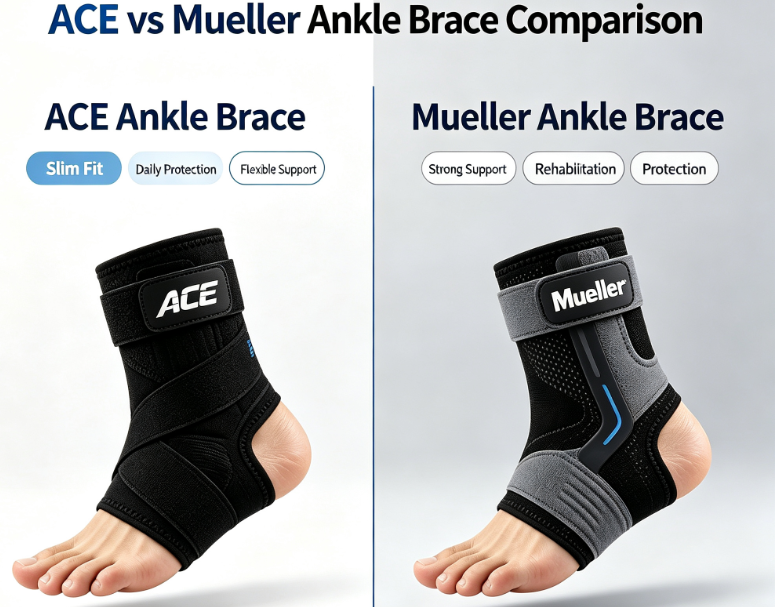
Standing in the pharmacy aisle with two nearly identical boxes in your hands, you’ve probably felt that flicker of decision paralysis. Both promise stability. Both claim to be “the” choice for athletes and rehab patients alike. The differences between Ace vs Mueller lace-up ankle braces show up in the stitching, the straps, and how your ankle feels three hours into a pickup basketball game or a long shift on your feet.
We put both braces through the wringer, checking rigidity, breathability, sizing accuracy, and real-world durability, so you don’t have to guess. Whether you’re recovering from a sprain, playing competitive sports, or restocking a clinic’s supply closet, what follows is a side-by-side breakdown that compares the two.
ACE Lace-Up Ankle Stabilizer
What surprised us most about the ACE lace-up ankle brace: you almost forget you’re wearing it.
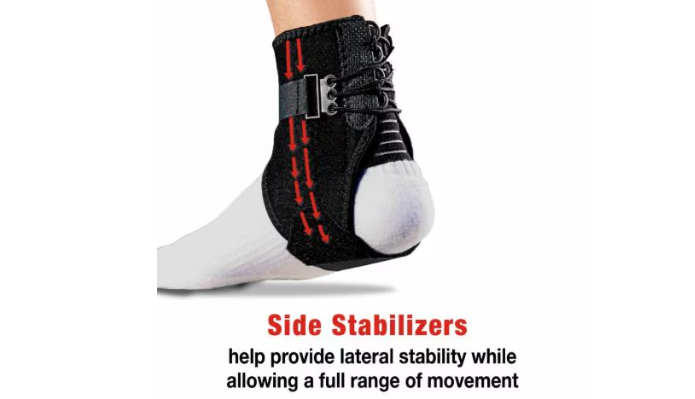
The design is deceptively simple. A fabric sleeve wraps your foot, laces sit at the back of your ankle (not the front), and the ACE logo faces forward for a low-key look. That back-lacing detail matters. It means the brace slides into sneakers, cleats, and work boots without bulking up your shoe. One strap anchors the outside of your ankle. A smaller strap loops around your heel and back again, mimicking a figure-8 ankle wrap for lateral stability.
Material-wise, this is a hybrid built from nylon, polyester, spandex, and neoprene blend, with terry cotton lining for sweat absorption. Some versions add steel or PVC for the side stabilizers—though these flex rather than lock rigid. That’s the key distinction: ACE sits in the moderate support category. It limits ankle roll (inversion/eversion) but won’t replace a rigid orthopedic ankle brace after surgery or a severe tear.
Breathability holds up during real wear. Testers running on treadmills or playing pickup basketball reported no overheating, no bunching, no “I forgot I have a brace on” awkwardness. That’s the terry-cotton lining doing its job.
Price sits around $15–18 per unit, depending on the retailer. You’ll find it at CVS, Walgreens, Walmart, and Target—usually near the sports medicine or first-aid aisle, no prescription required. One YouTube reviewer summed it up simply: “I think it’s like 18 bucks… worth the 18.”
For daily protection, recovery from minor sprains, or general ankle sprain brace needs, ACE delivers dependable, comfortable coverage without complexity.
Mueller “The One” Lace-Up Ankle Brace
Mueller built “The One” to feel like a professional taping job you can put on yourself in under a minute.
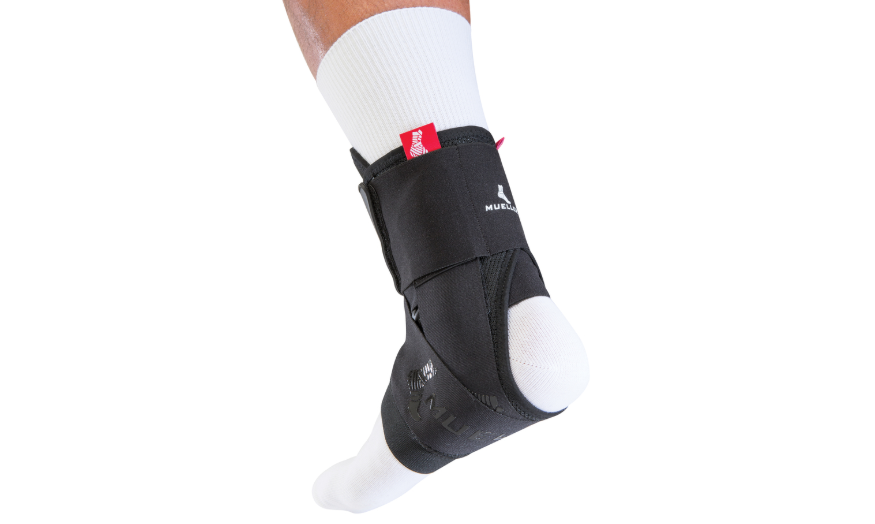
The engineering backs that up. A speed-lacing system with fewer eyelets and a flat lace lets you cinch the whole brace evenly in seconds. Add the figure-8 ankle wrap—crisscrossing straps that circle the ankle the way athletic trainers tape it before a game—and you get real compression around the subtalar joint. Then there’s the stirrup side straps: semi-rigid panels along the inner and outer ankle that clamp down on inversion and eversion movement. That’s what separates “The One” from a basic elastic sleeve.
The shell is ballistic nylon, chosen for tear resistance without adding bulk. A breathable mesh tongue handles airflow around the front of the ankle, a seamless underfoot construction keeps the brace low-profile inside cleats or sneakers, and a comfort band wraps the arch to ease pressure on the plantar fascia. Grip coating on the interior keeps the brace from sliding inside your shoe, so you don’t need to readjust mid-game.
This is a moderate-to-high support brace, built for weak, injured, or unstable ankles. Mueller markets it toward athletes managing inversion or eversion sprains in high-cut-and-pivot sports: basketball, football, soccer, volleyball.
Sizing runs XXS to XXXL, fits either foot, and Mueller recommends sizing up if you have wider feet or thicker ankles.
Price sits at $29.99–$34.99, roughly double what ACE charges. That gap isn’t arbitrary. It reflects a jump in construction and mechanical restriction, which we’ll unpack next.
Ace Vs Mueller Lace-Up Ankle Braces: Core Comparison Dimension
Numbers don’t lie, even when marketing copy does. Here’s what actually happens to your ankle when you strap on either brace.
Support Strength and Motion Control
Physical therapists measure stability in peak inversion angle, angular velocity, and how much your ankle wobbles mid-motion. That semi-rigid stirrup design in Mueller’s “The One” is where your money goes. Rigid side stabilizers with a Shore A hardness around 70-80 reduce peak inversion angle by 15-20% compared to unsupported movement. ACE’s flexible steel and PVC inserts, sitting in the 40-60 range, land closer to 5-10%. Both help. Mueller clamps down harder.
Angular velocity tells a similar story. When your foot rolls during a lateral cut or awkward landing, that’s the speed your ankle wants to fold under you. Rigid-support braces like Mueller’s slow that roll by 20-25%, dropping speeds from roughly 400°/s down to 300°/s. ACE’s figure-8 wrap manages 8-15%, which is meaningful but not the same category of control.
| Metric | ACE | Mueller “The One” |
| Peak inversion angle reduction | 5-10% | 15-20% |
| Inversion angular velocity reduction | 8-15% | 20-25% |
| Lateral ankle sway reduction (dynamic balance) | 5-8% | 10-15% |
| Y-Balance reach distance improvement | 3-6% | 8-12% |
That dynamic balance number matters more than people realize. Athletes with a prior sprain who wear higher-rigidity braces show ankle sway reductions north of 10% in Y-Balance testing, the kind of margin that separates a cautious jogger from a confident cutter. If you’ve rolled an ankle before, that stat alone should guide your decision.
ACE controls motion well enough for daily wear and mild instability. Mueller controls it like it means business.
Comfort, Breathability, and Footwear Compatibility
The extra millimeter matters. Research on footwear fit shows that every 1mm increase in sock or insert thickness raises peak plantar pressure in the forefoot by 8-12%. Strap that logic onto an ankle brace, and you start to understand why shoe fit becomes the real battleground between these two products.
ACE’s back-lacing design and thinner sleeve construction leave roughly 1.5-2.0mm of lateral space inside a standard D-width sneaker or work boot. That’s the sweet spot. Fit studies note that when this space compresses below 1mm, “squeeze” complaints jump to 30-40%. ACE stays comfortably above that threshold. Testers wearing it inside cleats and running shoes reported zero pinching, even after hours on their feet.
Mueller’s stirrup panels change the math. Those semi-rigid side supports add bulk, and while “The One” is engineered with a seamless underfoot design to minimize that bulk, it still asks more of your shoe’s interior volume than ACE does. If you wear narrow-toed athletic shoes or tight cleats, expect a snugger fit, sometimes snugger than you’d like.
Breathability tells a similar story. Terry cotton lining (ACE) and mesh tongue construction (Mueller) both aim to keep moisture-vapor transmission above the 5,000 g/m²/24h comfort threshold, the baseline where heat and sweat complaints start climbing during 4+ hour wear. Neither brace crosses into “stuffy” territory during normal use, but ACE’s simpler, thinner construction breathes slightly more consistently across long shifts or games.
The scenario math:
- Narrow shoes, cleats, dress-code footwear → ACE’s slimmer profile wins on comfort and fit
- Wider athletic shoes, basketball high-tops → Mueller’s bulk barely registers
- All-day wear (nursing shifts, retail, warehouse work) → ACE’s breathability edge shows up by hour six or seven
Comfort isn’t abstract here. It’s the difference between forgetting you’re wearing a brace and constantly adjusting your shoelaces to make room for one.
Price and Value Analysis
The sticker price is only half the picture. Look at what each dollar buys you over a full season of wear.
Total cost of ownership matters more than the shelf price. ACE costs $15-18 upfront. Mueller runs $29.99-34.99, nearly double. But if Mueller’s stirrup panels and ballistic nylon shell outlast two or three ACE units before failing, the “expensive” brace wins long-term. Rigid support structures typically hold up longer under repeated lateral stress than flexible steel-and-PVC inserts, so you get fewer replacements and a lower annualized cost.
The better deal depends on your use case.
- For casual or daily wear and budget-conscious users, ACE’s $15-18 price point gives solid moderate support without paying for structural rigidity you won’t stress-test.
- For athletes in cutting and pivoting sports, Mueller’s higher price reflects real mechanical upgrades like stirrup stabilizers and a figure-8 wrap, and the injury-prevention value outlasts a single season.
- For clinics or bulk buyers, ACE’s lower unit cost scales better for stocking shelves, while Mueller suits patients who need higher-grade support prescriptions.
Neither brace is “overpriced.” They’re priced for different risk tolerances.
Ace Ankle Brace Review Vs Mueller Ankle Brace Review
Seven out of ten. That’s the pain score one runner reported before switching braces. After two weeks of 10km training runs in Mueller’s “The One,” it dropped to three or four. Physical therapists tracking recovery count a shift of 2 points or more as clinically meaningful. That runner’s improvement clears the bar with room to spare.
Basketball players tell a different story about ACE. Testers rated stability 8-9 out of 10 during cuts and jump shots, with zero drop in vertical leap. They admit the tradeoff straight out: “support isn’t as strong as a hinged brace.” That’s the honest math behind moderate support.
Weightlifters split the two products by load. Mueller on squats above 220 lbs earns 9/10 for psychological security, though users flag tightness during extended wear. ACE under lighter loads, below 175 lbs, lands at 6-7/10, functional, not maximal.
Mueller wearers report numbness or pressure marks past the two-hour mark, especially with wider calves. Heavy sweat sessions bring “hot, hard-to-remove” feedback. ACE wearers report the opposite problem: the brace slips every 10-15 minutes during aggressive movement, and the elastic loosens noticeably after three to six months.
Neither brace fails universally. Each fails specific people in specific moments, and that’s the information worth knowing before you buy.
Final Buying Advice: How to Choose Based on Your Situation
Skip the guesswork. Answer four questions before you buy: how bad is the injury, what sport, what budget, and how does the shoe fit. Be honest, and the right ankle brace for sports picks itself.
Got a real injury or chronic instability? Support wins over style here. Get Mueller’s stirrup structure. When your ankle is already unreliable, control matters more than comfort.
Just preventing trouble during daily wear? ACE’s lighter build and lower price make sense. You don’t need orthopedic-grade rigidity for a Tuesday jog.
High-frequency training, cutting sports, or basketball? Pay for Mueller’s mechanical restriction. Cheap here just means replacing it twice as often.
Tight budget, occasional use? ACE at $15-18 covers you without overpaying for support you won’t stress-test.
Check the ankle brace sizing chart either way. Fit failures cause more returns than support failures ever do.
Conclusion
No universal winner exists in the Ace vs Mueller lace-up ankle brace debate—only the right fit for your ankle, your sport, and your recovery stage. If you’re rebuilding stability after a sprain or need serious lockdown for aggressive lateral movement on the court, Mueller’s rigid support and figure-8 construction justify their higher price. If you want reliable, budget-friendly protection for daily wear, hiking, or lighter activity, ACE delivers solid value without overengineering the problem.
Looking forward to launching private-label ankle braces? contact AOFIT, your reliable orthopedic brace supplier, to explore our custom solutions.