
So you just got home from urgent care, prescription in hand, staring down a mysterious fracture boot that looks suspiciously like it belongs on a Stormtrooper. Does this thing know which foot it’s going on, or are you about to strap medical Velcro chaos to the wrong ankle and hobble around like a confused flamingo for the next six weeks?
Deep breath. You’re not alone at 2 a.m. Google spiral, and the answer is way less complicated than your anxiety is making it. Most CAM walker boots and air cast boots are universal, built to fit either foot with equal indifference. But a few sneaky exceptions are worth knowing before you buy or buckle up wrong. Let’s sort out the question: Are Walking Boots Left Or Right.
Are Walking Boots Left or Right? (Quick Answer)
Most walking boot manufacturers shrug and say “eh, either foot works.” Look at the packaging. If you see “fits right or left foot” or “universal design,” your boot doesn’t care about anatomy politics.
Take the DARCO Body Armor Stirrup Walker: sold as one walker that fits either foot. The DARCO FX Pro CAM Walker uses the same universal setup. United Ortho’s Air CAM Walker is literally labeled “Universal – Fits Right or Left Foot,” and Bauerfeind’s b:joynz Walker Boot uses the same design for right and left. No drama.
If the listing doesn’t scream “LEFT” or “RIGHT” in the SKU or instructions, assume it’s universal. Side-specific boots are the rare oddballs, and they’ll announce themselves loudly.

Why Most Walking Boots Are Designed to Fit Either Foot
Your fracture boot is a very committed, very rigid opinion about protecting your leg, and that opinion doesn’t care which side of your body you’re on.
The hard outer shell—the part that makes you look like you’re cosplaying RoboCop’s ankle—is a protective cage. The actual fit comes from the liner and the adjustable straps. The rigid shell handles immobilization and impact protection. The soft liner cushions your actual leg and wraps identically whether you’re strapping it to your left foot or your right. Then the Velcro straps cinch everything down, compress the whole setup, and keep your foot from sliding around like a hot dog in too big a bun.
Look at the Ossur Rebound Air Walker Boot—stretch-to-fit shell, adjustable comfort features, built to work across different users without caring about anatomy. The Ossur FormFit Walker Boot is straight-up labeled “For Either Foot” by retailers. DonJoy and Aircast walking braces use semi-rigid shells with dual aircells for 360° compression, which is universal-fit code for “we don’t discriminate.”
It’s smart manufacturing. Clinics stock one SKU instead of two, which means less inventory chaos and faster same-day fitting for you. No waiting while someone hunts for the correct side in a back closet.
How to Wear Your Walking Boot (Left or Right Foot)
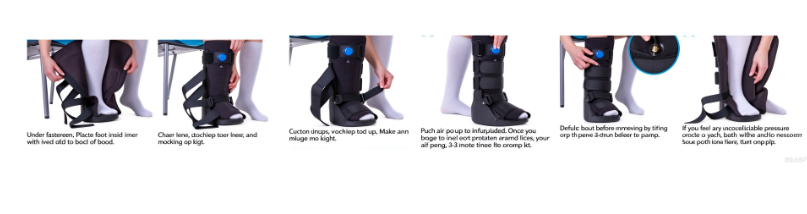
Putting on a walking boot correctly is a tiny ritual, and skipping steps is how you end up hobbling around feeling like your foot is being slowly eaten by a very aggressive marshmallow. The exact same sequence works whether you’re dealing with a fracture boot on your left foot or a post surgery walking boot on your right. The boot doesn’t care about sides. It cares about heels.
Step one: grab a long, thin sock—knee-high if you have one—and smooth out every single wrinkle before you do anything else. Wrinkles hiding under your boot liner are tiny betrayals waiting to become blisters.
Step two: open everything. All straps, the front panel, the liner—unfasten the whole rig like you’re dismantling a very committed piece of armor. Do not try to jam your foot into a half-closed boot. That’s how liners get shoved sideways and how your whole fitting goes sideways with it.
Step three: sit down and slide your heel all the way to the back of the boot. Not “kind of back.” All the way back, firmly in the heel cup. If your heel is floating forward, nothing above it will fit right, no matter how many straps you yank.
Step four: close the inner liner first, snug around your foot and leg, before you even think about the outer shell. Then lay the front plastic panel on top and start fastening straps from the bottom up—toe and ankle first, working your way toward the top of your leg. Some hospital instructions say start with the middle strap instead, so check the strap path printed on your specific boot. Walker boots manufacturers love to be slightly different from each other for no reason.
Step five: Tighten until it feels snug and secure, like a firm handshake, not a tourniquet. If you’re using a pneumatic walking boot with air chambers, inflate only until you feel comfortable support. Stop before it starts feeling like a blood pressure cuff having an identity crisis.
Step six: Once you’re strapped in, stand up and take a few steps. Check that your ankle and lower leg feel neutral and straight, not tipped to one side. If anything feels twisted, sliding, or numb, stop, reopen the boot, reseat that heel, and start again. Whether you bought a universal walking boot or a specific cast boot sizing option, the fit—not the foot—is what determines whether you’re comfortable or cursing by hour three.
When Left/Right DOES Matter?
Universal walking boots are the norm, but a specific category of foot gear gets very fussy about anatomy, and if you accidentally ignore that, you’re going to have a bad time.
Custom & Specialized Boots
Custom orthopedic boots are the main offenders. Skip the grab-and-go CAM walker boot from your local pharmacy; these are built for your actual leg. You’ll see a Left / Right selection field before checkout because the boot is molded, padded, or wedged specifically for one foot.
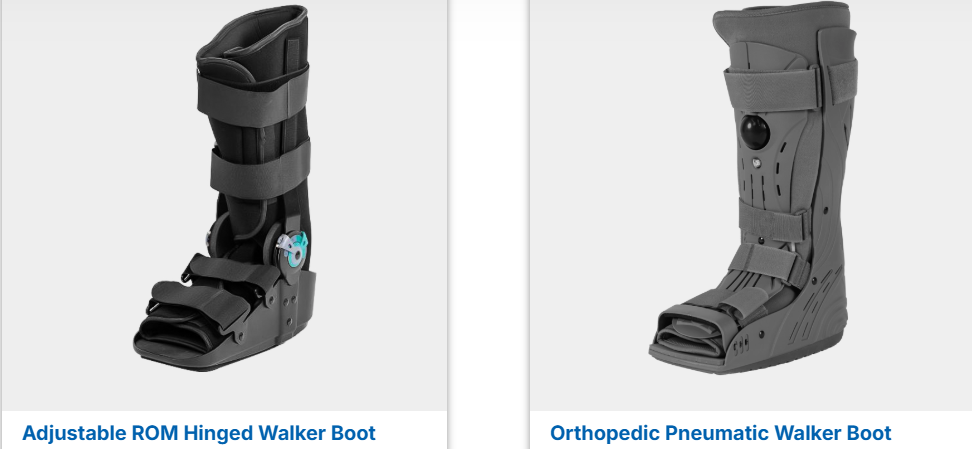
ROM walker boots are sneakier. Some are bilateral, fit either foot, no drama, same as your standard cast boot. Others aren’t. LigaStep ROM, for example, explicitly states which version goes on which foot. Always check the spec sheet before assuming.
Clinical scenarios of side-specific fit:
- High or low arches
- Varus/valgus (inward or outward ankle tilt)
- Leg length discrepancy
- Hindfoot elevation
- Forefoot amputation accommodations
- Metatarsal or heel pads
- Wedge supports
If your prescription mentions any of that, your boot isn’t universal anymore. It’s custom footwear with a medical excuse.
How to Spot a One-Foot-Only Boot
Look for wording. “Universal fit” or “bilateral” means grab either. “Left/Right choice required” means pick correctly or start over. Also check physical clues: an L or R stamped somewhere, asymmetric wedging, a single-sided support panel. That’s intentional design for one specific foot.
Before ordering, pull two documents: your doctor’s prescription (side, correction direction, wedge height, ROM angle limits) and the product spec sheet (bilateral vs. side-specific). Cross-check both. Mixing them up is how people end up with a very expensive, very wrong boot sitting in a closet.
Safety Considerations for Driving
Your CAM walker boot becomes a legal liability the moment you get behind the wheel. The foot side decides everything, and the rule is fixed: right foot boot means no driving.
Right foot boot means no driving, full stop. Your right foot handles both the brake and the gas, and a rigid fracture boot turns that delicate pedal choreography into a clumsy guessing game. Medical guidance is blunt: do not drive with a boot on your right foot. One study found brake reaction time increases by about 0.26 seconds. At 30 mph, that translates to roughly 9 extra meters of stopping distance, the difference between stopping safely and rear-ending someone. Some drivers even report mashing the gas and brake simultaneously because the boot’s bulk wrecks pedal awareness.
Left foot boot is a different story, but not by much. In an automatic, your left foot isn’t doing pedal work anyway, so the mechanical risk drops significantly. Manual transmission is a hard no: clutch control with a restricted left ankle doesn’t work safely.
Even with a left-side boot, safer doesn’t mean safe. Pain, sluggish reflexes, or awkward transfers getting in and out of the car can still make driving unsafe, boot or no boot.
The Real Rule Before You Turn the Key
Don’t self-diagnose your readiness. Get medical clearance first. Your doctor needs to confirm you can brake without pain, react fast in an emergency, and transfer your weight safely climbing in and out. Until then, arrange alternate transportation, especially with a right-foot air cast boot in play.
Choosing the Right Walking Boot: Universal vs Foot-Specific Options
Match the walking boot to the injury
Stable fractures and post-op recovery call for a fracture boot or CAM walker. Grade 2 and 3 sprains and soft tissue injuries usually fit the same category. If it’s a forefoot, midfoot, or ankle sprain that’s moderate to severe, a short pneumatic walker boot with an air bladder often controls swelling better than a rigid shell alone.
If insurance pays, look for boots labeled HCPC L4360 or PDAC Approved. These labels mean the boot is built for fracture recovery, not a minor sprain.
Compare Universal vs Foot-Specific Costs
Universal walking boots fit either foot. No side selection required. Prices range from $38 to $104. Bauerfeind’s universal walkers cost around $38.24, $59.49, and $89.99. Braceability’s tall universal boot runs about $74.99. Target’s inflatable air walker is near $103.96.
Foot-specific or custom orthopedic boots are rarer. You need one for specific anatomical issues like severe arch differences, post-surgical swelling that’s wildly uneven, or a doctor explicitly requesting a custom fit. These boots cost several times more than a standard universal boot and take longer to deliver.
Most fracture and sprain recovery cases are fine with a universal boot. Custom boots are for unusual circumstances.
Conclusion
Most walking boots are universal. They strap onto whichever foot needs them, because the adjustable straps and symmetrical liner don’t care if it’s your left ankle or your right one throwing a tantrum. You don’t need an engineering degree to put one on correctly. Custom orthotic boots are the rare exception, but for most of us, the real question is just “did I strap this thing on straight?”
Take a breath, strap in correctly—snugly, toe-to-shin—and stop Googling this at 2am out of panic. Your boot isn’t broken. You might be, temporarily. But you’re healing, and now you know how to gear up for it.