Sourcing a reliable hernia support belt manufacturer in China shouldn’t feel like gambling with your supply chain. Yet that is what happens when you spend weeks scrolling through Alibaba, chasing MOQs, and guessing which factories hold real CE or FDA certifications versus the ones that only claim they do.
Not every OEM/ODM supplier is built for private-label brands. Some specialize in bulk orders for distributors. Others cater to startups testing the market with samples before committing to a full production run.
I’ve done the legwork for you. Below, you’ll find ten vetted OEM/ODM hernia belt manufacturers in China, complete with verified production capabilities, certification status, and pricing tiers, so you can build a shortlist without rolling the dice on your next shipment.
Shijiazhuang AOFIT Import & Export Co. — Positioning in the Value-for-Money Segment
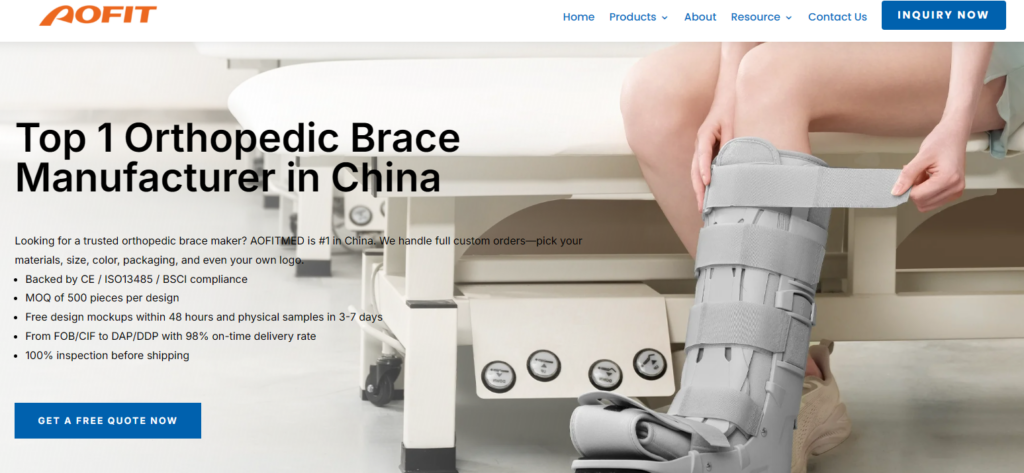
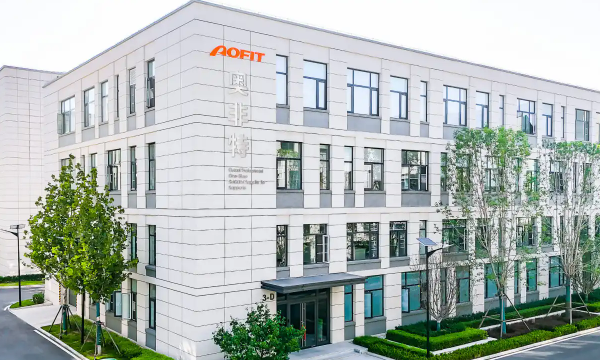
AOFIT sits in the budget-to-mid-tier range among suppliers for bulk hernia belt orders. Based in Hebei with roughly 12 years in business, the company lists itself as a “Custom Manufacturer”, with a factory address inside the Gree supporting industrial park in Shijiazhuang’s high-tech zone.
Pricing runs tight. Shaping belts quote around $3.50/unit at MOQ 100. Wrist training supports, typically neoprene-fabric composites, run $2.57–3.00 at MOQ 100, while nylon ankle braces drop to $1.50–1.90 at MOQ 100. Posture correctors use a confirmed blend of PP, 60% polyester, 17% rubber, 15% nylon, 8% cotton, and magnets, priced at $1.62–1.95 at MOQ 30, or $3.55 at MOQ 100.
Larger belt orders of 500–1,000 pieces shift to $3.90–6.98, though no formal tiered quote links 100-unit and bulk pricing for the same SKU.
Before ordering, request:
– Fabric composition ratios and GSM weight
– Neoprene thickness (industry standard: 2–5mm)
– Business license and registered capital
– Photos of sewing and cutting equipment
Public records show no verified production floor. Treat Aofeite as a vetted trading partner until documentation confirms otherwise.
Xiamen Huakang Orthotic-Braces Factory Line — Clarifying Its Relationship to the Similarly Named Company
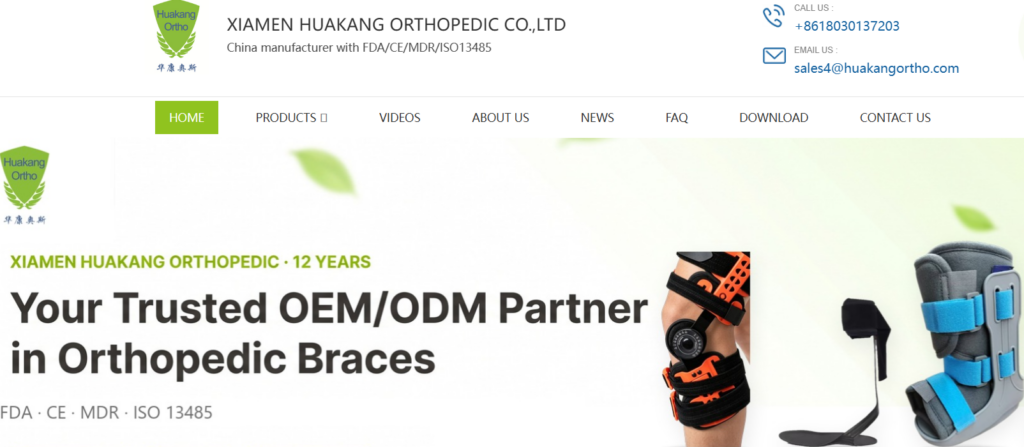
“Xiamen Huakang Orthotic-Braces” appears online as an independent product line, but corporate filings link back to Xiamen Huakang Orthopedic Co., Ltd. Company listings also cite two separate addresses: Shan Bian Road in Haicang District and Dongfu Avenue. The facility reports 2,050 square meters, 60–80 staff, and 3 production lines covering knee braces, ankle supports, night splints, back braces, cervical collars, and post-op fixation supports.
Before placing an order, demand these documents:
– Business license with a matching legal entity name
– Proforma invoice and payment account tied to that same license
– Written clarification stating whether “Huakang Orthotics-Braces” is a brand name or an independent trading company
If payments route through Reable Trading, request a signed authorization agreement confirming they have legal permission to sell on the factory’s behalf. Listed contact details include [email protected], +86-18030275537, and +86-592-6083387. Cross-check these against the contract before signing.
Certification Claims Without Paper Trails
This factory line advertises MDR, CE, FDA, and ISO 13485 compliance, but leaves off certificate numbers, notified body IDs, and expiration dates. Individual product listings even contradict each other: some drop MDR and cite only CE, FDA, and ISO 13485. Require the EU Declaration of Conformity, the notified body’s 4-digit code, and product-specific UDI data before accepting any compliance claim.
MOQ and Sample Testing Path
Standard orders require an MOQ of 1,000 pieces, though the supplier takes smaller volumes at a higher unit price. Lead time averages 45 days, and initial production runs often run longer. Sea freight departs through Xiamen port.
Recommended sampling sequence before committing to bulk:
1. Order 1–5 functional or sizing samples to evaluate material, support structure, stitching, and labeling
2. Move to a 30–100 piece test batch to assess size distribution, durability, and return rates
3. Scale to the full 1,000-unit run only after the test batch passes inspection
Write sample fees, tooling costs, and final invoice credit terms directly into the PI instead of relying on verbal assurances.
ChaoYue Sports (Dongguan) — Low MOQ Trial Order Strategy Analysis
ChaoYue Sports lists a starting MOQ of 10 pieces for select standard SKUs, including hernia trusses, heated shoulder wraps, waist supports, knee sleeves, arm sleeves, and posture correctors. That 10-unit minimum applies to existing standard molds and sizes rather than custom projects. ChaoYue notes on its site that minimum order volumes rise with deeper customization, depending on the product and manufacturing process.
For a private label inguinal hernia belt launch, basic changes like logos, colors, and packaging can fit within that 10-piece limit. Structural modifications like private molds or custom-shaped EVA pads require higher volume. Knee pad components involve EVA and SBR molding, specific hardness ratings, and ergonomic contours, which factory quotes treat as custom tooling with separate sampling fees.
Before placing a trial order, get written confirmation on:
– Whether the 10-piece MOQ covers only standard sizes and existing molds
– Minimum order quantities for heat transfer, silkscreen, and woven logo labels
– Minimum quantities for private molds, custom pads, and structural revisions
– Whether tooling fees get credited against bulk orders
– Whether small-batch orders allow mixed colors, sizes, and logos
Manufacturing Process and Verifiable Capabilities
ChaoYue outlines a standard production sequence at its Dongguan plant: material prep, cutting, sewing, assembly, inspection, and packaging. For knee supports, the stated process expands to include bonding and lamination, precision molding, custom EVA pad shaping, and branding through heat transfer, silkscreen, or woven labels.
The factory divides its verifiable production into two clear areas:
- Knit and soft structures: breathable mesh, SBR/neoprene, Lycra, polyester-spandex blends, elastic bands, woven labels, and sewn components.
- Molded and thermoformed structures: high-density EVA or SBR composite pads, custom inserts, adjustable thickness, hardness, and surface contouring.
ChaoYue lists EVA pad thickness between 8–18mm on one line, while a knee brace spec cites EVA hardness between Shore A 30–60 with localized thickness of 3–8mm. You can use these numbers directly to benchmark quotes from competing medical support belt factories.
Public documentation leaves out equipment brands, model numbers, stitch counts, and heat-press tonnage. When evaluating the plant for custom hernia truss production, ask for records showing:
– Flatbed, overlock, and bartack machine counts
– Heat-press platen sizes, temperature ranges, and pressure ratings
– EVA molding or vacuum-forming equipment models
– Die-cutting, laser-cutting, or CNC cutting tools
– Fabric weight, stretch rate, and shrinkage test records
Sample Timelines: What to Negotiate Before You Commit
ChaoYue supports product modifications, private branding, custom packaging, and size adjustments. However, the company does not publish fixed sample schedules, tooling charts, or sample price lists. Instead, they price each project individually based on product type, order volume, destination market, and technical complexity.
Without a published rate card, you can use these standard benchmarks to get ChaoYue to confirm specific lead times:
| Sample Type | Estimated Turnaround |
| Standard design + logo sample | 3–7 working days |
| Color, fabric, or size adjustment sample | 7–15 working days |
| Private mold/custom EVA pad first sample | 15–30 working days |
| Mold revision + second confirmation round | +7–15 working days |
| Packaging design and proofing (box, hang tag, poly bag) | 7–14 working days |
| Small-batch bulk production after sample approval | 15–30 working days (depends on fabric, mold, packaging sourcing) |
Ask for itemized pricing on each step: standard sample fees, logo plate and transfer costs, EVA die or steel tooling fees, custom pad development, packaging die-lines and proofs, pattern grading, and any revision or shipping charges.
The Smart Play for Testing Market Demand
If you want to test hernia belts or abdominal binders without paying upfront for private tooling, order ChaoYue’s standard sizes and molds with your logo and packaging applied.
You can validate market demand at the 10-unit minimum before investing in custom pads, revised sizing, or dedicated molds. ChaoYue’s model accommodates this approach, giving you a low-risk way to assess the factory’s quality before signing larger China medical device OEM contracts.
Hengshui Gangsheng — Vendor Verification Checklist for the Umbilical Hernia Belt Niche
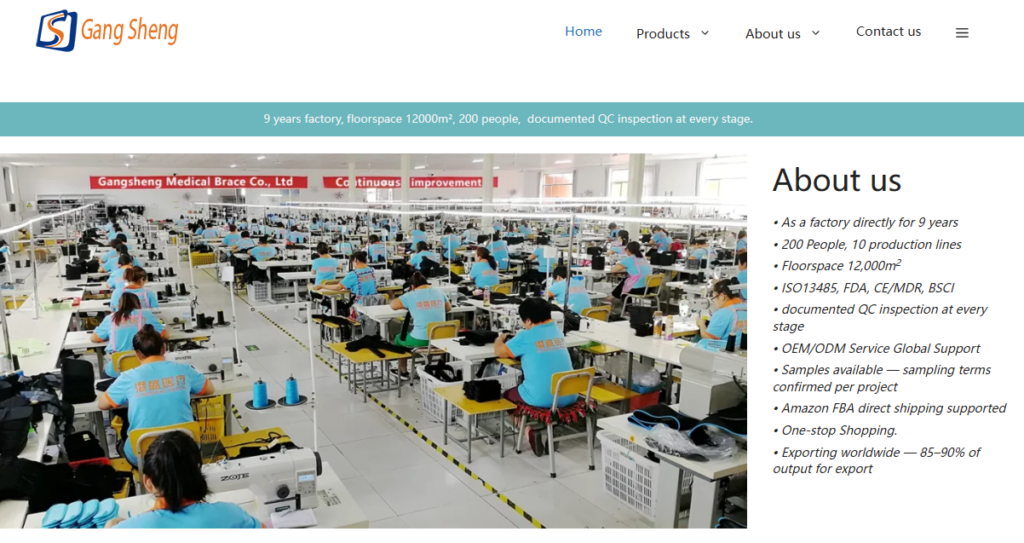
On its official site, Hengshui Gangsheng Medical Instruments Co., Ltd. in Hebei’s Shenzhou City claims 12,000 square meters of factory space, ten production lines, and 200 workers. Its B2B profiles show conflicting timelines, with one listing 9–10 years of experience making orthopedic supports and another claiming 15-plus years. Verify the operation directly through business licenses and factory audits rather than relying on supplier copy.
The company sells hernia belts, abdominal binders, and rehab braces, with inguinal belts featured heavily across its listings. Evidence for a dedicated umbilical line is much thinner. Public pages list infant umbilical abdominal binders at $2.28–3.48 per unit with an MOQ of 2 pieces, but adult umbilical models lack independent SKUs or spec sheets.
Before treating this as a verified umbilical hernia belt supplier, demand:
– A signed OEM capability confirmation letter
– An umbilical-specific quotation listing model numbers, sizing, and MOQ tiers
– ISO 13485, CE/MDR, and FDA documentation covering this product category
– Three years of order history for umbilical SKUs
Treat this factory as sample-stage until production audits confirm their actual capacity.
Hebei Topon Technology — Ultra-Low MOQ (2 Pieces): Risks and Best Use Cases
You can order as few as two pieces on several Hebei Topon hernia truss listings, with unit prices between $2.99 and $6.19. While the supplier maintains an average rating of 4.8–4.9/5, their reorder rate sits between 6% and 14%.
Who should use this MOQ:
– Review bloggers and product teams checking sizing, left/right fit, and daily comfort before ordering inventory
– Small-batch sellers testing market demand on Shopify or Amazon, where sample inventory costs $5.98–12.38 before shipping, taxes, or platform fees
– Buyers who want to test one left-side and one right-side unit, or split two sizes, rather than buying duplicate samples
Where this MOQ falls short: Avoid using it for volume OEM runs, medical distribution channels, or long-term supply contracts. Topon advertises OEM/ODM services and factory status, yet their public pages show no factory audit, verified production address, ISO 13485 scope, CE/MDR technical file, or FDA listing. Treat this supplier as a low-cost source for early samples rather than a primary custom manufacturer.
Verification Checklist Before Scaling
Request these items before placing a production order:
– Business license and verified production address
– ISO 13485 certificate with listed scope, CE/MDR applicability files, material test reports, and batch inspection records
– Private label minimum order quantities, woven and printed label costs, sample lead times, mold fees, size charts, and color options
Topon’s Alibaba listings quote terms of a 30% deposit with the balance due before shipment, along with piece-by-piece inspection claims. Both are self-reported statements without third-party audit backing.
Material and Durability: Still Unproven
Listings highlight adjustable straps, dual compression pads, left/right conversion, and washable fabric. None of them specify fabric composition, weight in GSM, tensile retention, Velcro cycle life, or pad hardness ratings. A high review score of 4.8–4.9 does not verify physical durability over time.
How to test your sample:
1. Wear the belt for 8 continuous hours to monitor edge rolling, heat retention, slippage, and pressure points.
2. Wash the unit 5–10 times to evaluate elastic recovery, seam stitching, Velcro grip, and pad shape retention.
3. Check waist adjustment range and left/right conversion stability across both wear and wash cycles.
Red-Flag Keywords to Search Before You Buy
No brand-specific negative reviews appeared during research, so issues from competing suppliers may not apply here. Even so, search buyer feedback for these specific terms before ordering samples: slippage, edge rolling, pad displacement, Velcro failure, elastic loosening, tight-cinching discomfort, heat trapping, skin irritation, undersized fit, seam splitting, odor, and post-wash deformation.
If your sample shows pad misalignment, slides during movement, or stretches out after washing, do not proceed. Ask for a corrected sample and obtain independent material lab tests before placing a bulk hernia belt order.
Dongguan Yuchuan Technology — Adjustable Support Structure Process Analysis
A 6,000-square-meter plant with 90-plus workers puts Dongguan Yuchuan Technology squarely in mid-size territory. Founded in 2008 in Guangdong, the company makes orthopedic, sports, and protective supports. CE and ISO marks appear on their pages, but neither lists certificate numbers or scope details. Ask for documentation before assuming that coverage extends to hernia belts.
What 1.73–1.82 Actually Buys You
This price point buys entry-level support products. Comparable listings include:
- Aluminum toe/finger splints: $1,131–1,669 (Korean won), MOQ 10 pieces
- Hammer toe correctors: $1,004–1,216, MOQ 1 piece
- Polyester/OK-cloth toe separators: $0.16–0.24, customizable packaging
- Soft SEBS toe separators: $0.72–1.09, MOQ 50 pieces
At this price tier, products use basic fabric, aluminum strips, and elastic components without injection-molded housings or metal hinges.
Adjustment Mechanisms, Not Patented Tech
Yuchuan builds its adjustable lines around four standard methods:
- Hook-and-loop straps on aluminum finger and toe splints for angle and tension control
- Fabric straps (adjustable strap, cross strap, compression wrap) for waist, pelvic, ankle, and foot support
- Elastic OK-cloth that relies on fabric stretch and friction instead of mechanical locks
- Aluminum-plus-soft-sleeve combos for low-cost shaping with external strap tension
More complex options with steel cable knobs, spring strips, or TPE arch supports run $3.57–3.66, well above the baseline band. No public listing shows patent numbers or utility model certificates, so require proof before taking any claim of a patented structure seriously.
Service Data and Realistic Timelines
One product page lists a response time under 7 hours, 581 reviews, and a 23% reorder rate. A separate listing shows 4.9/5.0 across 11 reviews, which is solid feedback from a small sample.
Lock these benchmarks into your inquiry:
– Initial quote: within 24 hours
– Logo mockup: 1–2 working days
– Sample: 7–15 days
– Bulk production: 15–30 days after sample approval
Changsha Shawphy Medical — Specialized Supplier for Infant Umbilical Hernia Belts
Shawphy Medical Products is a newer supplier with 1–2 years of verified history and a 4.2–4.5/5 rating. Its core SKU is an infant umbilical hernia belt made of cotton with compression pads, sized for 0–12 months.
The catalog also includes adjustable adult inguinal hernia belts, priced at $1.80–4.38 with MOQs as low as 1–20 pieces.
Pricing breakdown for the $1.98–3.28 MOQ-100 tier:
– Size/age range (newborn vs. toddler sizing)
– Pad configuration (removable vs. fixed compression pads)
– Packaging (OPP bag vs. branded retail box)
– Manual translation (English/Chinese baseline, EU languages cost extra)
Watch for unverified claims. “Medical grade cotton” and “ozone disinfected” appear on listings without certificate numbers attached. For EU buyers, infant products skip toy safety standards, but they still require an MDR classification review, ISO 10993 biocompatibility testing, and choking and strangulation risk assessments before launch.
Zhongshan Chukuang Textile — Custom Detachable Pad Structure Advantages
With eighteen years on B2B platforms, Zhongshan Chukuang Textile has a longer track record than most suppliers on this list. Based in Guangdong, the company manufactures custom waist supports, posture correctors, knee braces, and sports protective gear, listing OEM and ODM services across most product pages.
Pricing and MOQ vary by SKU:
– Sports gloves: $2.68–3.50/pair at MOQ 50 pairs, or $3–4/pair at MOQ 100
– Posture/support items: $3.60–4.80/unit at MOQ 50
– Waist support products: $2–4/unit at MOQ 100
Use $3.00/pair as a rough benchmark for basic textile supports, and get a dedicated quote for a detachable pad hernia belt. Public listings do not specify whether pricing includes OPP bags, retail boxes, hang tags, or custom labeling. Request three separate quotes: bare product, standard packaging, and custom branding.
No Verified Data on Detachable Pads
The factory lists breathable mesh, conductive fabric, and memory foam across its catalog, but none of these materials include wash-cycle test data for hernia belt pads. Before accepting claims of “removable and washable,” ask for:
- Structural drawings showing zipper, Velcro, snap, or hidden-opening attachment
- Pad fill specifications (memory foam, EVA, latex, 3D mesh, or composite foam)
- Wash testing: dimensional change, seam failure rate, and foam recovery after 30–50 machine washes
- Fastener durability: minimum 1,000 attach/detach cycles with before-and-after photos
This supplier fits buyers who need a composite build (fabric + foam + support structure + sensing component).
Saferlife Products — Post-Surgical Hernia Belt Certification Checklist (Unverified)
Saferlife Products Co., Ltd. operates out of Panyu, Guangzhou. Founded in 2009, the manufacturer runs over 1,000 square meters of production space across injection molding, sewing, and packaging departments. That part is easy to verify.
The paperwork is where gaps appear. Saferlife’s quality page lists ISO 13485, CE, FDA, RoHS, and SGS compliance, alongside an “FDA ORTHOSIS BRACE” claim and an EU Declaration of Conformity. Yet none of these records show certificate numbers, applicable regulations, or expiration dates tied to any hernia belt SKU.
Product alignment is an even bigger question. Saferlife’s public catalog focuses on first-aid kits, tape, bandages, sports therapy, and home care items. Nothing in their published materials confirms that post-surgical hernia belts or incisional hernia support belts are in production.
The 1,000-square-meter footprint covers the company’s entire facility, leaving no clear sign of a dedicated hernia belt line. Saferlife lists no monthly capacity, equipment count, or daily output. They also omit minimum order quantities, packaging rules, and sample fees for this category.
Before treating Saferlife as a verified custom hernia truss manufacturer, require:
– SKU-specific CE and FDA documentation that names hernia belts
– An ISO 13485 audit scope covering orthosis or hernia support belts
– Production records verifying hernia belt output instead of general factory figures
Treat every certification claim here as company-wide until proven otherwise at the product level.
Conclusion on OEM/ODM hernia belt manufacturers in China
Choosing the right hernia support belt manufacturer comes down to matching your production partner to your business model. If you’re testing a new product line, factories like Hebei Topon or ChaoYue Sports offer ultra-low MOQs so you can validate demand without tying up capital. If you’re scaling an established brand, suppliers like Xiamen Huakang or Shijiazhuang AOFIT provide the certifications and consistency larger runs demand.
The best custom hernia truss manufacturer for your brand depends on your order volume, certification requirements, and timeline. Make sure you complete the background checks outlined above: verifying CE and FDA documentation and testing physical samples saves far more buyers from costly mistakes than any sales pitch will.
Shortlist 2-3 manufacturers from this list, request samples, and start the conversation this week. Suppliers who respond quickly with transparent answers are usually the ones worth building a long-term partnership with.