
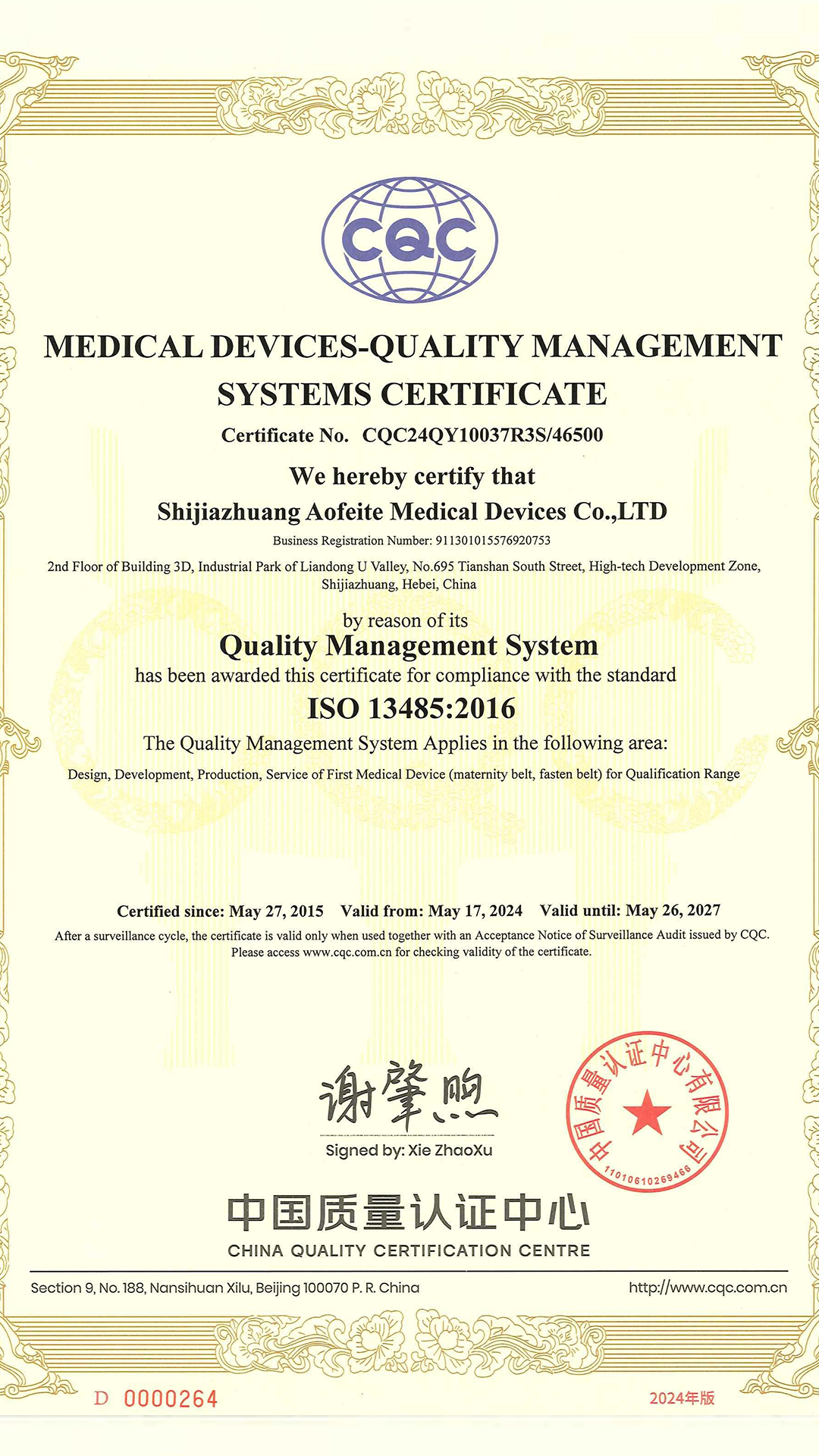
In today’s global medical device market, orthopedic products are no longer treated as simple consumer goods. Items such as wrist braces, knee supports, cervical collars, and rehabilitation orthoses are increasingly classified as regulated medical devices in many countries.
At the same time, regulatory requirements in Europe, North America, and other developed markets are becoming more strict and transparent. Buyers are no longer only focused on price or appearance. Instead, they are asking a more critical question:
“Can I trust this supplier to consistently produce safe, compliant medical-grade products?”
This is where many companies face their first real challenge.
Because in orthopedic manufacturing, the gap between a “regular factory” and a “medical-grade manufacturer” is not just about machines or materials—it is about systems, control, and responsibility.
And ISO13485 is exactly the system that defines this difference.
The Hidden Risk Behind Orthopedic Products
On the surface, many orthopedic products look similar. Two wrist braces may appear identical in design, color, and even material. However, what happens behind the scenes can be completely different.
For non-certified or loosely controlled manufacturers, common risks include:
- Inconsistent raw material quality between batches
- Lack of full traceability for components
- Manual production processes without standardized control
- No validated testing or inspection procedures
- Quality depending heavily on individual worker experience
While these issues may not be immediately visible, they can create serious consequences for brand owners and distributors.
For example:
A small inconsistency in compression strength of a knee brace can affect rehabilitation outcomes.
A variation in skin-contact material may lead to irritation or allergic reactions.
A missing production record can block market access during regulatory audits.
For importers and medical brands, these risks translate into something far more serious:
market rejection, compliance failure, and legal liability.
In other words, the product is not just a product—it is a responsibility.
What ISO13485 Actually Means (In Simple Terms)
ISO13485 is an international quality management system standard specifically designed for medical device manufacturing.
But more importantly, it is not just about the final product.
It is about the entire system behind the product.
Unlike general manufacturing standards that focus mainly on efficiency or customer satisfaction, ISO13485 focuses on three key principles:
- Consistency — every batch must meet the same standard
- Traceability — every material and process step can be tracked
- Risk control — potential failures are identified and prevented in advance
In simple terms, ISO13485 ensures that a factory does not rely on “experience” or “luck” to produce quality products. Instead, it enforces a structured system that controls every step—from raw material selection to final packaging.
This is especially important in orthopedic manufacturing, where products directly interact with the human body.
Why It Is Critical in Orthopedic Manufacturing
Orthopedic products are unique in the medical device industry because they sit between functional support and medical treatment.
They are used for:
- Injury recovery and rehabilitation
- Post-surgery support
- Chronic condition management
- Physical therapy assistance
This means they are often worn for long hours, in direct contact with skin, and under dynamic movement conditions.
Because of this, orthopedic manufacturing requires a higher level of precision than many other product categories.
Even small deviations can lead to:
- Reduced therapeutic effectiveness
- Patient discomfort during long-term wear
- Structural failure during movement
- Increased risk of secondary injury
ISO13485 ensures that these risks are not managed after problems occur, but are controlled during the production process itself.
It forces manufacturers to define clear standards for every critical stage, including:
- Design validation before mass production
- Controlled material sourcing
- Process standardization in production lines
- Final inspection and batch testing
This is what makes orthopedic manufacturing stable, predictable, and safe at scale.
What ISO13485 Changes Inside a Factory
When a factory implements ISO13485 properly, the transformation is not superficial—it changes how the entire system operates.
1. documentation becomes the foundation
Every process must be written, standardized, and followed. This includes production steps, inspection criteria, and handling procedures.
2. raw materials become traceable
Each batch of material can be tracked back to its origin. This ensures that any issue can be quickly identified and isolated.
3. production becomes controlled, not random
Operators no longer rely on personal habits. Instead, they follow validated SOPs (Standard Operating Procedures) that ensure consistency.
4. quality is no longer just inspection-based
Instead of only checking final products, ISO13485 introduces in-process control. This means potential issues are detected early, not at the end.
5. non-conformity is systematically managed
If a problem occurs, it is recorded, analyzed, and corrected through a structured CAPA (Corrective and Preventive Action) system.
Together, these changes create one outcome:
quality becomes repeatable, not accidental.
What Buyers Should Pay Attention To
For distributors, brands, and medical suppliers, ISO13485 should not just be a label on a website. It should be verified and understood properly.
When evaluating a supplier, buyers should consider:
- Is the ISO13485 certificate valid and up to date?
- Can the factory provide audit reports or documentation?
- Is there a real traceability system for production batches?
- Does the factory have experience exporting to regulated markets?
- Are quality processes visible beyond marketing claims?
In the orthopedic industry, trust is not built on claims—it is built on systems that can be verified. Visit AOFIT→
What Buyers Should Look For in ISO13485 Suppliers (Expanded Decision Layer)
As global healthcare standards continue to rise, ISO13485 is no longer just a competitive advantage. It is becoming a basic requirement for entering serious medical markets.
For orthopedic manufacturing, it represents more than compliance.
It represents:
- Lower operational risk
- Higher product consistency
- Stronger buyer confidence
- Better access to international markets
In short, ISO13485 is not about certification alone. It is about building a manufacturing system that global medical brands can rely on. And in today’s orthopedic industry, reliability is everything. However, understanding ISO13485 at a deeper level requires looking beyond certification into how it is applied in real production systems.
The Real Difference Between ISO13485 Factories and Normal Manufacturers
To many first-time buyers, the difference between an ISO13485-certified manufacturer and a regular factory may not be immediately obvious.
Both may have similar machines, similar product catalogs, and even similar pricing. However, the real difference lies in how decisions are made inside the factory.
In a non-certified factory, production is often driven by output efficiency. The main goal is to produce as many units as possible in the shortest time. Quality control usually happens at the end of the process, and in many cases, it depends heavily on manual inspection.
In contrast, an ISO13485-compliant orthopedic manufacturer operates under a completely different logic.
Every stage of production is defined, documented, and controlled. This includes:
- How materials are selected and approved before entering production
- How each production step must be executed and verified
- How equipment is calibrated and maintained
- How operators are trained and qualified
- How deviations are recorded and corrected
This means that quality is not something “checked at the end,” but something that is built into every step of the process.
For orthopedic products, this difference is critical.
Because when a knee brace or spinal support fails, it is not just a defective product—it can directly affect a patient’s recovery journey.
Why Consistency Matters More Than Innovation in Orthopedic Products
In many consumer industries, innovation is the key driver of competitiveness. However, in orthopedic manufacturing, consistency is often more important than innovation.
A knee brace that performs perfectly once is not enough. What matters is whether the same performance can be repeated across thousands or even millions of units.
This is where many suppliers struggle.
Without a structured quality system like ISO13485, small variations naturally occur in:
- Fabric elasticity
- Compression force
- Stitching tension
- Mold alignment
- Adhesive strength
Individually, these variations may seem minor. But when accumulated across large production volumes, they can lead to unpredictable product behavior.
ISO13485 reduces this uncertainty by enforcing process stability.
It ensures that every batch follows the same validated method, minimizing deviation and maximizing predictability.
For global orthopedic brands, this predictability is what allows them to scale confidently across different markets.
ISO13485 as a Market Access Requirement
Another often overlooked aspect of ISO13485 is its role in international market access.
In many regions, especially Europe and North America, regulatory frameworks for medical devices are becoming increasingly strict.
Distributors and importers are frequently required to demonstrate that their supply chain meets recognized quality standards.
In practice, this means:
- Without ISO13485, many products cannot even enter procurement consideration
- Hospitals and medical distributors often require documented compliance
- Insurance and liability systems favor certified supply chains
For orthopedic brands aiming for global expansion, working with ISO13485-certified manufacturers is no longer optional—it is a prerequisite.
It acts as a “passport” that allows products to move across regulatory boundaries with fewer barriers.
Without it, even high-quality products may be excluded before they reach the market.
How Buyers Should Interpret ISO13485 in Real Procurement Decisions
From a procurement perspective, ISO13485 should not be treated as a marketing statement. Instead, it should be used as a decision filter.
A more practical way to evaluate suppliers is to ask:
- Can the factory demonstrate how ISO13485 is applied in daily production?
- Is quality documentation available upon request?
- Are production records linked to individual batches?
- Can the supplier explain their risk control process clearly?
- Do they understand regulatory requirements of target markets?
A true ISO13485 manufacturer will not hesitate to explain these systems in detail. In fact, their entire production logic should naturally reflect these controls.
On the other hand, factories that only “display the certificate” but cannot explain the system behind it often lack real compliance depth.
For buyers, this distinction is critical when choosing long-term partners.
Final Thoughts — ISO13485 Is About Trust at Scale
In orthopedic manufacturing, success is not only defined by product design or material selection. It is defined by whether a product can be trusted consistently at scale.
ISO13485 provides the framework that makes this possible.
It transforms manufacturing from a variable process into a controlled system. It reduces uncertainty, strengthens compliance, and ensures that every product leaving the factory meets a defined medical standard.
For global orthopedic brands, this is not just about meeting regulations.
It is about building trust—trust that every product delivered will perform as expected, regardless of batch, time, or market.
And in the medical device industry, trust is the foundation of everything.