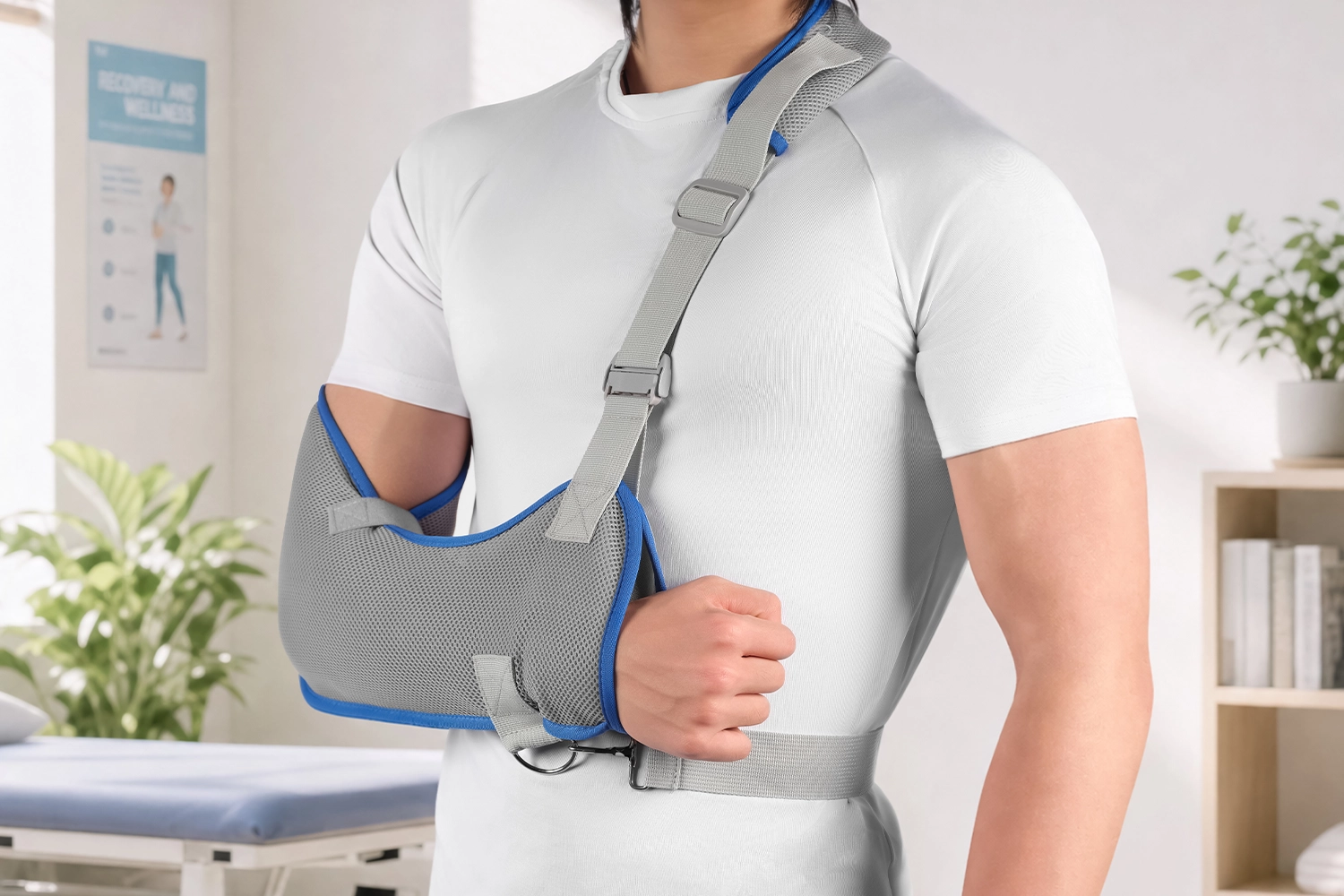
Every ankle brace on the market claims to be “lightweight,” but strap one on and you’ll find that claim doesn’t always hold up. Some sag, some overheat your skin, some feel bulky the moment you start moving. That gap between marketing and real-world performance comes down to the materials chosen, the way the structure is engineered, and the manufacturing process.
To make an ankle brace lightweight, product developers and manufacturers trying to shave grams without sacrificing stability, and athletes wondering why one brace feels like a second skin and another like a boot, both need to understand what goes into ankle brace design. That knowledge changes how you evaluate these products. The difference between genuine lightweight support and a brace that just says “light” on the box comes down to materials, engineering tricks, and production methods.
Lightweight Material Selection: Choosing the Right Fabrics & Polymers
Weight reduction starts on the spec sheet, not the sewing floor. GSM (grams per square meter) is the number manufacturers actually chase when they promise a lightweight ankle brace. Anything under 150 GSM earns the “lightweight” label in textile circles. Fabrics dropping below 100 GSM get filed under “ultra-lightweight.” That’s the benchmark worth knowing if you’re comparing spec sheets or evaluating a supplier’s claims.
Fabric Options: What the Numbers Actually Show
Not all lightweight fabrics behave the same way once they’re stitched into a compression ankle sleeve:
- Lightweight polyester runs 40–120 GSM, shrinks minimally, and shows up constantly in linings and performance textiles
- Rayon/viscose/modal blends sit heavier at 80–150 GSM. Viscose shrinks 5–10% — a real problem for a brace that needs to hold its fit
- Linen lands at 100–150 GSM with low 3–4% shrinkage and solid natural breathability
- Bamboo fabric matches linen’s weight range at 100–150 GSM with 3–5% shrinkage
For most orthopedic brace materials aiming at “supportive but light,” the sweet spot is 80–120 GSM synthetic performance fabric. Below that range, you start trading away durability. Denier matters just as much as GSM here: higher denier means thicker, tougher fabric. A manufacturer switching to a single high-tenacity nylon or polyester layer can often replace an entire multilayer stack without adding bulk. Open-weave and fine-yarn construction do the rest. They preserve breathable fabric technology properties that keep skin from overheating during long wear.
Rigid Polymers: Where Strength-to-Weight Ratio Rules
Structural components need a different playbook. Engineers reach for PP (polypropylene) and PE (polyethylene) as the default low-density plastics because they cut mass without demanding exotic manufacturing. When a brace needs serious rigidity — think stabilizer inserts or hinge points — CFRP and GFRP composites deliver strength that low-density plastics can’t match at the same weight. Aramid fibers and liquid-crystal polymers work too.
The smarter engineering move isn’t always swapping materials. It’s changing the geometry: honeycomb panels, hollow components, and foamed polymer structures reduce weight while keeping load-bearing capacity intact. That’s the same logic ankle stabilizer designers apply when replacing metal reinforcement with polymer alternatives. The material changes, but so does the structure around it.
Structural Design Optimization: Reducing Bulk Without Sacrificing Support
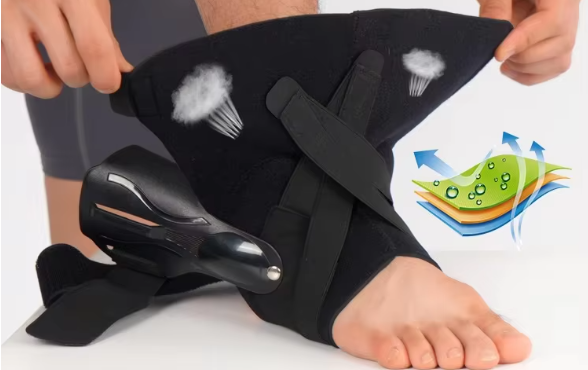
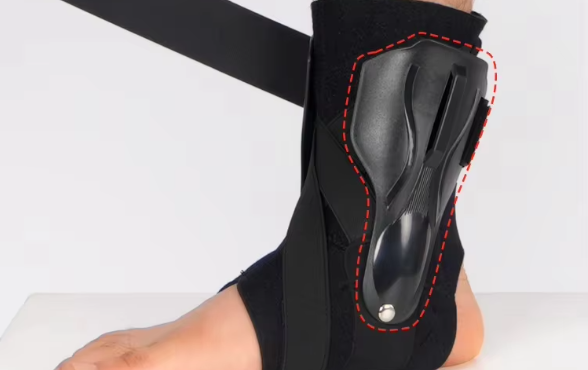
A traditional rigid-shell ankle stabilizer uses an ABS or PP shell plus foam lining. It weighs 200 to 350 grams per unit and covers 120 to 180 cm² around the joint, with more than 80% solid coverage. That’s a lot of material doing very little in the low-stress zones. Structural engineers have figured out how to strip that mass without gutting support.
Figure-8 Strapping Replaces the Solid Shell
Swap the hard shell for a Figure-8 or Figure-6 strapping system, and weight drops to 80–160 grams, a 50–70% reduction. The strap-and-compression-zone approach cuts material volume by 40–60% while covering roughly the same area. Topology optimization research confirms this: converting a solid support panel into a banded or truss-like structure typically shaves 25–30% off mass while keeping stress and displacement response nearly unchanged. The rule engineers follow is simple. Keep the strap along the main load path — inner ankle, outer ankle, Achilles direction — and open up everything else. Removing material from low-stress zones cuts 10–30% of weight while bending stiffness loss stays under 5–10%.
Low-Profile Design: Fitting Inside a Shoe
Most athletic shoes tolerate only 3–5mm of added thickness around the ankle before the shoe upper starts pinching. Go past 5–6mm and athletes feel it with every stride. That’s why high-performance braces keep fabric thickness at 1.5 — 3.0mm, reserve 3–4mm for reinforced compression zones, and cap forefoot and tongue-area thickness at 3mm or less to avoid lace pressure.
Modular Components for Adjustable Support
Some manufacturers build a base brace under 100 grams, then let users clip on support modules like reinforced ribs or extra Figure-8 straps as needed. A full setup tops out around 150–180 grams, but daily training weight drops 20–40% once the extra pieces come off. Each module typically adds 10–20% mass for a 15–30% stiffness gain, letting the wearer match support to actual risk rather than carrying full armor for a light jog.
Open-Heel and Open-Boot Structures
Cutting coverage area by 30–50% through open-heel designs — replacing solid shells with framed, banded structures along the ankle and Achilles — keeps stiffness loss under 10–15%. The framework needs to retain 60–70% of the original shell’s cross-sectional area at the closure point, with hollowed zones running 40–60% open. That balance is what separates a genuinely engineered lightweight brace from one that’s just thinner.
Advanced Manufacturing Processes for Weight Reduction
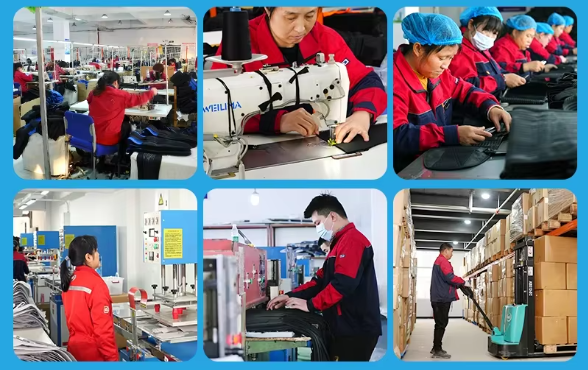
Machinery does what strapping tricks and fabric swaps can’t. Changing how you make a brace, not what you make it from, can cut another 20-40% of its mass.
Precision Injection Molding for Thin-Wall Components
Traditional support shells run 2-3mm thick. Precision injection molding pushes that down to 0.4-1.0mm, cutting weight by 30-60% on rigid polymer components. Process control matters more than thinner molds. Manufacturers compress fill times to 0.3-0.8 seconds under injection pressures of 120-200 MPa, using high-flow PA, PP, or TPU resins at melt temperatures of 230-280°C. Raising mold temperature to 60-90°C shaves another 10-20% off wall thickness without warping the part. Shortening pack time from 8-10 seconds down to 4-6 seconds, paired with reinforced cooling channels, lets a 1.5mm panel drop to 0.8-1.0mm — a 33-47% weight cut while holding ±0.05mm dimensional accuracy. Rib-and-thin-wall geometry, with ribs at 2-2.5 times wall thickness, adds another 25-40% reduction over solid designs.
Laser Cutting for Strap and Fabric Precision
Laser-cut nesting layouts push material utilization from the 82-88% typical of mechanical cutting up to 90-95%. That’s 0.5-1kg saved per 10kg of fabric. Kerf width drops to 0.1-0.3mm versus 0.8-1.5mm for blade cutting, so parts sit closer together on the layout. Precision holds at ±0.1mm, letting manufacturers cut complex weight-reduction perforations that mechanical blades can’t handle. Heat-sealed edges eliminate binding tape, trimming 3-8% off individual strap weight.
Seamless Anatomical Knitting
Traditional multi-panel construction loses 5-12% of its mass to seams and stitching. Seamless circular knitting removes that almost entirely while zoning GSM by region, with 260-320 GSM at support zones and 150-180 GSM at breathable zones. Combined with integrated elastic bands, part count drops from 3-7 pieces to 1-2, cutting total weight 10-20% compared to sewn compression sleeves.
3D Printed Orthotics
Topology-optimized lattice structures in 3D-printed polymer or metal components deliver 30-70% weight reduction. One documented case dropped a mounting bracket from 1,454g to 500g, a 65.6% cut. For custom ankle stabilizers, scanned-fit shells using 15-35% relative-density lattice in low-stress zones achieve 30-50% weight savings over uniform-geometry designs, with production turnaround under 12 hours per batch versus 4-8 weeks for tooling.
Breathability–Comfort–Weight Balance: Engineering Trade-offs
Cut fabric weight by 30-40%, and airflow can jump by a factor of ten. This is basic textile physics, the lever every manufacturer pulls when chasing breathable fabric in a compression ankle sleeve.
The GSM-to-Airflow Relationship
Density and breathability move in opposite directions, always. A tight plain weave at 150-180 GSM lets through less than 10 cm³/s/cm² of air (ASTM D737). Switch to an open mesh at 90-120 GSM, and that number jumps past 100 cm³/s/cm². Target air permeability above 50-100 cm³/s/cm² in high-heat zones, with MVTR above 5,000 g/m²/24h. Drop below 5,000 g/m²/24h and sweat starts pooling during sustained activity. Push past 20,000 g/m²/24h, and wear time without discomfort stretches from under an hour to 2-3 hours in field testing.
Zoning Beats Full Coverage
Full-shell coverage at 300-500 GSM equivalent traps heat everywhere, not just where support matters. Reserve dense material for bony prominences and pressure points only. Everything else drops to a ≤150 GSM mesh or perforated layer. That single move can cut total shell weight 50-70% while multiplying airflow in the ventilated zones. A sports sock uses thick padding only at heel and forefoot with thinner mesh elsewhere, trimming total weight 20-30% without losing cushioning where it counts.
Where Sweat Spot Sits
Textile research on performance fabrics puts the comfort sweet spot at 120-140 GSM, light enough to breathe through 90°F+ conditions and dense enough to survive 200+ wash cycles. Below that, durability suffers. Above it, heat builds up fast.
Refer to Real-World Case Studies: Ankle Brace Lightweight Recommended
Numbers on a spec sheet only tell half the story. Look at what actual products ship, and the lightweight ankle brace playbook gets a lot more concrete.
McDavid Ultralight 195
McDavid Ultralight 195 strips a traditional 170–220g laced-and-neoprene brace down to roughly 95–120g. It uses a single-layer high-density polyester body (0.4–0.6mm thick) with the padding cut entirely, backed by a Figure-6 crossing strap that controls inversion and eversion. That single swap from body material to strapping accounts for about a 45% weight cut, with the strap itself contributing 10–15% of the savings and slimmer support strips adding another 5–10%.
BetterGuard Lite
BetterGuard Lite goes further, landing around 60g total, a 65% reduction over standard designs. Instead of a full compression sleeve, it uses a hybrid rigid-flex frame of PA/PP or fiber-reinforced composite around the ankle joint, connected through a handful of anchor points rather than full-wrap fabric. Fabric drops from 60–70% of total weight in conventional braces to just 20–30% here, with the frame’s hollow, rib-style geometry doing the rest of the structural work.
Shock Doctor Ultra Laceless
Shock Doctor Ultra Laceless takes a different route by cutting the lacing system entirely. Standard laced braces carry 6–8 eyelet pairs and 20–25g of lace hardware alone. Removing that, plus switching to stirrup stays (rigid U-shaped supports at the medial and lateral ankle) paired with a Figure-8 strap, delivers a claimed 30% weight reduction, from roughly 170–190g down to 120–135g.
Weight-to-Use Benchmarks
| Weight Class | Best For | Price Range |
| Under 80g | Running, daily prevention | $30–45 |
| 80–120g | Basketball, volleyball, multidirectional sports | $40–60 |
| 120–180g | Post-op recovery, chronic instability | $60–90 |
Across all three, manufacturers relocate structural function to strapping and frames, then remove whatever material was doing nothing.
Conclusion
Smart trade-offs make a lightweight ankle brace work. Manufacturers that get it right combine strategic material selection—nylon-spandex blends over bulkier neoprene where support allows—with structural design that removes material without removing stability, plus manufacturing processes like 3D printed orthotics that customize support zones instead of over-engineering the whole brace.
AOFIT, as your reliable ankle brace manufacturer, uses this framework as its starting checklist. Test material combinations early, and don’t sacrifice compression or ankle stabilizer function just to hit a weight target. Now, contact AOFIT for a custom solution.