
You’re sitting in the driver’s seat, keys in hand, and now you’re second-guessing everything. Can you drive with a neck brace on? That hesitation is smart. Whether you’re driving with a neck brace after a car accident, recovering from whiplash, or a few weeks post-surgery, the answer depends on your collar type, your range of motion, and what your doctor cleared you for.
Here are the real differences between soft and rigid cervical collars behind the wheel, the situations where you should not drive at all, and the health condition of your doctor confirmed before you start the car.
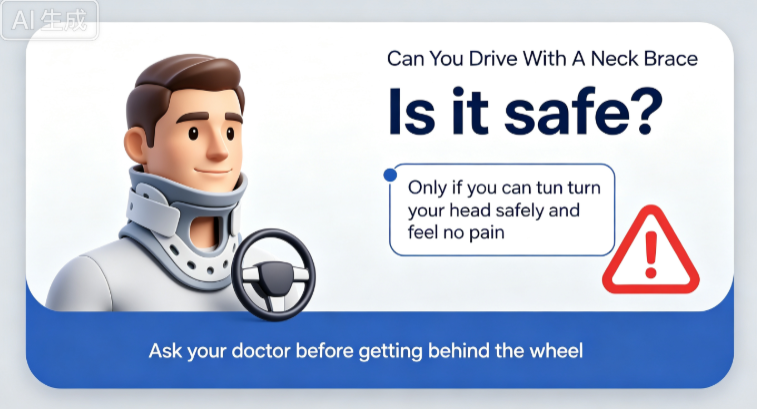
Can You Drive With A Neck Brace: The Short Answer and How to Decide
If you’re wearing a hard cervical collar, don’t drive. That’s the rule. UK hospital patient guidelines say a rigid collar restricts the head and neck movement you need for safe driving, cuts your visibility, and can void your insurance coverage if you’re in an accident while wearing one.
The research gives you the numbers. A driving study of people in rigid cervical orthoses found significant drops across the board: velocity decreased (P<0.05), lateral acceleration decreased (P<0.05), and axial rotation decreased (P<0.05). What that means: slower reactions, less stable steering, and a much harder time turning your head. The same study flagged inadequate intersection traffic evaluation and increased blind spots—two things you don’t want compromised when you’re merging or checking before a turn.
Rigid Cervical Collar vs Soft Cervical Collar: Comparing the Impact on Driving Ability
A rigid cervical collar is a hard plastic shell with a foam or vinyl liner, made to stop neck movement in almost every direction. It’s the go-to after surgery, fractures, or major trauma—cases where any motion could cause real harm. That’s why it kills your driving ability. If the collar’s job is to prevent head rotation, it’s also preventing head rotation. You need to check blind spots or glance at your mirrors.
A soft collar works differently. Made from foam, polyethylene, or sometimes an inflatable design, it allows some forward-and-back movement while still limiting side-to-side rotation. Doctors prescribe these for whiplash, neck strains, and short-term chronic neck pain relief, usually for 10 days or less, based on available data, without documented harm from that limited-duration use.

| Collar Type | Range of Motion | Driving Risk | Recommendation |
| Rigid | Nearly fully restricted | High | Not advised—typically prohibited outright |
| Soft | Partial motion retained | Moderate to high, depending on visibility and head turn | Only if it doesn’t limit safe observation |
The real question is whether you can still complete a full head check, see your mirrors clearly, and react fast enough. If a soft collar blocks any of that, treat it like a hard collar and don’t drive.
The 4 Questions That Actually Decide Whether You Can Drive
Forget the collar type for a second. Ask yourself these:
- Can you turn your head fully left and right, then snap back to center? Rigid collars kill axial rotation—that’s the motion mirrors can’t replace.
- Can you check your blind spot reliably before changing lanes or backing up? If you’re guessing instead of seeing, that’s a no.
- Can you hold your speed and lane position without overcorrecting? The study’s velocity and lateral acceleration drops suggest people compensate by driving too cautiously or too erratically.
- Are you dealing with pain, dizziness, or sedating medication? Any one of these disqualifies you, regardless of collar type.
What Situations Rule Out Driving With A Neck Brace
Some scenarios are hard stops. If any of these apply to you, put the keys down.
You can’t complete a full mirror-and-blind-spot check. This is non-negotiable. If turning your head to confirm a lane change or intersection feels impossible or genuinely limited, you’re not safe behind the wheel. Research shows that restrictive collars reduce axial rotation and increase blind spots—that risk plays out in real traffic.
You’re taking opioids or sedating pain medication. Post-surgical guidance is blunt: don’t drive until you’ve stopped narcotic pain relievers. These drugs slow reaction time and cause drowsiness, a combination that’s dangerous even without a neck injury.
You still need a rigid brace or fixation device. Recovery timelines vary, but the pattern holds. Most guidance points to 2–4 weeks post-surgery before normal driving resumes. More conservative sources push that to 6 weeks, especially after anterior cervical procedures. Commercial or heavy vehicle driving often requires waiting the full 6 weeks minimum.
You’re dizzy, lightheaded, or mentally slow. Anything affecting balance, focus, or braking reflexes disqualifies you immediately.
Sharp pain limits your movement. If turning your head or slamming the brakes causes noticeable pain, you don’t have the range of motion or emergency response capability driving demands.
Acute Whiplash and Post-Crash Restrictions
Right after a collision—even a minor one—driving is off the table. Impacts as low as 10–15 mph can cause significant neck and upper back injury. Early whiplash recovery means avoiding motions that aggravate symptoms first, then gradually rebuilding activity. If there’s a fracture, ligament damage, or nerve symptoms, treat any doctor-ordered restriction as absolute.
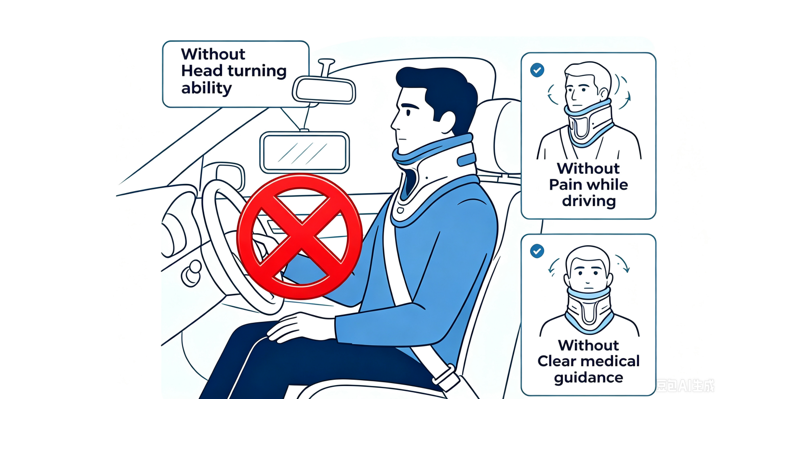
How Doctors Decide If You’re Cleared To Drive With A Neck Brace
Most patients return to normal driving within 2–4 weeks, but only once a surgeon has cleared them, narcotics are stopped, and head rotation is pain-free. Doctors don’t take your word for it. They assess neck rotation, pain tolerance, alertness, and medication use to decide if you’re cleared to drive. Most clinical guidelines require a surgeon or physician sign-off—you don’t get to self-certify.
The Checklist Your Doctor Actually Runs Through
- Neck rotation. Can you turn your head enough to check mirrors and blind spots without straining? If that motion is visibly limited, driving is off the table.
- Pain tolerance. Doctors check if you can move quickly, accurately, and repeatedly without pain stopping you mid-motion. Severe neck pain during sudden stops or head turns is a red flag.
- Alertness and reaction time. Drowsiness or slowed reflexes disqualify you fast, especially if you’re still on pain medication.
- Medication check. Opioids and other narcotic pain relievers are almost always flagged. Stopping them is one of the baseline conditions most post-surgical driving guidance requires.
- Emergency braking. Your doctor needs to confirm you can hit the brake hard and fast, under pain or restriction, without hesitation.
Why “No Legal Restriction” Doesn’t Mean Safe
Some research states no legal restriction exists on driving with a neck brace. That’s not the same as safe. Safety depends on your actual physical function, not on what’s written in a statute. For anyone driving commercially or transporting passengers, the bar is even higher—fitness-to-drive guidelines call for thorough, cautious evaluation whenever a physical limitation could affect safe vehicle operation.
Safety Precautions for Driving With a Neck Brace (Once Your Doctor Says Go)
Getting cleared to drive starts a new checklist.
Adjust your seatbelt first. The shoulder strap should sit against your collarbone, not press into the collar or ride up toward your neck. If it’s rubbing, don’t just tolerate it. Raise the seat, tilt the backrest, or move the shoulder anchor point until the belt clears the brace. Then run a sit-up-straight test. The belt should be flat against your pelvis with no pressure on the collar edge.
Set your mirrors before you move. Adjust them so you rely on mirror coverage instead of neck rotation. A common trick is to lean your head toward the driver’s window to set the left mirror, then center your head to set the right one. This minimizes overlapping blind spots.
Run a parked-position vision check. Confirm you can see traffic lights, both mirrors, and your dashboard without straining. If your neck brace compresses that field of view, don’t start the trip.
Stick to Short, Low-Speed Routes
Skip highways, night driving, bad weather, and construction zones. Daytime neighborhood routes with light traffic are your safest bet while range of motion is limited.
Conclusion
Whether you can drive with a neck brace comes down to whether your range of motion has recovered enough to check blind spots and react in a split second. A soft collar might let you get away with short, careful trips, but a rigid cervical collar almost always means you are safer in the passenger seat. Don’t guess. Get your doctor’s explicit sign-off, and understand your specific neck brace’s restrictions. Your neck is healing. Give it the time it needs and let someone else take the wheel until you are ready to drive safely again.
Need a cervical collar supplier for your product line? AOFIT, your reliable medical brace manufacturer, has you covered—with rigid collars for post-surgical support and soft foam collars that don’t sacrifice stability. Get in touch today.