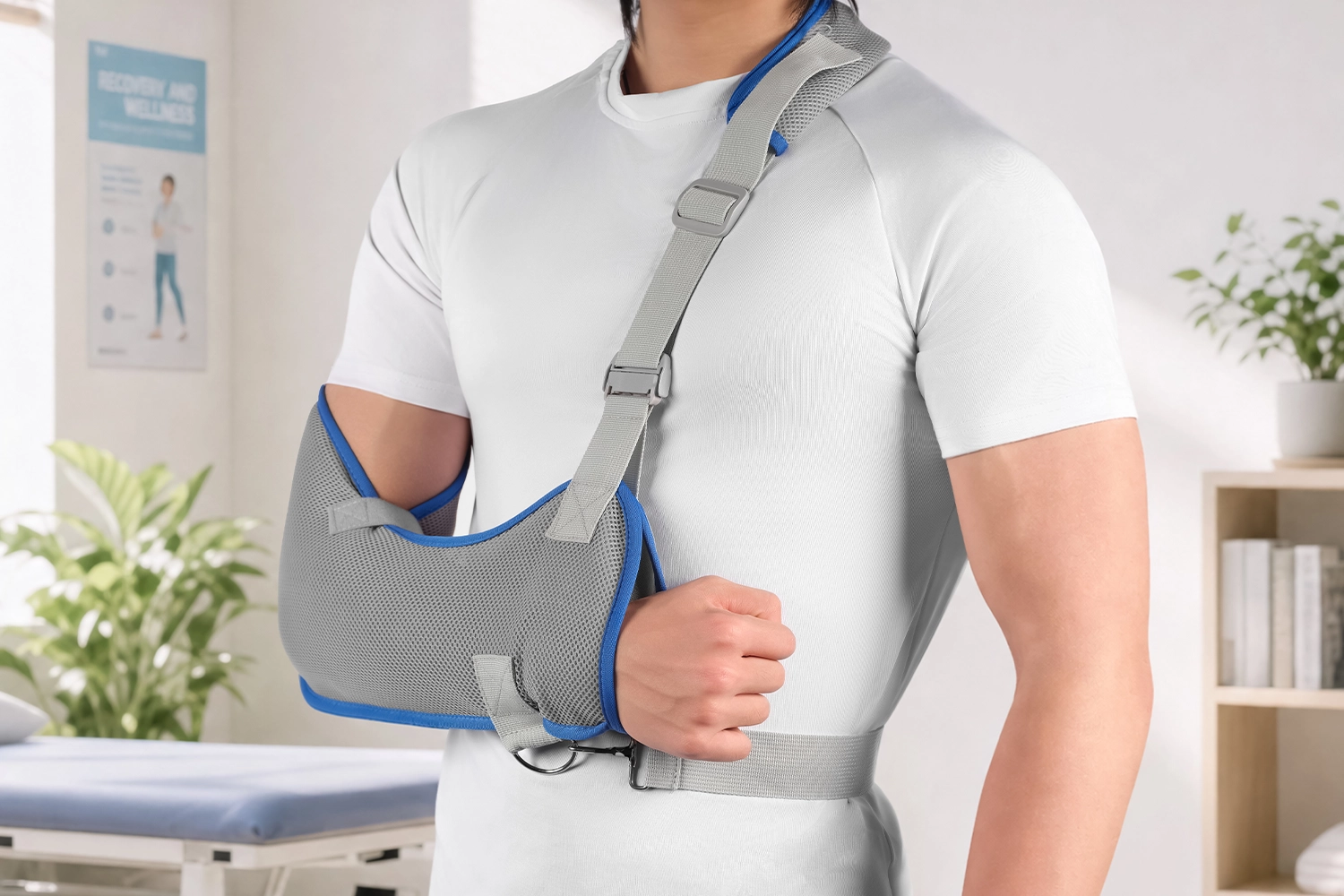
Week one after ACL surgery, your knee is locked straight in a rigid leg immobilizer, and bending it even slightly feels wrong. By week three, your surgeon mentions a hinged brace, leaving you to wonder whether something went wrong or if you are making normal progress. If you are checking discharge papers to figure out whether you need a hinged knee brace or an immobilizer right now, the answer depends on which procedure you had and how many weeks out you are.
This guide walks through a real ACL patient’s six-week timeline, breaks down the five key differences between both options (Hinged Knee Brace Or Immobilizer) side by side, and gives you a simple decision tree to confirm when to make the switch, complete with the specific flexion angles your doctor is watching for.
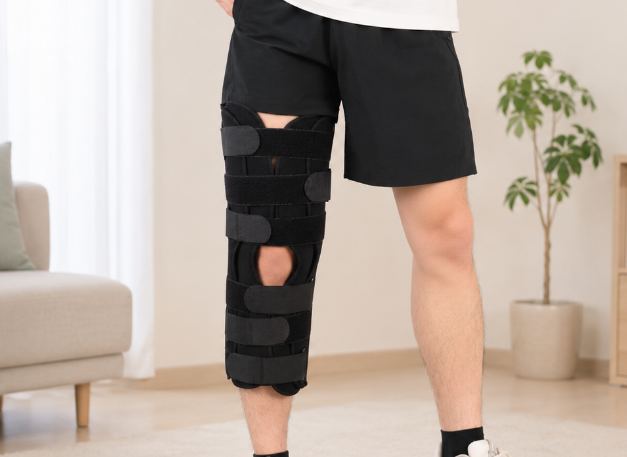
An ACL Patient’s First Six Weeks: When an Immobilizer Becomes a Hinged Brace
Here is what happens during those six weeks, broken down by what your knee needs to do before earning more freedom.
Days 0–7: Your brace stays locked at 0° extension for walking, and usually for sleeping as well. Crutches are mandatory. Weight bearing is allowed as tolerated, unless you had a meniscal or root repair that requires partial or non-weight bearing. The locked brace protects your graft while your quads wake up and you figure out how to walk again. You’ll do straight-leg raises with the brace locked, and if your knee cannot straighten completely on its own (an “extension lag”), keep it locked longer.
Weeks 1–2: Still locked for walking. The goal now is controlling your knee without buckling, hitting full extension, and managing swelling.
Weeks 2–3: Many protocols open the hinged brace to 0–90° for controlled motion, though you still need protection while walking.
Weeks 3–4: If you have full extension and solid quad control, your surgeon may unlock the brace for walking, or even discontinue it here.
Weeks 4–6: Meniscal repairs often keep the brace on longer. By week 6, many patients begin unlocking in stages starting around 30°, provided they can complete 10 straight-leg raises without lag.
The timeline shifts depending on your surgery. Isolated ACL reconstructions move faster, while ACL-plus-meniscal repairs stay restricted longer, sometimes with toe-touch weight bearing for a full month.
Hinged Knee Brace Or Immobilizer: The Five-Dimension Comparison
Numbers settle arguments better than opinions. Here is how these two devices stack up side by side.
| Dimension | Hinged Knee Brace | Knee Immobilizer |
| Indication | Ligament sprains, moderate instability, post-op protection with controlled movement allowed | Acute injuries, fractures, patellar dislocation, immediate post-surgical immobilization |
| Motion Control | Adjustable hinge stops let you dial in flexion and extension as you heal | Locks the knee near full extension with zero bend by design |
| Stability | Dynamic support; you move while ligaments stay protected | Maximum short-term rigidity via aluminum stays and foam panels |
| Duration | Built for weeks of progressive rehab and gradual ROM gains | Meant for short-term use unless your surgeon says otherwise |
| Cost | Varies widely; custom post-op versions run higher than basic soft braces | Typically 36–74: AliMed Economy Foam (36),MedlineCompression(48.95), AliMed Universal ($74.31) |
How long you wear either device carries real consequences. A randomized study of 64 patients with first-time patellar dislocations found that four weeks in a motion-restricting brace caused worse knee range of motion and quadriceps atrophy compared to earlier mobilization. Redislocation rates showed no significant difference between the two groups.
Immobilizers protect firmly, but you lose mobility fast. Hinged braces trade away some rigidity for the movement your quad needs to rebuild strength. They are built for different weeks of your recovery timeline.
ACL Reconstruction: When a Hinged Knee Brace Usually Becomes More Useful
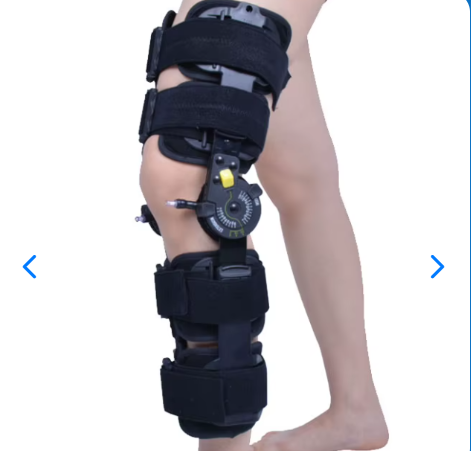
Weak quadriceps make your knee buckle during the first few weeks. A hinged knee brace earns its keep during weeks 2 through 6, while your gait is still shaky and your quads haven’t caught up yet.
Your knee needs the hinge most when:
– It still buckles during normal walking
– Quadriceps control feels incomplete (you can’t trust your leg under load)
– You have an associated MCL or meniscus injury needing extra protection
– You’re easing back into pivoting or cutting movements
You can retire the hinged brace once:
– Full extension is consistent, with no lag
– Your gait looks symmetrical, not guarded
– Strength testing shows solid, stable quad control
– Rehab drills don’t trigger instability
ACL-plus-MCL cases are the exception. These patients often keep the hinged brace locked for 4–6 weeks to limit valgus stress while the MCL heals alongside the graft.
There’s a second life for hinged braces, too. Months later, once you’re running, cutting, or playing contact sports, a functional hinged ACL brace can offer 6–12 months of return-to-sport protection. Even so, a systematic review of 1,196 patients found no definitive proof that bracing prevents reinjury, except possibly in athletes under 17. Bracing alone shouldn’t replace your surgeon’s clearance criteria for a full return to sport, typically set at 9–12 months out.
Meniscus Repair: Why the Flexion Limit Can Matter More Than the Brace Type
Meniscus recovery depends more on the angle your knee bends under load than the brace itself. Most protocols cap flexion at 0–90° for the first 2–6 weeks, while the brace stays locked near 0° for walking. People confuse those two limits all the time.
Passive bending toward 90° is safe early on, but loaded bending past 90°—squats, leg presses, and lunges—can tear the repair. Gundersen’s protocol blocks knee flexion until 6 weeks and prohibits weight-bearing stretches into flexion until 8 weeks. CHOP unlocks the brace around week 6 once your straight-leg raise shows no lag.
Repair Pattern Changes Everything
Your timeline depends on the tear:
- Radial, root, and horizontal-cleavage repairs: stricter restrictions, sometimes non-weight bearing entirely
- Vertical longitudinal or ramp repairs: weight bearing as tolerated, but flexion still capped at 90°
- Root repairs: no weight bearing for 4 weeks, partial weight bearing weeks 4–6, full weight bearing around week 6
SLU’s protocol keeps loaded flexion under 45° through weeks 1–3, then under 90° through week 8.
Ask your surgeon for your specific loaded flexion limits based on your tear, rather than focusing only on the brace.
Total Knee Replacement: When an Immobilizer Is Temporary Rather Than Routine
A standard knee replacement differs from an ACL reconstruction. Most uncomplicated TKA patients need an immobilizer for about one week to stay safe while walking. Once you complete 10 straight-leg raises without extensor lag, your surgeon will usually clear you to stop using it. Keep it on at night only if you still struggle to achieve full passive extension.
Wearing the brace longer than necessary can backfire. Current TKA physical therapy guidelines note that extended bracing often restricts flexion and slows rehab more than it protects the joint. In routine cases, the harms outweigh the benefits.
Certain surgical repairs change this timeline:
– Patellar or quadriceps tendon repair
– Extensor-mechanism reconstruction
– Patellar fracture fixation
– Major revision TKA with a compromised extensor mechanism
These cases require 6–8 weeks locked in extension, sometimes longer, with flexion capped around 90° once movement begins.
Falls remain a real risk regardless of brace type. One study found 39.2% of post-op patients fell within six weeks, with 78.3% of those falls happening in the first three weeks. Pain and weak muscle control drove most incidents.
An uncomplicated TKA calls for short-term brace use. If your extensor mechanism was repaired or reconstructed, follow your surgeon’s specific schedule instead.
A Decision Tree for Choosing a Hinged Brace or Immobilizer
Three questions settle this quickly.
Question 1: Is this an emergency or unstable injury? If you have a gross deformity, suspected dislocation, open fracture, neurovascular deficit, or cannot perform a straight-leg raise, put on an immobilizer and get an urgent orthopedic evaluation. Do the same for displaced tibial plateau fractures or any injury awaiting surgery.
Question 2: Does your knee need full immobilization right now? Use an immobilizer for acute quadriceps or patellar tendon ruptures, patellar fractures, or early MCL protection that demands extension control. Keep this protection short term, because prolonged immobilization leads to stiffness and muscle atrophy.
Question 3: Can your knee tolerate controlled motion? Pick a hinged brace for Grade II-III MCL or LCL sprains, stable ACL or PCL tears, and post-op rehab. Most rehab braces stay on for 6 to 12 weeks.
| MCL Grade | Device | Duration |
| Grade I | None/light support | Early motion |
| Grade II | Hinged brace | 3+ weeks |
| Grade III | Hinged brace, locked initially | 6+ weeks |
Lock the brace in full extension for walking if you have an extension lag or instability. Unlock it in stages as your swelling goes down and quad control returns.
When to Switch From Immobilizer to Brace: Objective Readiness Criteria
Calendars lie. Your knee only cares whether it is ready. Switching from a rigid knee immobilizer to a hinged knee support adjustable device depends on meeting clinical criteria, even though most protocols place that window somewhere between weeks 2 and 6.
Six boxes need checking before you unlock anything:
- Straight-leg raise with zero extension lag, keeping your knee dead straight while lifting
- Strong quad set, meaning you can control the knee while standing
- Full or near-full passive extension (0° is the target)
- Swelling and pain stay manageable without spiking the next morning
- Safe gait with your prescribed weight-bearing, no buckling or wobble
- Normal sensation returned, especially if you had a nerve block—numb legs fall down
Brace setting benchmarks matter as well. Meniscal repairs often cap knee brace range of motion at 0–90° for six weeks. Arthroplasty protocols frequently start at 0–30°, then open to 0–90° once pain, swelling, and quad strength cooperate.
Pass 10 consecutive SLRs without lag, transfer without giving way, and walk a level surface with stable extension. Once you hit those marks, you are cleared to unlock.
How to Adjust a Hinged Brace During the Transition Period
Your surgeon sets the degrees. You set the brace to match.
Before touching any dial, confirm your prescribed range of motion. Common hinge ranges run from -10° hyperextension to 70° flexion, with locking positions at -10°, 0°, 10°, 20°, and 30°. Other models use 15° increments, extension 0° to 105°, flexion 0° to 120°. Never widen these limits on your own, even if walking feels fine.
Re-check the fit every time swelling drops. Loose straps let the brace migrate off the joint line.
- Center your knee between both hinges.
- Align the hinges with your kneecap on both the medial and lateral sides.
- Fasten the straps nearest the knee first, keeping them loose.
- Pull the slack from behind the leg, then secure the Velcro.
- Check for two fingers of space underneath each strap.
To change the stop, press the hinge tab, slide to your prescribed degree, release, and confirm that the lock is engaged on both sides.
Get a clinical review if you notice numbness, skin color change, pressure sores, or the brace blocking your authorized motion.
Everyday Function: Sitting, Toileting, Showering, Stairs, and Sleep
Your brace choice shows up the moment you try to live a normal day. Sitting, using the bathroom, showering, climbing stairs, and sleeping all test your knee in ways a quick clinic visit never does.
Sitting and transfers: An immobilizer locks your leg straight, so getting into a chair means pivoting and lowering yourself with your arms. A hinged brace set to 0–30° flexion gives you enough bend during a bed-to-chair transfer to ease upper-body strain and feel less awkward.
Toileting: An immobilizer makes the bathroom tricky. Without bend in the joint, you have to back up and lower yourself using the sink or a grab bar. Unlocking a hinged brace to even 30-40° restores a natural sitting motion.
Showering: Non-slip mats and an adjustable shower chair help either way, but sitting down with a locked leg is stiff and awkward. Once your hinged brace opens past 30°, seated showers get much easier.
Stairs: Immobilizers force a step-to pattern, making you lead with your good leg on every step. Hinged braces with some flexion allow a reciprocal gait once your surgeon approves weight bearing.
Sleep: An immobilizer keeps your leg straight all night to protect extension, but it makes side-sleeping difficult. A hinged brace locked at 0° provides that same joint protection while making it easier to shift positions in bed.
Warning Signs That Require Medical Reassessment Before Changing the Brace
Some red flags override standard timelines. Call your surgeon instead of adjusting anything on your own if you notice:
- Toes turning blue, pale, or cold, or swelling that doesn’t improve with elevation
- New numbness, tingling, or weakness beyond what the brace itself causes
- Blisters, pressure sores, or redness that lingers 20–30 minutes after removing the brace
- A brace that’s cracked, loose, wet, or no longer fits due to changes in swelling
- Popping, clicking, or a knee that suddenly feels unstable
Diabetics and anyone with circulation issues need faster medical follow-up, because numbness can hide real damage. Any deformity, inability to bear weight, or sudden severe pain requires an immediate evaluation for a fracture.
Conclusion
Choosing between a hinged brace and an immobilizer comes down to your surgery and your week of recovery. Right after ACL reconstruction, a rigid immobilizer protects the graft during the fragile first 1-2 weeks. Once your surgeon clears controlled motion (typically around weeks 3-4 and tied to a specific flexion angle), the hinged brace helps you bridge back to normal movement. Meniscus repairs and knee replacements follow their own timelines, but they share the same progression of protecting the joint first before restoring movement.
Don’t guess your way through recovery. Match your surgery type and week to the readiness criteria in the decision tree, and ask specific questions at your next follow-up about your current flexion range and whether you are cleared to adjust brace settings.