That pop, twist, or buckle in your knee didn’t just hurt—it changed your next six to twelve months. Now you’re staring at a wall of knee brace options online, wondering if a $30 sleeve does the same job as a $200 hinged knee brace, or whether your surgeon’s advice to “wear a brace” means something specific you’re missing.
Not all knee braces are created equal, and using the wrong one at the wrong stage of your ACL reconstruction recovery can slow you down—or worse, put you at risk for reinjury. This guide breaks down how a knee brace for ACL injuries supports healing at each recovery phase, and how to choose and use one so you can get back to the sport and life you love—with confidence, not guesswork.
ACL Injuries and How Knee Braces Really Help
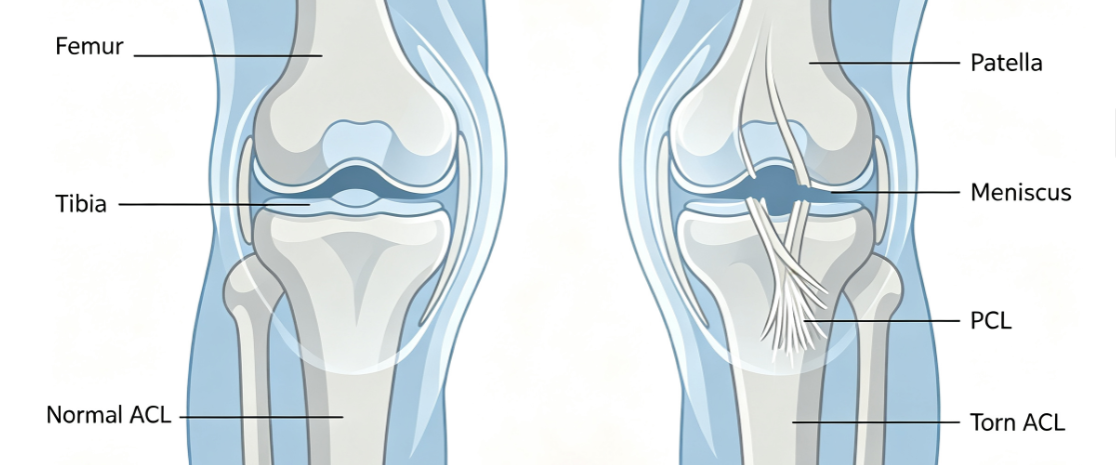
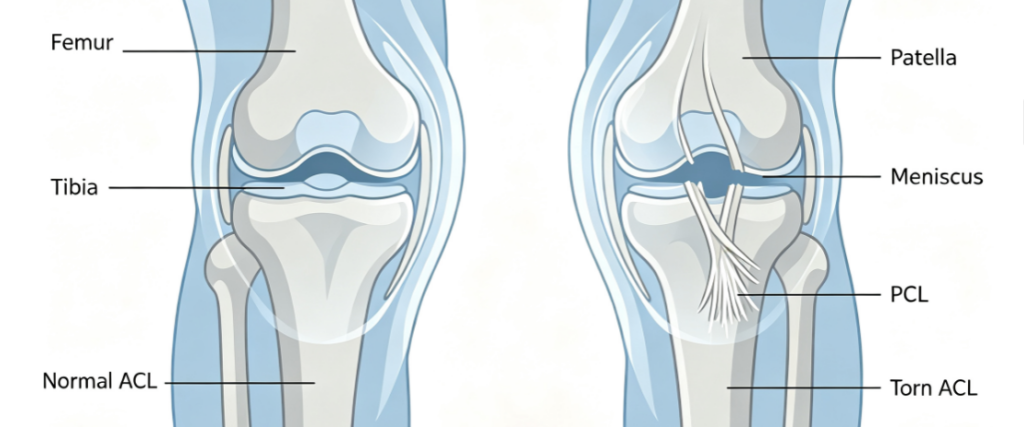
ACL injuries aren’t all the same—they run on a spectrum. A partial tear (Grade 2) means the ligament is stretched and partly torn, but some fibers still hold. You get mild-to-moderate instability, not total collapse. A complete rupture (Grade 3) is different: the ligament splits into two pieces. Now you’re dealing with significant instability, forward shifting of the shinbone, and rotational control that just isn’t there anymore.
Here’s what your ACL actually does: it stops your tibia from sliding forward (anterior tibial translation) and from rotating inward too much. Tear it, and both movements go rogue. And the instability isn’t just mechanical. Your ACL also houses mechanoreceptors—tiny sensors that feed your brain proprioceptive data. Damage them, and your quad activation drops, coordination suffers, and your reinjury risk climbs.
Most ACL tears happen during:
– Non-contact deceleration and cutting (valgus + internal rotation combo)
– Forceful hyperextension
– Direct anterior tibial impact (think dashboard injuries)
What a Brace Actually Does (and Doesn’t Do)
A knee brace doesn’t heal your ACL. It can’t. What it does is mechanically limit the dangerous movements—anterior tibial translation, rotation, and that valgus-rotation combo causing most non-contact injuries. Think of it as external scaffolding, not biological repair. For partial tears, this support alone often manages activity safely. For complete ruptures involving high-demand sports, bracing buys stability, but surgical reconstruction remains the definitive fix.
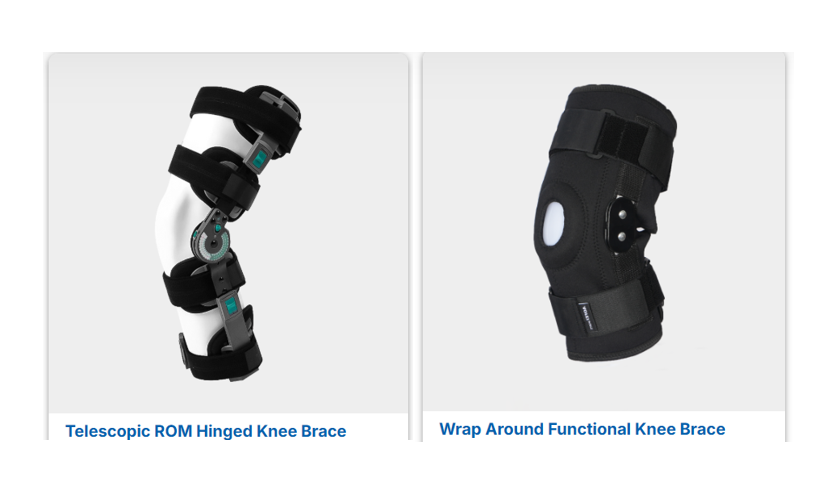
ROM hinged knee brace or Functional knee braces use metal hinges and side supports to allow controlled flexion while blocking abnormal rotation and valgus or varus stress. This is the choice for ACL, MCL, LCL, or PCL injuries when you need to keep moving: walking, light training, structured rehab.
Acl Recovery Braces: Different Phases, Different Braces
Timing is everything here. The brace that protects you in week one can hold you back by week twelve. Recovery runs through four distinct windows, and each demands a different type of knee brace for ACL injuries.
Acute Injury Phase (Weeks 1–2, Pre-Evaluation)
Right after injury, before you’ve even seen a specialist, you need a locked or limited-ROM post-surgical knee brace—not a flexible sleeve. Doctors lock these near full extension, usually between 0° and 30° of flexion, to keep the torn ligament from stretching further. The goals: control swelling, manage pain, maintain extension, and stop your knee from buckling again while you wait for imaging and an orthopedic consult. Pair the brace with straight-leg raises and quad isometrics to slow muscle atrophy.
Post-Surgical Early Phase (Weeks 0–4)
After ACL reconstruction, you’ll wear an adjustable ROM hinged knee brace, rigid frame and locking hinge, to protect the graft. The progression looks like this:
- Weeks 0–2: 0° extension, up to 90° flexion
- Weeks 2–6: near-normal extension, up to 120° flexion
Some protocols start flexion work at 3 days post-op, hitting 90° by 2 weeks, then adding about 15° per week. Weight-bearing often reaches 50% body weight by week 2, with crutches dropped around week 4.
The brace gives you mechanical protection and psychological security. But AAOS clinical guidelines are clear: for isolated primary ACL reconstruction, routine long-term functional bracing isn’t recommended—no proven clinical benefit. Short-term protection makes sense. Long-term dependence doesn’t have evidence behind it.
Mid-Recovery to Return-to-Sport (Weeks 6–24+)
Around weeks 6–12, most people transition to a hinged functional knee brace designed for lateral stability during increasing training loads. Strength targets guide the timeline. You want more than 70% of the uninjured leg by weeks 12–16, and more than 85% by weeks 16–24 before you start running, agility drills, or sport-specific work.
Returning to cutting-heavy sports—soccer, basketball, skiing—means shifting from a locked brace to a functional hinged one built for pivoting and sudden stops. Even so, AAOS maintains that standard ACL reconstruction patients shouldn’t default to long-term functional bracing.
Non-Surgical (Conservative) Recovery
If you skip surgery or put it off, a functional knee brace mainly targets that “giving way” sensation during walking, stairs, or light activity. The evidence is blunt: a brace alone doesn’t replace strength, proprioception, or neuromuscular control training. One tracking study found that patients who combined bracing with structured rehab scored 41% higher on knee function at 6 months than those using bracing alone. Treat the brace as a risk-control tool paired with rehab, not a standalone fix.
How a Knee Brace for ACL Injuries Actually Helps: The Verified Benefits
Not everything we assume about knee braces holds up under scrutiny. Systematic reviews on post-surgical functional bracing are blunt: no proven improvement in function, no measurable reduction in pain, no boost to range of motion, and no confirmed drop in reinjury risk. The real verified benefits come from a more specific, more honest picture.
Short-Term Wins: Pain, Swelling, and Motion
The strongest evidence clusters around early recovery. Combining external support with rehab, whether taping or targeted physical therapy, shows measurable results: pain scores drop by an average of -0.74 (95% CI, -0.93 to -0.54), range of motion improves by a standardized mean difference of 1.19, and swelling shrinks dramatically, with an SMD of -1.72. One early e-stim study tracked VAS pain scores at days 3, 7, and 14 post-op, and each checkpoint showed significantly lower pain than the control group, alongside better quad circumference and strength. Kinesio taping delivers similar early wins for pain and swelling.
Mid-Term Gains: Confidence Over Chemistry
A hinge holds the joint, but the “giving way” feeling only goes away when your nervous system relearns control. At 12 weeks, patients doing isokinetic training scored VAS 2.55 (±0.85) versus 2.96 (±0.74) for those who didn’t. The brace’s real job here is psychological. It reduces movement avoidance, so you’re more willing to squat, climb stairs, and load the knee. That loading is where actual strength gains happen.
Long-Term Reality Check
For reducing anterior tibial translation, rotation, or preventing reinjury long-term, the evidence gap is significant. Systematic reviews consistently find no proof that routine functional bracing improves these outcomes. If you’re choosing a knee brace for ACL injuries expecting it to replace rehab, that expectation needs resetting. The brace supports your comfort and confidence early on—your training does the rest.
Practical Tips for Wearing a Knee Brace Correctly to Improve Effectiveness
Wearing a knee brace correctly is half the battle. Get the timing, tightness, and placement wrong, and even the best hinged knee brace won’t do its job.
How Long to Wear a Knee Brace for ACL Injuries?
Short, purposeful wear is the goal. Aim for 1–2 hours per session, then take it off and let your leg breathe. Hinged braces typically max out around 2 hours before a break; molded one-piece designs can stretch to 4–6 hours.
Phase matters, too. In the acute or early post-surgical stage, your surgeon might have you in the brace closer to 24 hours a day. That schedule is a medical decision, so follow their instructions. Around the two-week mark, most protocols start tapering that reliance. Once you’re back to training, save the brace for heavy workouts, long walks, stairs, and prolonged standing. Take it off once you’re back to easy movement.
Can I Sleep with a Knee Brace for ACL Injuries?
NO. Continuous, round-the-clock wear can restrict circulation and train your knee to lean on the brace instead of your own muscles. Skip it at night, during rest, and for light indoor walking.
How to Get the Knee Brace Size Right?
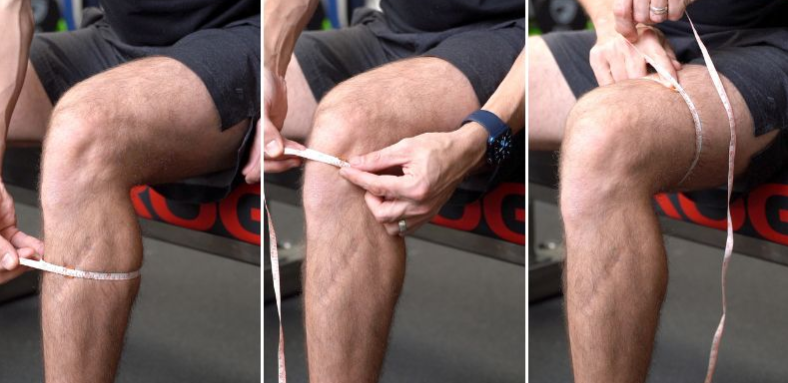
Measure three points: thigh circumference 15 cm above the kneecap, knee circumference at the widest point, and calf circumference 10 cm below the kneecap. Compare against the medical brace manufacturer‘s size chart. Never adjust the brace’s angle range yourself—let your surgeon or physical therapist set it. Widening range of motion too early can undo the healing you’re working to protect.
Use the one-finger test, and you should be able to slide one finger under the strap. Too tight brings numbness, throbbing, or poor circulation; too loose means slipping and zero support. Wear it directly against skin (never over clothing), centered on the kneecap, roughly three finger-widths above and below. Smooth out wrinkles; they kill support and cause friction.
Never replace ACL surgery with knee brace and Pair It With Rehab
A knee brace for ACL injuries manages instability; it doesn’t repair torn tissue. Surgical reconstruction and conservative bracing-plus-rehab are two separate paths—your surgeon and your knee’s demands decide which one fits.
A brace doesn’t replace quad and glute strengthening, mobility work, or swelling control. Lean on it during high-load moments; skip it during ROM drills or light strength training when your PT clears you to build active control instead.
Warning Signs to Stop and Reassess
If you notice catching, popping, numbness, tenderness, coldness, or color changes, loosen or remove the brace immediately. When pain lingers past two weeks, keeps recurring, or your knee feels unstable the moment the brace comes off, get it checked. There may be more going on than the brace can fix.
Conclusion
Recovering from an ACL injury means using the right brace for the stage you’re in. A post-surgical knee brace protects you in those fragile early weeks. A hinged knee brace supports you as you rebuild strength and range of motion. A functional knee brace has your back when you’re ready to cut, pivot, and chase that ball again.
Are you choosing the right bracing solution for your clients or patients? Contact AOFIT now and we offer the full OEM/ODM knee brace lines.