That throbbing finger makes the pain obvious, but it offers no clues about your recovery timeline. You need to know when the splint can safely come off.
The timeline for how long to wear a finger splint for fracture depends on details your doctor likely mentioned while the stress of the injury distracted you. A hairline crack requires different care than a displaced break at the joint. Treating every injury the same way is a common reason healed bones break again.
This guide tracks finger splint healing time by fracture severity to show what happens beneath the splint week by week. It also flags the specific warning signs that mean you need to call your doctor before something goes wrong.

How Long To Wear a Finger Splint For Fracture: Quick Answer
Three weeks. Most doctors recommend this for a straightforward fractured finger, but the full range runs 3 to 6 weeks depending on the specific break.
Here’s the breakdown by fracture type:
Splint Duration By Fracture Type (Wear Time Corresponding to Finger Fracture Types)
Finger fractures heal at different rates depending on the specific bone, how it broke, and whether it shifted out of place.
| Fracture Type | Splint Duration | Splint Position |
| Distal phalanx fracture | 4–6 weeks | DIP joint splint; leaves the PIP and MCP joints free |
| Mallet finger (dorsal avulsion) | 8 weeks, strict and continuous | DIP joint held straight or hyperextended with zero flexion allowed |
| Bony mallet finger | 6–8 weeks, then night splinting for 4 more weeks | DIP held in full extension during the day |
| Middle phalanx fracture | Up to 3 weeks (stable), 3–4 weeks (nondisplaced) | Buddy taping or an interphalangeal extension splint |
| Proximal phalanx fracture | Up to 3 weeks (stable), 3–4 weeks (nondisplaced) | Safe-position splint or buddy taping |
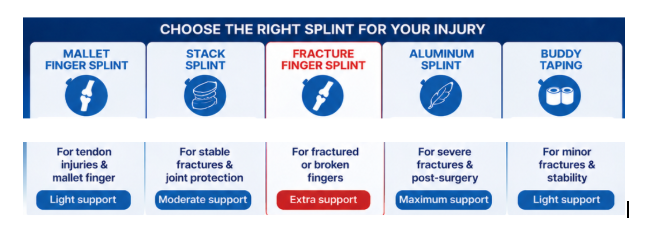
| Hairline/nondisplaced fracture | 2–4 weeks, often closer to 3 | Finger cage, molded aluminum splint, or buddy taping |
Stable, nondisplaced breaks in the middle or proximal phalanx heal fastest and can finish in two weeks. Distal phalanx breaks take longer because you constantly use that bone to grip and pinch.
With a mallet finger, the extensor tendon tears away along with the bone. Flexing the joint even once resets the healing clock to zero. Doctors require absolute stillness until the full 8 weeks pass.
Surgery or a reduction to realign the bone changes this timeline. Surgeons cap immobilization at 5 to 6 weeks maximum and encourage motion as soon as it is safe. Leaving the splint on too long stiffens the joint without speeding up bone recovery, as the bone heals at its own pace underneath.
Your doctor’s diagnosis determines exactly where you fall in these ranges.
Factors That Affect How Long You Need The Splint
Not every broken finger follows the chart above to the letter. Your own body dictates the timeline.
Stability and displacement. A stable, nondisplaced break often needs 2 to 4 weeks in a splint or buddy tape. If a bone is pushed out of alignment and put back into place, expect a minimum of 3 to 4 weeks. Healing takes longer if that reduction fails to hold. Unstable or rotated fractures, especially near a joint, often bypass the simple splint and require a surgical evaluation.
Location. Fractures near a joint need tighter alignment. Doctors immobilize them longer and monitor them closely. By contrast, a nondisplaced fracture through the shaft of the proximal or middle phalanx might only need 2 weeks of buddy taping.
Your biology. Patients under 30 tend to heal faster. Smokers take longer. A study on tibia fractures found smokers took a median of 269 days to heal clinically, compared to 136 days for non-smokers. That is a 69% delay on imaging alone. Diabetes and low bone density also slow down bone formation. If these apply to you, expect your doctor to stretch a standard 3-to-4-week splint to 4 to 6 weeks. They will also rely more on physical tenderness than X-rays alone before clearing you.
Treatment method. Surgical fixation often means the splint comes off in about 1 week. Internal hardware stays in for 4 to 5 weeks, and heavy lifting is restricted for roughly two months.
Finger Fracture Healing Timeline (Timeline of Each Healing Stage)
Bone heals through distinct biological stages, with each step building on the previous one. This timeline explains why your doctor adjusts expectations for when you can use your finger again.
Days 0–5: The Inflammatory Stage
Right after the break, your body floods the area with blood and inflammatory cells. Your finger swells and throbs during these first few days. A hematoma forms around the fracture site to start the repair process.
Days 5–14: Soft Callus Formation
Around day four or five, your body starts building a soft, cartilage-like bridge across the break. This fibrocartilage callus provides basic stability before the hard bone forms.
Weeks 2–4: Hard Callus Formation
The soft callus mineralizes into hard bone during this window. Your X-rays will show visible healing, and your finger can tolerate more activity without pain.
Weeks 6–8: Clinical Bone Healing
Most finger fractures reach bony union by this point. Your splint comes off around this milestone, though you still need time to regain full function.
Months 3–4: Strength Returns
Regaining full strength takes more time than healing the bone. Expect another 4 to 6 weeks beyond the 6–8 week mark before your grip recovers.
Months 6+: Remodeling Continues
Your internal bone structure keeps refining for up to a year. This phase restores the last bits of structural strength long after your hand feels completely healed.
How To Care For Your Finger While Wearing The Splint
Bone heals on its own schedule, but bad habits during the wait can sabotage the process. Moisture, pressure, and impatience cause most splint-related setbacks.
Keep it dry. A wet splint turns soft and loses its shape. Trapped moisture against your skin causes soreness or breakdown. Wash the exposed skin and the splint once a day with soap and water or wipes. Dry everything before putting the splint back on.
Shower smart. Cover the splint with a plastic bag or a rubber glove, or skip washing that hand. Leave the splint on for bathing unless your doctor tells you otherwise.
Control swelling. For the first three days, ice the area for 10–20 minutes every one to two hours while you are awake. Put a thin cloth between the ice pack and your skin. Keep the hand elevated above heart level. Resting on a pillow works well whether you are sitting or lying down.
Sleep with it on. Many mallet finger protocols require continuous wear, including overnight. Bending the fingertip during sleep can undo weeks of progress in seconds.
Dress around the splint. Loose sleeves help. Feed the injured hand through clothing first to avoid snagging the splint.
Move only what is allowed. Hand therapists often want the middle joint moving while the end joint stays locked straight. Do not start flexion exercises on your own schedule. Early motion in the wrong joint can reset your healing clock.
When To See A Doctor / Recheck Your Splint
You should never ignore pain or discomfort in a splint. Worsening pain, skin color changes, or a feeling that something is wrong underneath all signal that a doctor needs to check your fracture.
Call your doctor or go to urgent care if you notice:
- Severe or worsening pain that doesn’t ease with rest
- Numbness, tingling, or a burning sensation
- Skin turning pale, purple, gray, or feeling cold
- Significant swelling trapped under the splint
- Discharge, odor, or warmth coming from the splint
- Difficulty moving the finger or nearby joints
- A splint that feels too tight, too loose, cracked, or misshapen
- Redness, blistering, or raw skin at the splint’s edges
These symptoms usually mean the splint is cutting off circulation, irritating your skin, or hiding a worsening fracture.
Standard Follow-Up Checkpoints
Even without red flags, your doctor will want to check your progress on a schedule:
- Around 1 week: Checks swelling, splint fit, skin condition, and circulation. The doctor often switches you to a better-fitting or removable splint.
- Around 3 weeks: Reassesses pain, motion, and stability through an exam or imaging. If the fracture is healing well, you can start wearing the splint less often.
- Around 6 weeks: Checks if the splint can come off permanently and if you need hand therapy before returning to full activity.
Skipping these checkpoints can turn a minor fracture into a major problem. Taking the splint off early slows your healing, risks re-injury, and threatens your bone alignment, which extends your entire recovery timeline.
Risks Of Removing The Splint Too Early Or Wearing It Too Long
Taking a splint off too early rushes the bone, while wearing it too long punishes the joint.
Pulling the splint off too soon tops the list of preventable setbacks. The AAOS states that removing a splint before your doctor clears you can “impede proper healing.” Without enough protection, the fracture can shift out of alignment, slow its own repair, or heal crooked (a malunion). Cleveland Clinic warns that taking the splint off early or often increases your chances of re-injuring the spot before it can handle stress.
Wearing it too long causes different damage. The AO Foundation notes that keeping the proximal phalanx or MCP/PIP joints rigid for more than 4 weeks increases the risk of stiffness. The joint capsule tightens, range of motion drops, and grip strength fades. One review on elbow injuries found that even after appropriate immobilization periods, up to 10% of patients lost some motion after splint removal. Another 10% kept improving. This shows recovery requires careful staged management over time.
Finding The Right Balance
Doctors usually avoid prescribing all-day wear for the entire healing window. Once swelling drops and tenderness fades, most protocols shift toward gentle, supervised motion. Arthritis UK recommends taking off hand splints for light finger and thumb exercises, because unnecessary all-day wear worsens stiffness without speeding up bone repair. One clinical review found that spending more than 6 hours a day in a stretched end-range position improved contractures faster within a 4-week span. Still, more time does not guarantee better results. Protection and motion both matter, and your doctor or hand therapist will decide when to adjust your schedule.

Conclusion
Finger splint healing times follow a reliable pattern. A hairline crack might set you free in three weeks. A displaced or joint fracture could keep you splinted for six, and sometimes longer if your body takes its time.
Understand why your timeline looks the way it does, recognize the healing stages as they unfold, and know the warning signs that mean something is off.
If your finger still feels tender, swollen, or stiff at the expected removal date, call your doctor before taking off the splint.
Your finger needs to heal correctly the first time. Keep the splint on for the full duration your injury requires. Want to know more, contact AOFIT now.