That sharp, burning pain just below your elbow doesn’t have to sideline your daily routine. It just depends on whether your brace is doing its job. Most people wearing a tennis elbow brace have it positioned wrong, cranked too tight, or on for the wrong hours of the day. That means they’re getting a fraction of the relief they should be. Wearing it correctly is the difference between real tendon relief and another piece of gear collecting dust in your gym bag.
Below, I’ll walk you through How To Wear A Tennis Elbow Brace, including elbow strap positioning, how tight is too tight, and when you should—and shouldn’t—keep it on. By the end, you’ll know how to make this simple brace work as hard as you do.
Where to Position a Tennis Elbow Brace on Your Forearm
The correct tennis elbow brace positioning starts on the outside (lateral) top of your forearm. Never on the elbow joint itself. Your target zone sits 1–3 inches (3–8 cm) below the elbow crease(2 inches with the most ideal effect), right over the bulk of your forearm extensor muscles.
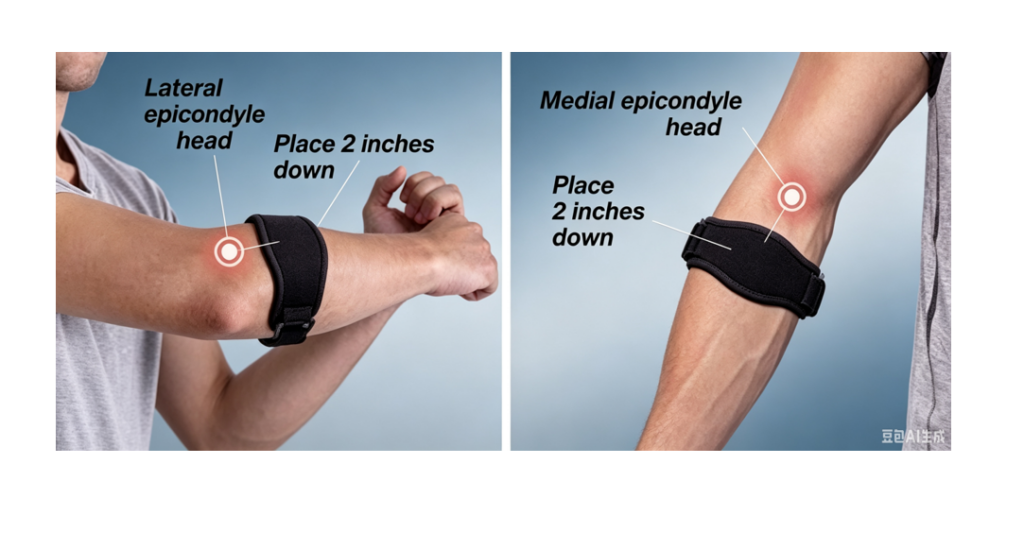
Where to put the tennis elbow brace: The 2-Finger Rule
Skip the ruler. Use your fingers instead. Place two fingers below your elbow tip—that’s your starting point. Some people with larger forearms need 2–3 finger-widths. Either way, you’re looking for the thickest part of your upper forearm, just below the joint.
Correct vs. Incorrect Placement
Correct placement: pad centered over the outer forearm extensor mass, snug but not crushing. Incorrect placement: pad sitting directly on the elbow bone or shifted to the inner forearm.
If your pain sits lower down your forearm, slide the brace toward your wrist. Elbow strap positioning should follow where the tendon pain lives. It’s not one-size-fits-all.
Tennis Elbow vs Golfer’s Elbow: Don’t Confuse
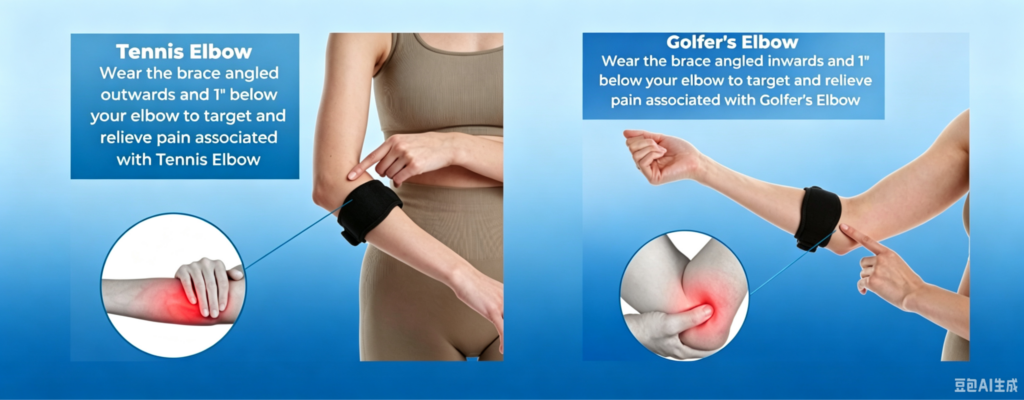
This matters more than people realize. Tennis elbow (lateral epicondylitis) means the brace goes on the outside of your forearm. Golfer’s elbow (medial epicondylitis) flips that—brace goes on the inside, over the flexor muscles. Same general distance below the elbow, opposite side entirely.
How to size the tennis elbow brace: Quick Check
Measure around your forearm just below the elbow before buying. Match that number to the manufacturer’s size chart. A properly fitted lateral epicondylitis brace should feel supportive, not numb, tingly, or restrictive.
Step-by-Step: How to Wear a Tennis Elbow Brace
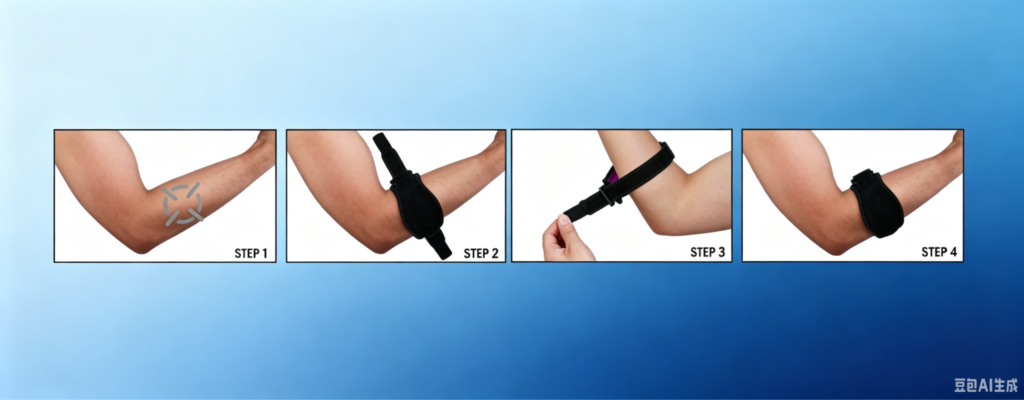
Four steps to go from “random armband” to an actually working brace.
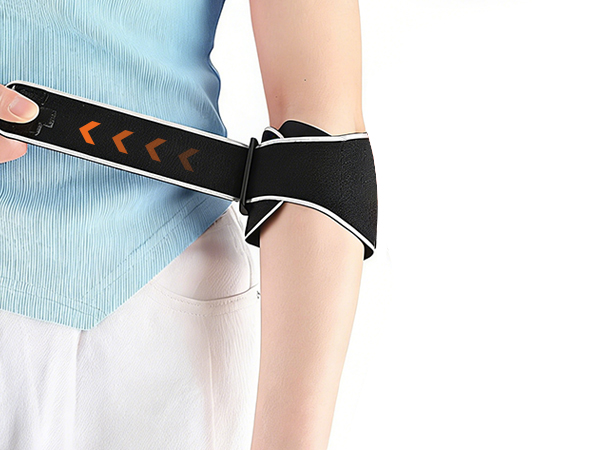
1. Slide the strap up from your hand. Don’t try to wrap it around the mid-forearm like a bandage. Slide it on like a sleeve, pressure pad facing the painful side, then position it once it’s on.
2. Center the pad over your pain point. Most people rush this step. Take a second to line the pad up directly over the sore spot before you tighten anything.
3. Fasten with the one-finger test. Tighten until it’s snug but you can still slide one finger underneath. Tingling, numbness, or discoloration means it’s too tight. Loosen it immediately.
4. Test it with a grip. Make a fist, mimic a racket swing, or grab something. Pain should ease up. If it doesn’t, adjust the position slightly up or down before you commit.
Putting It On With One Hand
An injured arm makes this awkward. Loosen the strap fully first, then slide your hand through it before pulling it up your forearm. Brace your arm against a table edge or your knee to keep it steady, then use your good hand to pull the velcro tight. Position before you tighten. This cuts down on repeat attempts.
How Tight Should a Tennis Elbow Strap Be
There’s a sweet spot, and most people miss it in one direction or the other. You want it snug, not strangling. You want steady, supportive pressure that never cuts off circulation or limits how your wrist and fingers move.
The Finger Test, Refined
One finger should slide under the strap with mild resistance. That’s your target. If three fingers glide in easily, you’re too loose—no real compression, no real relief. If you can’t get a fingertip underneath at all, you’ve overtightened it. Back off immediately.
Signs You’ve Gone Too Tight
- Tingling, numbness, or a cold, tingly feeling in your fingers
- Skin turning white or purple
- Trouble making a fist or gripping objects
- Deep, lingering indentation marks after removal
If you notice any of these, loosen the strap right away, then re-tighten to “supportive, not suffocating.”
Signs You’ve Gone Too Loose
- The brace slides down or twists during movement
- You feel zero pressure relief when gripping or lifting
- Pain returns the moment you use your arm
Fix it by nudging the pad back over the forearm muscle belly, then tightening in small increments.
Run the Quick Tests
Make a fist. Grip a water bottle. Mimic a backhand swing. Your fingers should stay warm and mobile throughout. The ideal feel is like a blood pressure cuff—firm, around an 8 out of 10 on a tightness scale, but never numbing.
The Adjustment Order That Works
Position the pad first. Tighten gradually. Test with a grip. Loosen if you feel tingling or discoloration; tighten slightly if it slides or offers no support.
When and How Long to Wear a Tennis Elbow Band Each Day
Timing trips up more people than positioning does. Wear your brace when your elbow is working hard, and take it off when it’s not. Match your tennis elbow brace timing to your pain triggers, not the clock.
Match Wear Time to Your Activity Level
If pain flares with one specific task (typing, lifting, a tennis serve), wear the band only during that task. No need for all-day wear.
If pain shows up across most daytime activities, wear it for most of your waking hours during the rough patch, then taper down as things improve. Some rehab protocols call for wearing it through all daily activities for six weeks straight, removing it only to shower, sleep, or do rehab exercises.
If your discomfort is mild and occasional, skip continuous wear entirely. Use it intermittently, just for flare-up moments.
Scenario Breakdown
- Sports, gym sessions, manual labor: wear it through the entire activity, remove it once the load stops.
- Desk work, typing, light repetitive tasks: only wear it if that specific task clearly triggers pain. Continuous wear for low-intensity work often isn’t necessary.
- Early, more painful phase: some clinicians recommend near-continuous daytime wear for a short stretch, then gradually reducing hours as pain subsides.
Some practitioners suggest 2–3 hour wear intervals rather than nonstop use, to avoid over-relying on the brace.
What About Sleeping?
Skip it. Most guidance says no night wear. There’s no clear benefit while resting, and continuous use risks skin irritation or muscle over-dependence. If pain is severe, some sources mention night wear, but it’s not the standard recommendation.
Common Mistakes When Wearing a Tennis Elbow Brace
Five errors keep showing up, and each one cancels out the relief your brace should be giving you.
Pressing directly on the elbow bone. If your outer elbow bone feels crushed the moment you fasten the strap, or gripping something makes it worse, the strap is pressing on bone. Shift it down 1–2 finger-widths (about 2.5–5 cm) until the pad sits over the forearm’s fleshy part, away from the joint.
Placing it too high or too low. Too high, and it hugs the elbow joint. Too low, and it works like a plain wristband with zero pain relief. With your arm straight, palm down, measure 2–3 finger-widths (roughly 5 cm) down from the bony point, then secure it there.
Cranking it too tight. Numbness, coldness, swelling, or discomfort within five minutes are all red flags. Loosen until one finger slides underneath—never aim for that blood-pressure-cuff squeeze.
Letting it slip during activity. Constant sliding or twisting mid-swing means the placement was off from the start. Reposition over the muscle belly first, then tighten just enough to stay put under load.
Misaligned pressure pad. If the pad isn’t centered over the visible forearm muscle bulge, gripping or extending your wrist won’t feel noticeably better. Line it up directly over that muscle, then test with a fist. Pain should drop immediately if it’s positioned right.
Conclusion
A counterforce brace works by redistributing pressure away from your damaged tendon. It works only when positioned correctly and worn during activity. Get those basics down, and you’ll notice less strain within days.
Don’t just wear your brace and hope for the best. Check your positioning against a mirror, test the tightness with the two-finger rule, and pay attention to how your forearm feels after each wear. Looking for a custom elbow brace solution? Reach out AOFIT, your reliable orthopedic brace manufacturer, now.