
You’ve probably seen those posture correctors before and after photos—shoulders pulled back, spine looking impossibly straight—and wondered if it’s real or just clever marketing. Maybe you already own a back brace and you’re standing a little taller right now, curious whether that improvement will actually stick once you take it off. It’s a fair question, and it deserves a real answer.
Consider what happens to your body when you strap one on. Physical therapists want you to know something before you rely on it daily. And the timeline for lasting change might look different than you’d expect. Understanding the mechanism and the risks is the only way to know if this is a genuine fix.
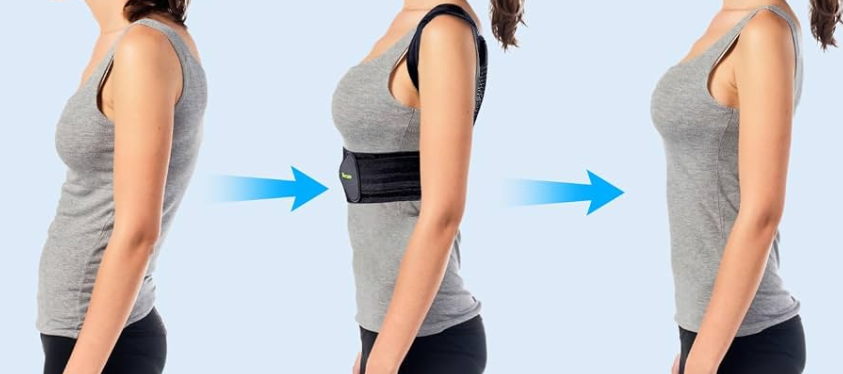
Posture Corrector Before And After: What Really Changes When You Wear One
Those before-and-after shots make posture correctors look dramatic, but the real story has more nuance than product pages let on.
The “Before” Picture: What Poor Posture Actually Looks Like
Rounded shoulders, a forward head, and an exaggerated curve in the upper spine—these are the hallmarks of the “before” state. Look in a mirror or scroll through your own photos and you’ll likely spot the telltale signs: shoulder straps drifting forward, ears sitting ahead of the shoulders instead of stacked above them, and that “collapsed” look through the upper back.
The “During” Picture: Real, But Temporary
Once the brace goes on, the change is immediate. Shoulders get pulled back, the chest opens up, and the head-neck alignment suddenly looks cleaner. It’s satisfying to see. But here’s the catch—this is largely a visual and reminder effect, not permanent structural correction.
The “After” Picture: The Short-Term vs Long-Term Truth
A back brace works while you’re wearing it. What happens after you take it off is a different story.
The Short-Term Evidence Is Actually Pretty Solid
Several small studies back this up. A pilot study on a thoracolumbar brace found that 9 out of 10 participants showed at least one statistically significant posture change, nudging the trunk and hip-knee position toward a more neutral, extended alignment. Another study looking at shoulder and scapular braces found something interesting mechanically: bilateral lower trapezius muscle activity dropped significantly while the brace was on. The brace is doing the supporting work for your muscles, not making them stronger. That raises fair questions about whether wearing a back brace weakens muscles over time if it becomes a crutch.
Even sitting posture responds fast. In one trial, a postural-adjustment brace worn for just 2 hours in an office chair reduced anterior sway and eased the workload on the L3 paravertebral muscles. So yes, the short-term posture brace benefits are real and measurable.
The Long-Term Truth Is Less Encouraging
This is where things fall apart. A 2019 review identified only 11 controlled studies on posture orthoses in otherwise healthy adults—and the quality across them was rated moderate to low, with small sample sizes throughout. There’s little proof that gains stick around once the brace comes off.
The most telling comparison? Brace-only users maintained improvements just 30% of the time at follow-up, compared to 68% for those doing posture correction exercises. That gap points toward strength and motor control work, not passive support.
Think of the brace as training wheels—useful as a cue, not a fix.
Posture correction timeline
| Application conditions | Timeframe | Phase | What to Expect |
| Use only when needed | / | / | How Long Does The Effect Last After Removal? 15 to 60 minutes. Almost as soon as it’s off, your shoulders start drifting back toward their old resting position. |
| Longstanding rounded shoulders or forward head posture often need the full 3-to-6 month window before change holds. | Weeks 1–2 | Reminder Phase | The shoulder posture corrector nudges you into better alignment while worn, but gains vanish almost immediately once removed. |
| Weeks 8–12 | Early Stable Change | More stable change starts to appear, but only if you’ve added targeted work. | |
| Months 3–6 | Habit Formation | New posture habits start feeling automatic instead of forced. |
How Does A Posture Corrector Work: Mechanism Behind The Before-And-After Change
A posture corrector is a passive cueing device. It doesn’t build strength. It taps you on the shoulder every time you slouch.
The physical pull from most straps is weak compared to your body weight. The real work comes from the sensation. The strap tightens against your skin, you feel it, and your brain realizes you’re rounding forward again. That awareness prompts a voluntary reset. It’s feedback.
That’s why before-and-after shots show an instant change. Put one on, and your shoulders retract, chest opens, upper back straightens. The change is real, visible, and immediate. But the device isn’t rebuilding strength, so it only changes posture while it’s on. Take it off, and your body drifts back to its habitual pattern.
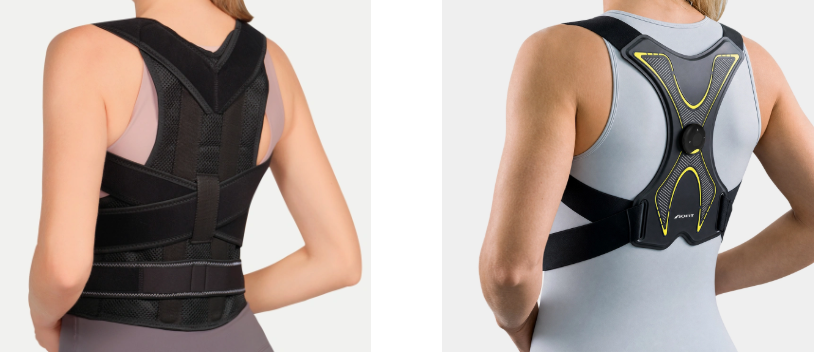
Shoulder Strap vs Upper Back Brace: Different Tools, Different Jobs
Not all correctors work the same way.
A strap-style figure-8 corrector loops over both shoulders and crosses the upper back, gently retracting the scapulae. It works best for rounded shoulders or forward head from desk work.
A full upper back brace wraps more of the thoracic region, giving broader contact and stronger restraint. It’s better for pronounced hunching or thoracic flexion, but it’s meant for short-term support, not all-day wear.
Both types share the same limitation: cueing raises awareness, but passive support also reduces how hard your postural muscles have to work while you’re wearing it. Less effort means less training stimulus. That’s exactly why lasting change requires more than the brace alone.
Risks And Side Effects: Does Wearing A Back Brace Weaken Muscles
The fear that back braces weaken muscles might be overblown. The evidence is less alarming than the internet makes it sound.
What the Research Shows
A systematic review of short-to-mid-term brace use found no support for the claim that back braces cause muscle weakness or atrophy. Another meta-analysis backed this up, finding lumbar brace wear didn’t significantly lower trunk muscle activity during functional tasks. Ultrasound imaging showed similar results: 4 weeks of lumbar brace use showed no measurable atrophy in the abdominal or lumbar muscles. Even longer-term data holds up. A study on adolescents wearing rigid scoliosis braces for 6 months found no significant difference in back muscle strength or endurance. Daily wear time didn’t correlate with weaker muscles either. Some older EMG studies did show fluctuation: trunk muscle activity shifted anywhere from a 9% decrease to a 44% increase depending on brace type, suggesting the effect isn’t a straight line down, just a redistribution of effort.
The Real Risk Is Deconditioning and Dependency
Full-time, long-term wear without any strength training is where theoretical risk creeps in. The brace does part of the stabilizing work, so your muscles and nervous system get less practice taking over. Take the brace off and things can feel unsteady. Three overlapping factors cause this: mechanical substitution, reduced activity levels, and psychological dependency (feeling supported only when the brace is on).
Physical Side Effects Worth Watching
Physical side effects include skin irritation (redness, chafing, rashes, pressure marks, often under armpits and along straps), stiffness (reduced natural movement through the shoulders, neck, and thoracolumbar spine), discomfort (soreness, pressure, fatigue with prolonged or overly tight wear), and reduced flexibility (more common with rigid, all-day designs).
Wear the brace in 2-4 hour intervals, pair it with core and back-extensor training, check your skin daily, and treat “feeling worse after removal” as a signal to train more, not wear more.
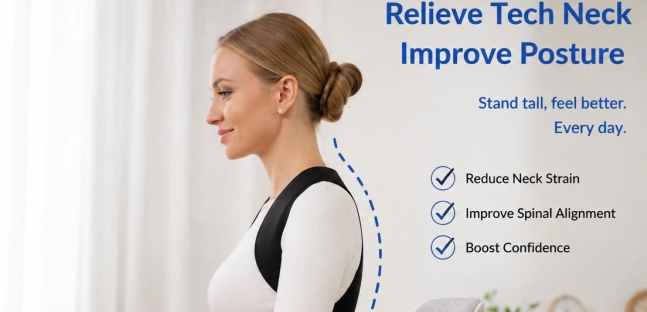
How to Use a Posture Corrector Effectively: Pairing With Exercises for Real Change
Wearing schedules make or break results. Most people either give up in a week or overdo it and end up sore and stiff, no closer to lasting change. The smarter path is to treat the brace as a reminder tool rather than a crutch.
Build Up Wear Time Gradually
Start small. Week 1: 45-60 minutes a day. Week 2: 75-90 minutes. Week 3: 90-120 minutes. By week 4, move toward 2-3 hours daily, capping out around 2-4 hours by week six. Break this into 2-3 sessions timed to your worst posture triggers—desk work, studying, commuting. Never wear it all day, every day. Your muscles need unsupported stretches to actually engage.
Scapular and Core Work That Sticks
Pair every wear session with targeted movement:
- Shoulder blade squeezes: hold 5 seconds, 10-15 reps, 3 sets daily
- Band rows: 3 sets of 12-15, elbows tucked close
- Wall angels: 2-3 sets of 10-15
- Prone Y raises or cobra extensions: 3 sets, holding 30 seconds
For core, the McGill Big 3—plank, side plank, bird-dog—builds the endurance that keeps you upright long after the brace comes off. Add glute bridges and pelvic tilts to support the chain further.
A Sample Day That Works
Try this rhythm. Start with chin tucks and wall angels in the morning. At midday, wear the brace for 30-60 minutes while doing scapular squeezes. In the afternoon, do band rows and planks. At night, chest stretches and bird-dogs. Every 30-45 minutes, stand up, retract your shoulder blades ten times, and reset your posture—chin tucked, ribs down, shoulders gently back.
This combination, the brace plus the exercises, is what actually rewires the pattern.
Not every rounded back is the same problem, and some shouldn’t be treated with a drugstore brace.
Clinical spine braces exist for structural conditions—scoliosis and kyphosis—not casual slouching. Doctors base the recommendation on X-rays and bone maturity (Risser staging), not a glance at your shoulders.
Scoliosis thresholds, according to SRS and SOSORT guidelines:
– Bracing is considered when the curve is over 20-25° and the patient is still growing
– Curves under 15° don’t warrant bracing
– Curves over 40° often need more than a brace to help
Kyphosis thresholds follow the same pattern. Scheuermann’s kyphosis reaches bracing territory around 55-80°, paired with X-ray evidence like vertebral wedging or Schmorl’s nodes.
The Combination That Sticks
Relying on the brace alone rarely produces lasting results once it comes off. Pair it with posture correction exercises, and the picture changes. Scapular stabilization, back extensor strengthening, and deep neck flexor training all help. Those who combine the brace with these exercises retain about 60% of their improvement even after it’s removed.
When to See a Specialist Instead of Ordering Online
Get evaluated if you notice:
– Persistent or worsening back pain, especially at night
– Uneven shoulders or a visibly shifted spine
– Curve progression—an increase of 5° or more within six months
– Adolescent growth combined with a spinal curve approaching 20-25°
If it’s simple fatigue-driven slouching, posture management is fine. If there’s structural deformity or progression, that’s a spine specialist’s job.
Conclusion
The visible change in the mirror—shoulders back, chin lifted—is real, but it’s temporary unless you build the muscle strength to hold that position on your own. Wear it as a temporary support, and check in with a professional if pain or numbness show up.
Looking forward to updating your design and product line with AOFIT, your reliable medical brace manufacturer? Our posture correctors are designed around frustrations. In addition, we offer complete OEM/ODM back braces based on your requirement.