You’re standing in the orthopedic office, ankle throbbing, and the doctor just said five words that changed your next six weeks: “You have a few options.” You’re staring down a choice between a clunky plaster cast and this newer removable walking boot thing, and nobody’s explaining what that means for your actual life. Can you shower? Drive? Go back to work next week? Will one heal faster than the other, or is that just marketing fluff?
The honest answer is it depends—on your fracture type, your lifestyle, and a handful of clinical factors most people never think to ask about. This guide breaks down how walker boots vs plaster casts compare on healing time, daily comfort, cost, and real-world practicality, so you can walk into your next appointment (sorry) with the right questions already in hand.
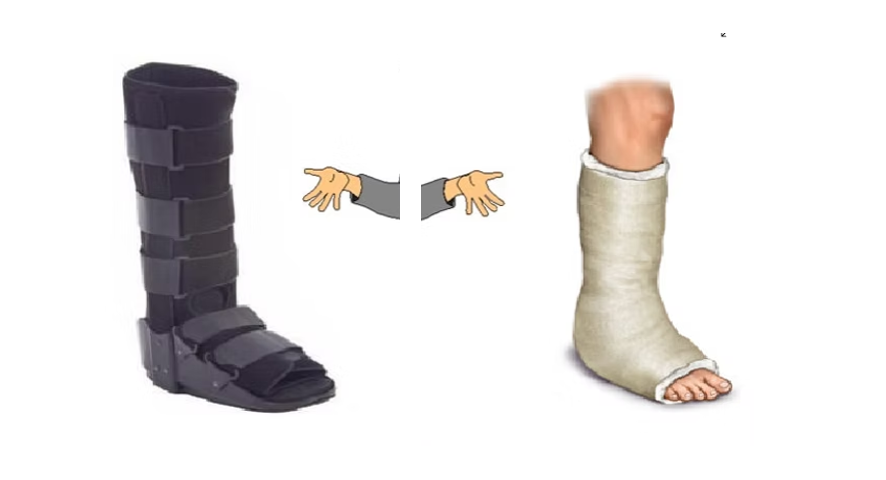
Walking Boot For Broken Ankles: What It Is & How It Works
Picture a ski boot crossed with a medical device, and you’re pretty close to a cam walker boot. It has a rigid outer shell, a removable inner liner, several adjustable Velcro straps, and a rocker-bottom sole that lets your foot roll forward while keeping your ankle locked in place. Some models have inflatable air bladders inside that pump up for extra compression and stability.
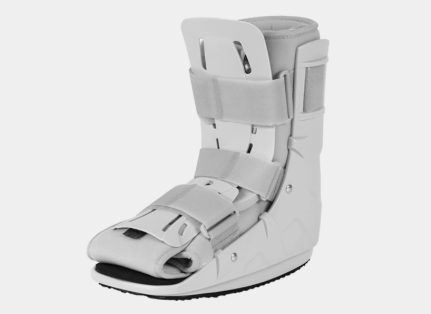
The boot holds your ankle in a protected, near-neutral position, which limits motion right where the bone is healing. No motion, less irritation, better healing.
You can take this boot off to shower, change clothes, sleep, or let your skin breathe. That also means you or a caregiver can check for swelling, redness, or skin breakdown—something a sealed cast doesn’t allow.
Who gets this boot?
Mostly people with stable, non-displaced ankle fractures like medial or lateral malleolus breaks. A Weber A lateral ankle fracture, for example, often means wearing the boot for walking during the first four weeks, with weight allowed through the foot as tolerated.
Putting it on matters more than people expect:
- Start with a clean, smooth, wrinkle-free sock
- Slide your heel all the way back into the liner
- Fasten straps from the forefoot upward
Wear schedules vary. Some clinicians say boot-on-for-walking-only, others want it worn nearly continuously. Expect a different gait too, since the rocker sole shifts weight heel-to-toe. Many patients start with crutches, used on the side opposite the injured ankle, especially if their protocol calls for a strict non-weight bearing phase early on.
Plaster Cast For Broken Ankles: What It Is & How It Works
A below-knee cast is the version most of us picture when someone says “broken bone.” It runs from just under your knee down to your toes, wrapping your ankle and hindfoot in a solid, unyielding shell. There’s no taking it off for a shower or a change of clothes. That’s the point.
The whole mechanical goal is strict immobilization. While your boot-wearing counterpart gets some controlled motion, a plaster cast locks the joint down completely, preventing displacement, rotation, and shear stress at the fracture site while swelling settles and early healing kicks in.

Plaster vs. Fiberglass: Not the Same Material
“Plaster cast” often gets used as a catch-all term, but there are two real options:
- Plaster of Paris: slower to dry (24–48+ hours to fully harden), but it molds beautifully while still soft—ideal when precise shaping matters.
- Fiberglass/resin: sets within a few hours, lighter, more durable for daily wear.
Doctors often lean toward traditional plaster specifically because of that slower set time. It gives them a window to mold the cast precisely around complex fracture-dislocations or unstable breaks where maintaining reduction is critical.
Who Needs This Level of Rigidity?
Plaster casting tends to get recommended for:
- Unstable fracture-dislocations, especially ones involving the ankle joint itself
- Situations where patient compliance is a question mark—a cast doesn’t come off accidentally
- Fractures requiring urgent reduction, where any neurovascular compromise demands tighter post-reduction control
The First 48 Hours Matter
Fresh plaster needs real care:
- Elevate the leg on 2–3 pillows for the first 2–3 days
- Never rest it on hard, flat surfaces while drying
- Keep it bone-dry
- Wiggle your toes often to support circulation
Walker Boots Vs Plaster Casts: Where the Real Differences Show Up
Healing time is about the same. What separates them is function and comfort.
Function
Patients in walking boots scored better on the OMAS (Olerud-Molander Ankle Score) at that 6-week mark, a standard measure clinicians use to track ankle fracture healing stages and quality of life. People in boots were moving better and feeling more capable sooner.
Range of motion showed no major difference overall. But in subgroups, the boot pulled ahead: better dorsiflexion in comminuted fractures and improved plantarflexion among older adults.
| Factor | Walking Boot | Plaster Cast |
| Union/healing rate | ~100% | ~100% |
| Functional recovery (OMAS) | Better at 6 weeks | Lower |
Complication Trade-Off
Boots, because they’re removable, come with more reported skin issues and minor wound complications: straps shifting, pressure points, that sort of thing. Casts, being sealed tight, have almost none of that.
Re-injury rates tend to run higher in cast patients, possibly because the rigid immobilization limits proprioceptive feedback during early healing. Neither device wins outright. It’s a genuine trade-off between skin comfort and structural protection, one worth discussing directly with your orthopedic team based on your specific fracture pattern.
Comfort, Convenience & Daily Life Impact
Six weeks sounds short until you’re the one trying to shower with one leg. This is where the two devices diverge, and it has nothing to do with bone healing.
Showering is the big one. A removable walking boot comes off before you step into the tub, letting you shower normally. A below knee cast has to stay bone-dry, which means waterproof covers, careful leg positioning, and usually a second person helping out. Boot wearers consistently report showering independently. Cast patients more often need help with basic hygiene.
Skin checks follow the same pattern. Take the boot off, and you can actually look at your skin, wash it, dry it properly. Under a cast, you’re blind to what’s happening underneath. That matters a lot if you have diabetes or reduced sensation, where pressure sores can develop unnoticed.
Independence shows up everywhere else too. Interview-based research on recovery found boot-wearers describing easier cooking, carrying drinks, getting in and out of bed, running errands. Cast-wearers described more restriction, more reliance on others. The gap narrows by 12 weeks post-injury. The boot’s advantage is front-loaded into those early, hardest weeks.
Sleep tends to favor the boot too, since most people remove it at night and elevate the leg to reduce swelling. Casts are harder to get comfortable in; patients call them bulky, awkward positions. That said, some fracture patterns require wearing the boot overnight for a week or two regardless.
Driving is a flat no for both devices, especially with right-foot injuries where brake response matters. Left-foot injuries in automatic vehicles sometimes get cleared case-by-case.
Work depends on your job. Desk work pairs fine with a boot. Jobs requiring standing, walking, or lifting don’t suit either device well. Casts restrict more, but a boot doesn’t mean business as usual either.
Boots offer convenience but tempt early weight-bearing; casts force compliance at the cost of comfort.
Cost & Healthcare System Considerations
Sticker shock cuts both ways here. The number you focus on depends on whether you’re looking at the bill or the bigger picture.
In the UK’s NHS system, a removable walking boot runs about £50 compared to £25 for a plaster cast. Partly that’s the device itself, partly the extra staff time needed to fit it properly. Add in follow-up visits over a 12-week window, and the boot costs the health system roughly £88 more per patient than the cast. Straightforward enough.
But widen the lens to include your life—missed work, a family member taking time off to help you shower or get groceries—and the math flips hard. When you factor in those societal costs, the boot saved £676 per patient on average. Fewer productivity losses. Less informal caregiving burden. The upfront price difference nearly disappears against that backdrop.
U.S. pricing tells a similar story, just with bigger numbers. A 2026 cost guide pegs a walking boot between 100–400. A full cast episode—application plus X-ray plus the office visit—lands between 450–1,650 without insurance. Casts also tend to need more follow-up adjustments, each adding 100–200. Boots are patient-adjustable, so they often sidestep some of that.
Casts look cheaper on paper. Boots often save more in practice.
Pros & Cons Summary Table
Sometimes you just want the whole thing at a glance, no backstory, no caveats, just the facts side by side.
| Factor | Walking Boot | Plaster Cast |
| Mobility | Protected weight-bearing, easier daily movement | More restrictive, often non-removable |
| Comfort | Adjustable, better airflow | Heavier, hotter, less forgiving |
| Skin/hygiene | Easy checks, lower pressure-sore risk | Harder monitoring, higher irritation risk |
| Compliance | Depends on the patient | Built-in, forced immobilization |
| Best for | Stable fractures, good compliance | Unstable fractures, poor compliance risk |
That said, a navicular stress fracture often calls for a non-weight-bearing cast for 6–8 weeks, since strict rest matters more than convenience here. Compare that to fifth metatarsal base fractures, where boot-wearers reported less pain between weeks 3 and 12, returned to normal function roughly three weeks sooner, and missed fewer days of work.
How To Choose: Walking Boot Or Plaster Cast For Your Broken Ankle
Five things decide this for you, and none of them are preference. Your surgeon is weighing fracture stability, whether you had surgery, how well you follow instructions, your daily life, and how swollen your ankle is right now.
Boot makes sense when:
– Your fracture is stable and non-displaced, especially an isolated lateral malleolar break
– You can bear weight as tolerated without risking displacement
– You want to shower easily, keep moving a little, or start gentle ankle motion early
BOFAS, the British Orthopaedic Foot & Ankle Society, notes that most ankle fractures seen in clinics are stable enough to skip plaster casting and go straight into a removable walking boot.
Cast makes more sense when:
– The fracture is displaced, there are multiple fractures, or the joint feels unstable
– Your doctor isn’t confident you’ll follow weight-bearing restrictions
– Safe weight-bearing isn’t possible yet, and stricter immobilization is needed to prevent shifting
Kids and anyone unlikely to cooperate with a removable device usually land in a cast too.
What Happens With Acute Swelling
Fresh, swollen ankles typically go into a splint or backslab first, not a full cast. Once swelling drops, your team decides on the final immobilization device.
The Cast-To-Boot Timeline
Most below knee casts run four to six weeks total. NHS guidance often cites six, with reassessment around two weeks once swelling settles. BOFAS protocols for non-surgical, unstable-leaning fractures call for weekly X-rays, with conversion decisions made around six weeks based on healing and stability. MedlinePlus notes broken ankles treated without surgery often need four to eight weeks of fixation, with a walking boot introduced as weight-bearing increases.
Conclusion
There’s no universal winner between walker boots and plaster casts—only what’s right for your fracture, your lifestyle, and your healing timeline. Removable walking boots offer unmatched convenience for stable fractures and shorter-term injuries; below knee casts provide rock-solid immobilization that some complex breaks require. Your ankle fracture recovery time depends heavily on matching the device to the injury.
Bring this comparison to your orthopedic appointment. Ask your doctor directly whether a cam walker boot or traditional cast fits your specific break, your job, and your daily routine.