You pull a pair of compression socks off the shelf and see 15-20 mmHg on the label. It looks like a secret code, leaving you to wonder whether you’re about to buy something useless or something that squeezes too hard.
The abbreviation mmHg stands for millimeters of mercury, a unit of pressure. On compression socks, that number tells you how firmly the fabric hugs your ankle, shaping how they feel and what they can do for tired, swollen legs. What Does Mmhg Mean In Compression Socks? Below, we cover how graduated compression works, what each pressure level means, and which one fits your situation.
What Does mmHg Mean in Compression Socks? (Definition and Ankle Pressure Explained)
mmHg is a pressure unit, and the number on your socks shows how hard they squeeze at the ankle. It is the same unit medical staff use to take your blood pressure. One mmHg equals the pressure generated by a one-millimeter column of mercury.
mmHg Is Not Your Blood Pressure
A reading like 120/80 mmHg measures the force of blood against artery walls. On compression socks, a rating like 15-20 mmHg measures the external pressure the fabric applies to your leg.
They share a unit of measurement, but each does a different job. A “20 mmHg” label does not mean your blood pressure is 20.
Why the Ankle Matters
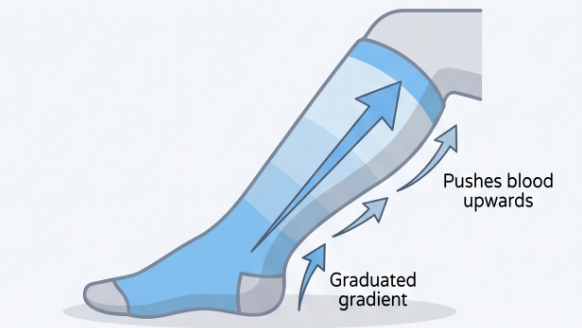
Most medical-grade and graduated compression socks are engineered to fit tightest at the ankle. That pressure eases as the fabric moves up the calf.
- The label number is the target pressure at the ankle alone.
- Medical compression levels reflect resting pressure at the ankle.
- A higher number indicates a tighter sock that takes more effort to pull on.
Tight is not the same as well-fitted. The wrong size, a rolled cuff, or a bunching wrinkle can create constriction spots the manufacturer never intended.
How to Read the Label
Brands describe pressure in a few different ways:
- A range (15-20 mmHg) is the target pressure zone.
- A single number (20 mmHg) is the nominal ankle pressure.
- A word or class (mild, firm, Class 1) can mean different mmHg ranges depending on the brand or country. For example, a U.S. Class 1 is often 20-30 mmHg, while a UK Class 1 can be 14-17 mmHg.
- “Graduated compression” alone doesn’t tell you the real ankle pressure. Check the spec sheet or ask the compression sock manufacturers.
Medical compression classes lack a single global standard. Always check the specific mmHg rating, where it was measured on the leg, and which standard the maker followed.
Common Misunderstandings
- mmHg is not “tightness.” Fit, fabric stretch, and leg size all shape how a sock feels against your skin.
- The whole sock isn’t one number. Peak pressure sits at the ankle and decreases upward.
- Higher isn’t automatically better. The right level depends on your specific needs, your leg shape, and a proper fit.
Graduated Compression: How Pressure Changes From Ankle to Leg
Gravity pulls blood down to your ankles all day, and your veins have to push it back up. Graduated compression gives them a hand.
The design follows the physics. Your lower leg carries the highest hydrostatic pressure, so the sock squeezes tightest at the ankle and eases as it moves toward the heart. That pressure gradient narrows superficial veins, reduces venous blood volume, and helps the calf muscle pump blood upward. Firm compression around the calf is particularly effective at driving that return flow.
What the Gradient Looks Like
Measured ranges from knee-high and thigh-high stockings show how the pressure steps down:
| Leg location | Typical pressure | Relative to ankle |
| Ankle | 25-32 mmHg | 100% |
| Calf | 18-22 mmHg | about 56%-88% |
| Thigh | 10-13 mmHg | about 31%-52% |
A simpler example is a sock rated about 20 mmHg at the ankle and 15 mmHg at the knee, a drop of roughly 25%.
Labels Aren’t Guarantees
Real-world numbers wander. One test of a sock labeled “20 mmHg ankle, 15 mmHg knee” measured 35 mmHg and 29 mmHg. Another recorded 17.5 mmHg at the ankle, 4.4 at the calf, and 6.1 at the thigh. Leg circumference, sock size, positioning, and fabric elasticity all change the fit, making any single data set a rough reference point.
Graduated vs. Uniform Compression
- Graduated socks (medical, travel, varicose vein) peak at the ankle. They aid venous return, control swelling, and ease blood pooling. Common ratings are 8-15, 15-20, 20-30, and 30-40 mmHg.
- Anti-embolism stockings are made for post-surgery or bedridden patients. Their pressure is lighter and distributed more evenly, so they cannot substitute for medical graduated socks.
- Sports sleeves may use localized or non-standard gradients. One tested garment used a 3:4:3 ankle/calf/thigh split of about 15/20/15 hPa, concentrating the squeeze on the calf.
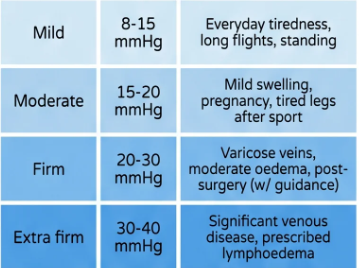
Compression Socks mmHg Chart: 8–15, 15–20, 20–30, 30–40 and 40–50+ Explained
Think of mmHg ratings as a ladder. The higher you climb, the more medical the sock becomes.
| Pressure | Common label | Typical use | Prescription note |
| 8–15 mmHg | Mild, light | Desk days, long standing, travel, post-workout recovery | Sold over the counter for daily support, not treatment. |
| 15–20 mmHg | Mild to moderate | Mild varicose veins, early pregnancy discomfort, flights, light swelling | Available without a prescription, though brand labels vary across this range. |
| 20–30 mmHg | Medium, firm | Noticeable varicose veins, persistent swelling, venous insufficiency | Cleveland Clinic advises getting a prescription or speaking with a clinician for 20 mmHg and above. |
| 30–40 mmHg | Firm, extra-firm | Severe varicose veins, post-thrombotic syndrome, venous ulcers | Medical grade. Use under a doctor’s supervision. |
| 40–50+ mmHg | Very firm | Severe lymphedema, advanced venous disease, complex ulcers | Requires specialist assessment, a prescription, and professional measurement. |
The Simple Clinical Shortcut
Clinicians often group pressure into three bands:
- Low: under 20 mmHg
- Medium: 20–30 mmHg
- High: over 30 mmHg
Don’t Trust the Marketing Word
“Firm” is the slipperiest label on the shelf. Some U.S. brands use it for 20–30 mmHg, while others use it for 30–40 mmHg. Always check the actual mmHg number.
Country standards add another layer:
- UK BS 6612: Class 1 is 14–17, Class 2 is 18–24, Class 3 is 25–35 mmHg.
- European RAL: Class 1 is 18–21, Class 2 is 23–32, Class 3 is 34–46, Class 4 is about 50+ mmHg.
A “Class 2” sock under BS does not match a “Class 2” under RAL. When comparing products, check the pressure range, the standard used, the ankle pressure, the sizing method, and whether the compression is graduated.
Who Needs a Prescription?
The rules vary by region:
- United States: You can buy some 15–20 and 20–30 mmHg socks over the counter. Medical-grade, custom, and 40+ mmHg socks require a prescription or professional fitting.
- United Kingdom: The NHS decides based on your condition, arterial circulation checks, and the severity of swelling or wounds. Class 2 and above follow a clinical pathway.
- Other European countries: RAL is a manufacturing standard, not a prescribing rule. Each country sets its own policies for prescriptions and reimbursement.
- 40–50+ mmHg anywhere: Treat this as specialist compression therapy, requiring professional measurement and an arterial circulation check first.
What mmHg Compression Socks Do: Benefits at Each Pressure Level
Compression socks manage symptoms rather than curing underlying vein disease. Keep that in mind, and the pressure ratings make sense.
The gradient squeezes tightest at the ankle and eases toward the knee, lowering venous reflux and the pressure that builds while you walk. That takes the edge off heaviness, aching, fatigue, and calf swelling. Compression also helps reduce pain, cramping, and ankle swelling.
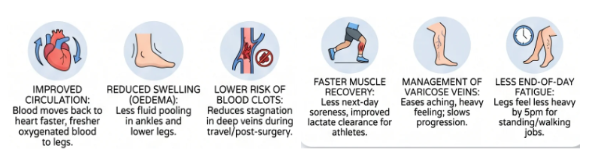
Real-world use sits around 37%, according to one review. Fit, comfort, and consistent daily wear decide how much relief you actually get.
| Pressure | Possible benefits | Evidence and cautions |
| 8–15 mmHg | Light support for tired, mildly swollen legs after sitting or standing. | Evidence is weak and study results vary, though some reviews suggest 10–15 mmHg helps chronic venous insufficiency. |
| 15–20 mmHg | Minor varicose veins, light swelling, and support during travel or desk work. The American Heart Association lists this as a standard range for mild symptoms. | Eases discomfort, but cannot be counted on to prevent or treat every clot. |
| 20–30 mmHg | Moderate swelling, visible varicose veins, venous insufficiency symptoms, post-surgery recovery, and long flights. | Travel trials frequently test 10–20 or 20–30 mmHg. |
| 30–40 mmHg | Larger varicose veins, moderate-to-severe venous insufficiency, marked swelling, and some post-thrombotic syndrome. | Requires professional checks for fit, pressure, and arterial circulation. Difficult to wear over the long haul. |
| 40+ mmHg | Severe cases, wound care, and lymphedema. | Requires a prescription and medical monitoring. |
What the Research Says About Varicose Veins
A Cochrane review found too few trials to confirm whether socks alone treat early varicose veins. Across studies using pressures from 10 to 50 mmHg, no specific level or style came out ahead. Right now, socks remain promising for symptom relief, unproven for stopping progression.
For uncomplicated varicose veins without ulcers, socks offer conservative symptom care. They do not replace a full vascular assessment, regular exercise, leg elevation, or clinical procedures when needed.
Travel, Sitting, and Standing
The strongest evidence points to travel. Cochrane pooled 9 trials covering more than 2,800 passengers on flights lasting at least 7 hours. Passengers wearing compression socks reported less leg discomfort and swelling, along with far fewer silent deep vein clots. Swelling improved by a mean difference of −4.72 (95% CI −4.91 to −4.52), though the certainty of that evidence remains low.
Light to moderate pressure can ease fatigue, heaviness, and mild swelling during long desk shifts or hours on your feet. The data here is thinner, so these socks will not guarantee better circulation or prevent clots.
On long trips, combine socks with periodic walking, ankle pumps, water, and posture changes. Anyone with a high clot risk, a past clot, or a single leg that is swollen and painful should speak with a doctor first.
What mmHg Compression Socks Do I Need? Recommendations by Condition and Lifestyle
For most people, 15-20 mmHg is the right place to start. Move up only when your symptoms or your doctor tell you to.
The table below matches common situations to a pressure rating.
Recommendations by Situation
| Situation | Typical pressure | Practical recommendation |
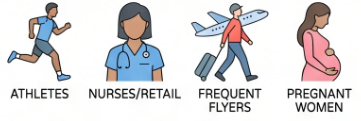
| Desk work, commuting, air travel | 15-20 mmHg | A solid starting point for tired legs, mild ankle swelling, and long hours in a seat. Consider 20-30 mmHg for long flights if you carry a higher risk of DVT. |
| Nurses, teachers, retail and hospitality staff | 15-20 mmHg | Daily support for leg fatigue, aches, and mild swelling caused by long shifts on your feet. |
| Pregnancy with heaviness, mild swelling, or small varicose veins | 15-20 mmHg | The most comfortable starting point. With clinical guidance, step up to 20-30 mmHg for more pronounced edema or varicose veins. |
| Exercise, running, recovery, sports travel | 15-20 mmHg | Relieves leg fatigue and post-workout soreness. Reserve 20-30 mmHg for managing verified swelling or diagnosed venous disease during recovery. |
| Occasional mild swelling or early spider veins | 15-20 mmHg | Fits mild symptoms tied to long stretches of sitting, standing, or travel. |
| Early varicose veins with persistent symptoms | 20-30 mmHg | A better choice when 15-20 mmHg fails to keep swelling down. |
| Diagnosed chronic venous disease, moderate swelling, phlebitis | 20-30 mmHg | Standard medical-grade compression. A professional fitting ensures the socks fit safely and work properly. |
| After DVT or post-thrombotic syndrome | 20-30 mmHg; 30-40 mmHg may be prescribed | Follow your clinician’s instructions on pressure level and wear schedules, particularly during acute DVT. |
| Severe edema, large varicose veins, venous skin changes | 30-40 mmHg | Firm compression requires medical evaluation, exact sizing, and routine monitoring. |
| Venous leg ulcer, healed ulcer, severe post-thrombotic disease, lymphoedema | 30-40 mmHg or higher | Use under the direct care of a wound or vascular specialist. Many cases require multilayer wrap systems or specialized garments. |
15-20 mmHg vs. 20-30 mmHg: Which One Fits?
These two ratings cause the most confusion. Here is how they compare.
| Factor | 15-20 mmHg | 20-30 mmHg |
| Pressure feel | Light to moderate, easy to keep on all day | Noticeably tighter, particularly around the ankle |
| Best for | Healthy adults, office workers, travelers, standing shifts, mild pregnancy swelling, sore athletes | Persistent edema, varicose veins, chronic venous insufficiency, high-risk travel, post-DVT recovery |
| Swelling control | Manages mild puffiness and prevents daily fluid buildup | Controls moderate or persistent fluid retention |
| Comfort | Easy for beginners to tolerate right away | Can pinch or bind if sized incorrectly or worn without medical need |
| On and off | Pulls on with minimal effort | Requires a firm grip and careful technique to slide over the heel |
| When to step up | Stay here if your legs feel fine and swelling stays minimal | Move up when lighter socks fail to relieve swelling or a doctor diagnoses venous disease |
Clinical guidelines classify 15-20 mmHg as light support for tired legs, minor varicosities, and occasional fluid buildup. They treat 20-30 mmHg as medical-grade compression suited for moderate swelling, established varicose veins, and chronic venous disease.
The rule of thumb: start at 15-20 mmHg for lifestyle-related symptoms. Move to 20-30 mmHg when swelling persists, resists lighter pressure, or comes with an official medical diagnosis.
Get the Fit Right Before You Chase a Number
Pressure alone can’t make up for a poor fit. A few habits help:
- Measure your ankle and calf circumference, ideally in the morning. Then match the results to the manufacturer’s size chart.
- Put your socks on first thing, before swelling builds.
- Smooth out wrinkles and never fold the top band.
When to Talk to a Doctor First
Get medical advice before wearing compression if you notice any of these:
- Suspected acute DVT
- Sudden swelling in one leg
- Severe pain
- Skin discoloration
- Numbness
- Known significant arterial circulation disease
Socks at 30-40 mmHg and above should be prescribed or supervised. That applies to severe edema, ulcers, significant venous disease, lymphoedema, and post-thrombotic syndrome.
Conclusion
The numbers on the package—15-20 mmHg, 20-30 mmHg, or higher—measure pressure in millimeters of mercury. This rating reflects the force the sock applies at your ankle before easing as it moves up your leg. Higher numbers mean firmer compression, which is not always what you need. The right level depends on your situation, whether that is a long flight, a long shift, or venous insufficiency. A snug, accurate fit matters as much as the rating itself.
Match your needs to the chart, measure your ankle and calf, and start with the lowest level that fits your goal.