Whether compression socks are good for diabetics sounds like a simple question until you are the one choosing what goes into your catalogue, onto a pharmacy shelf, or onto a product label. Diabetics can wear them safely, but only within a narrow window. They require gentle pressure, thoughtful construction, and a clinician’s check on circulation and sensation first. Get that balance wrong, and a sock meant to support can leave marks on fragile, less sensitive skin. Are Compression Socks Good For Diabetics? From here, you’ll see which compression levels make sense, who should be steered away, and how diabetic socks differ from standard compression styles.
Can Diabetics Wear Compression Socks Safely?
Safety depends on the condition of the arteries. People with diabetes can safely wear compression socks to manage leg swelling or venous disease once a clinician evaluates circulation, skin integrity, and nerve health. In fact, one clinical study reported zero compression-related adverse events in screened patients with diabetes or peripheral artery disease.
Mild Pressure Has the Best Evidence
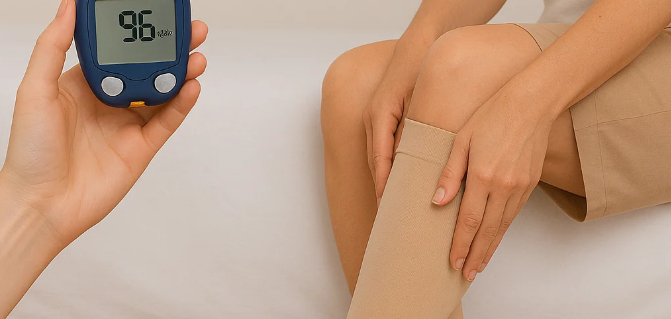
A randomized trial showed that 18-25 mmHg reduced lower-leg swelling without compromising blood flow in diabetic patients with lower limb edema. None of the participants developed skin lesions, ulcers, gangrene, pressure marks, numbness, or tingling. Stronger 30-40 mmHg compression is usually reserved for diagnosed venous disease or active ulcer prevention rather than routine self-treatment.
Check the ABI Before Compression
Pairing compression therapy with peripheral artery disease requires caution. An ankle-brachial index (ABI) test provides the initial baseline:
- 0.8-1.3: standard compression is usually acceptable.
- 0.5-0.8: light compression only, often up to 30 mmHg, under clinician supervision.
- Below 0.5: avoid higher pressure and get a vascular evaluation.
- Above 1.3-1.4: stiffened arteries can distort the reading, so measure toe pressure or the toe-brachial index next.
Neuropathy Raises the Stakes
Diabetic neuropathy demands extra vigilance. Reduced sensation can easily hide tight spots, friction, and early blisters before a patient feels them. Anyone with severe sensory loss needs professional oversight before wearing compression garments.
When to Say “See a Clinician First”
Active ulcers, infection, gangrene, rest pain, severe neuropathy, untreated heart failure, and sudden, worsening swelling require a medical evaluation before use. Make sure these clear warnings appear on your labels and product pages.
A Simple Safety Routine
- Start with properly fitted 15-25 mmHg, unless a clinician advises a different pressure level.
- Choose seamless, non-binding socks that will not bunch or roll down.
- Put them on first thing in the morning before swelling builds.
- Check feet daily for redness, blisters, or pressure marks.
- Remove them immediately if you notice new pain, numbness, coldness, or pale or bluish toes.
- Do not sleep in them unless a doctor explicitly tells you to.
Compression Levels, ABI Thresholds, and Suitable Use Cases
Compression classes are not interchangeable, and the number on the label makes sense only alongside the patient’s ABI. Pressure peaks at the ankle and tapers toward the knee or thigh. The actual pressure delivered depends on garment fit, limb shape, fabric stiffness, patient mobility, and daily wear time.
Compression Classes at a Glance
| Class | Typical pressure | Common use | ABI guidance |
| Light / modified | Up to 30 mmHg | Mixed venous-arterial disease, mild edema, selected lymphedema | ABI 0.5-0.8, after clinical assessment |
| Class 1 | 20-30 mmHg (U.S.) | Varicose veins, symptomatic venous disease | ABI 0.8-1.3 |
| Class 2 | 30-40 mmHg (U.S.); about 23-32 mmHg (German) | Chronic venous insufficiency, edema, venous ulcer support | ABI ≥0.8 |
| Class 3 | 40-50 mmHg (U.S.); about 34-46 mmHg (German) | Severe venous hypertension, venous leg ulcers | ABI ≥0.8, with correct fitting |
| Class 4 | 50-60 mmHg (U.S.); above 49 mmHg (German) | Refractory edema or ulcers under specialist care | Not for significant arterial disease |
For diabetic lines, stick to the lighter end. Classes 2-4 belong in clinical practice, not on retail shelves.
Reading ABI Results
- 0.9-1.3: Blood flow is adequate. Use standard compression if clinically indicated.
- 0.5-0.8: Indicates mixed venous and arterial disease. Keep compression modified to 30 mmHg or less, monitor tolerance closely, and involve vascular or wound-care specialists.
- Below 0.5: Severe ischemia. Do not apply compression until a vascular surgeon evaluates the limb.
- 0.4 or lower: Critical ischemia with limb risk. Avoid all compression and arrange an urgent vascular consult.
- Above 1.3: Arteries may be calcified and incompressible, making the reading unreliable. Check toe pressures or get a specialist evaluation before prescribing.
Matching Pressure to the Situation
- Varicose veins, no ulcer: 20-30 mmHg is the typical starting range.
- Chronic venous edema: 20-40 mmHg, titrated to limb swelling, skin condition, mobility, and ABI.
- Venous leg ulcer, ABI ≥0.8: High compression, targeting 40 mmHg or more at the ankle.
- Venous leg ulcer, ABI 0.5-0.8: Reduced compression, staying below 30 mmHg.
- Lymphedema, ABI 0.5-0.8: Cap sustained pressure at 25 mmHg under specialist supervision.
- ABI below 0.5 or above 1.3: Assess arterial status before choosing any compression product.
Contraindications of Compression Therapy in Diabetic Users
Diabetes by itself does not rule out compression therapy. The danger comes from complications that frequently accompany it, such as severe arterial disease, critical limb ischemia, serious nerve damage, and fragile tissue.
Hard Stops
Do not apply compression when any of the following are present:
| Finding | Implication |
| Ankle systolic pressure <60 mmHg | Contraindicated |
| Toe pressure <30 mmHg | Contraindicated |
| TcPO₂ <20 mmHg | Contraindicated |
| Gangrene, untreated arterial ulcers, or rapidly worsening ischemic tissue | Contraindicated |
Severe diabetic neuropathy with major sensory loss also rules out treatment, particularly when the patient cannot feel a pressure injury developing. Microangiopathy with a documented risk of skin necrosis is another barrier, as is decompensated heart failure, where increased venous return can worsen congestion.
Why Pulses and ABI Alone Can Mislead
Do not rely on palpable foot pulses. Calcified ankle arteries in diabetic patients resist the cuff and frequently produce a falsely normal ABI. If the reading is above 1.3, check a toe-brachial index, toe pressure, Doppler waveform, skin perfusion pressure, or TcPO₂ instead. When toe pressure is above 30 mmHg, selected patients can be considered for modified compression of 40 mmHg or less, provided they are monitored closely.
Pre-Fitting Checks and Risk Controls
Before fitting, a clinician should check for:
- Loss of protective sensation
- Callus, deformity, or Charcot foot
- Existing ulcers or infection
- Fragile, swollen skin and pressure points
Preventing foot ulcers also depends on how the garment fits. Watch for wrinkles, tight bands, rolled edges, and focal pressure over bony areas. Inspect the feet daily. Stop use and seek urgent assessment if pain, pallor, blue toes, coldness, numbness, blistering, or darkening skin appears.
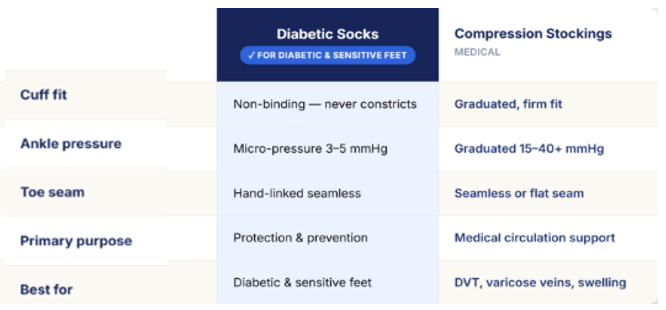
Diabetic Socks vs Compression Socks: Product Parameter Comparison
On a shelf, a diabetic sock and a compression sock look almost identical, but they serve opposite purposes. One protects vulnerable skin by avoiding pressure, while the other applies measured pressure to support circulation.
| Parameter | Diabetic socks | Compression socks |
| Design goal | Reduce friction, moisture, and constriction | Support venous return and ease swelling |
| Pressure | Non-binding, about 0-8 mmHg; some marketed up to 8-15 mmHg | Graduated: tightest at the ankle, looser toward the calf |
| Pressure grades | Usually not sold by mmHg grade | 8-15 light, 15-20 mild, 20-30 firm, 30-40 medical-grade, 40+ specialist |
| Top band | Wide, soft, non-binding cuff | Elastic band that holds position; too tight creates a constriction point |
| Toe | Seamless or flat-seam | Varies; fit and pressure come first |
| Footbed | Often padded to redistribute plantar pressure | May be cushioned; leg compression is the main feature |
| Moisture | Wicking or absorbing yarns are a key spec (bamboo, cotton blends, acrylic, merino) | A comfort feature, not the core spec |
| Fit | More forgiving, but still smooth and wrinkle-free | Needs accurate sizing; wrong size changes delivered pressure |
What the Materials Tell You
In a review of seven commercial diabetic socks, 6 of 7 used cellulose fibers and 5 of 7 contained more than 90% cotton. All 7 contained Lycra. Compression socks instead rely on high-recovery elastic fibers to maintain a consistent pressure gradient.
Procurement Checklist
- Diabetic socks: non-binding cuff, seamless or flat toe, padded sole, moisture-wicking or antimicrobial yarn, low internal seam height, non-irritating dyes, wide size range.
- Compression socks: declared mmHg class, graduated pressure, ankle and calf size chart, pressure testing method, fabric recovery, reinforced heel and toe, skin-safe top band.
The Selection Rule
Choose diabetic socks when foot protection, low friction, and minimal constriction come first. Choose compression socks when you need a defined mmHg profile to manage swelling or support venous care.
A non-binding diabetic sock cannot replace measured compression hosiery, since it will not control significant edema. Conversely, firm compression socks can aggravate feet that need friction reduction above all else. Select pressures of 20-30 mmHg and higher with clinical guidance; socks in the 30-40 mmHg range require direct medical supervision.
Design Specifications for Diabetic-Friendly Compression Socks
A good diabetic-friendly sock comes down to small design choices, each protecting skin that cannot always sense injury. Here is what to put on the spec sheet.
Pressure Profile
- Compression shape: Graduated, with the highest pressure at the ankle and decreasing toward the calf.
- Core retail range: Graduated compression of 8-15 mmHg is the standard range for everyday diabetic socks.
- Clinician-directed options: Mild compression of 15-20 mmHg for patients needing extra edema control. Sigvaris Specialty Diabetic Compression Socks, for example, are manufactured at 18-25 mmHg.
- 20-30 mmHg and above: Reserve for diagnosed venous disease, significant edema, lymphedema, or post-treatment recovery under clinical supervision.
- 30-40 mmHg: Do not position this for direct consumer purchase. A published smart-sock prototype (tracking temperature, plantar-pressure, and blood-oxygen sensors) uses this pressure, but it serves as a research benchmark rather than a retail spec.
Foot Construction
- Toe box: Seamless, hand-linked, or flat-seam, paired with a wide forefoot and extra vertical depth to clear bunions, hammertoes, and swelling.
- Cushioning: Targeted padding under the heel and the ball of the foot, kept thin enough to preserve normal shoe fit.
- Interior: Low-friction surfaces and yarns that stay flat instead of bunching.
- Easy removal: Socks must come off without a struggle. Daily foot inspection, especially between the toes, is central to foot ulcer prevention.
Cuff and Sizing
- Cuff: A wide, soft, non-binding band that holds position without rolling down or leaving a ring on the leg. Avoid narrow elastic bands.
- Size inputs: Base sizing charts on ankle circumference, calf circumference, foot length, and lower-leg height. Shoe size alone will cause fit failures.
- Fit: Zero fabric bunching while walking, with enough give to pull on and off smoothly.
Fabric and Materials
- Moisture control: Select moisture-wicking technical yarns such as drirelease, CoolMax-type polyester, merino wool, or bamboo blends. Do not use 100% cotton as the primary fiber. Require laboratory verification for any antimicrobial claims from the mill.
- Sample blend: One proven commercial blend uses 76% drirelease (65% polyester, 11% cotton), 19% nylon, and 5% spandex, built without latex.
- Latex-free: Specify latex-free synthetic elastics and state this clearly on retail packaging.
- Ventilation and durability: Knit open mesh over the instep, and reinforce heels and toes without adding interior seams.
Documentation to Include
Record pressure in mmHg, test the gradient between ankle and calf, and supply wash-and-care directions that preserve the elastic yarns. Print an explicit recommendation that wearers consult a physician first if they have neuropathy, active ulcers, peripheral arterial disease, or sudden swelling.
Recommended retail positioning: 8-15 mmHg, seamless toe, non-binding cuff, moisture-wicking, cushioned sole, latex-free, wide toe box, and measured sizing.
Size Measurement and Fit Control Before Product Selection
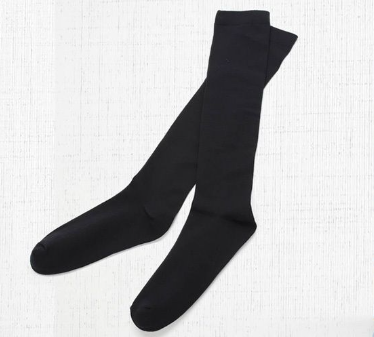
A nominal S/M/L label tells you almost nothing about fit. Base your selection on body measurements instead of product dimensions. ISO 8559-2 defines sizing around the wearer’s body, requiring manufacturers to designate a primary dimension (PD) and optional secondary dimensions (SD) in centimetres. For hosiery, the standard allows height, weight, or both. In practice, pair those values with the ankle, calf, and foot measurements already on your spec sheet. A sock that is a size too small will not stay non-binding, no matter how gentle its rated pressure.
Measurement Control Steps
ISO 8559-1 provides standard measurement definitions. A few consistent habits keep the data reliable:
- Measure over close-fitting clothing or underwear.
- Keep the tape firm without compressing the skin.
- Measure both sides, since legs and feet are rarely identical.
- Record to the nearest 0.5 cm or 0.25 in.
- Repeat any measurement that shifts by more than 1 cm.
- Use the larger measurement whenever the product has limited stretch.
For footwear fitted over diabetic socks, measure each foot while standing, ideally at the end of the day. Take the heel-to-longest-toe length and forefoot width at the widest point, then size to the larger foot. Columbia’s published method, for example, recommends choosing the closest larger chart value.
The Fit Decision Rule
Compare every measurement against the supplier’s product-specific chart. If measurements fall across different sizes, follow the product’s fit priority. Size up for low-stretch items. For elastic products, pick the size whose key measurement sits safely within the chart interval. Always confirm whether the chart lists body or finished-product measurements, as the two are not interchangeable.
Supplier Verification Checklist
- Request the full body-measurement chart in centimetres.
- Identify the PD and SD for the exact product.
- Ask for tolerance limits on each measurement.
- Confirm whether values are taken relaxed, stretched, flat, or on-body.
- Request a graded spec for every size, not just the sample size.
- Fit-test the smallest, midpoint, and largest target measurements on a physical sample.
- Record any deviations from the approved spec before bulk sign-off.
Put the policy in writing so product selection always rests on standardized body measurements, a product-specific size chart, and documented tolerances.
Conclusion on Are Compression Socks Good For Diabetics
Compression socks work well for diabetics as long as the pressure stays gentle and a clinician checks the ankle-brachial index (ABI) and nerve sensation first. Stick to mild compression around 8-20 mmHg, and treat severe peripheral artery disease or a low ABI as clear warnings that belong on your labels.
The rest comes down to practical details like seamless toes, non-binding tops, moisture-wicking antimicrobial yarns, a cushioned sole, and a size chart that helps prevent tight, marking fits. Add honest, claim-safe wording, and you have a product your customers can trust.
Ready to turn this checklist into a real product line? Request samples, ask about MOQ, or share your custom compression socks ideas with us, and we’ll help you shape it.