Compression socks and calf sleeves handle different jobs, and the right pick depends on who buys from you. Socks cover the foot and ankle, while sleeves stop at the calf. That single difference shapes pressure levels, materials, pricing, and how often a box comes back marked “didn’t fit.” If you’re weighing compression socks vs sleeves for a new line or a fuller catalog, this breakdown covers functional differences. It also matches each product to runners, nurses, travelers, and recovery patients.
Compression Socks vs Sleeves: Material and The Functional Difference
A sock has more failure points than a sleeve. Adding a foot brings a heel, toe, instep, and sole into play, and every one of those zones influences fit and pressure.
Materials and construction
| Dimension | Compression Socks | Compression Sleeves |
| Coverage | Foot, ankle, and calf, with continuous compression working up from the foot | Calf only, leaving the foot and ankle exposed |
| mmHg compression levels | Graduated: 8–15, 15–20, 20–30, and 30–40 mmHg, with pressure concentrated at the ankle | 12–14, 15–20, 20–30, and 21–26 mmHg. Confirm whether the rating applies to the entire sleeve or a single zone |
| Best-fit use | Travel, long shifts on your feet, daily swelling, and circulation support. OEM suppliers pitch 15–20 mmHg for travel and workday wear, and 20–30 mmHg for firmer athletic recovery | Running, cycling, calf recovery, shin-splint relief, and sports where athletes want bare feet |
| Footwear and donning | Adds fabric inside the shoe and takes real effort to pull on, especially at 20–30 or 30–40 mmHg | Leaves shoe fit untouched and pulls on quickly, though tight bands can roll or slide down if sizing is off |
| Sizing risk | Demands accurate foot, ankle, and calf measurements. A bad ankle fit ruins the graduated compression profile | Relies on calf circumference and sleeve length. One 15–20 mmHg model spans calf sizes from 11 to 20 inches |
| Materials | Covered elastane/Lycra, nylon or polyamide, cotton/microfiber, and moisture-wicking blends | Nylon/spandex blends such as 85/15 and 77/23. Seamless, breathable knits with anti-slip bands are standard |
| Price signals | Custom pricing tracks your target mmHg, length, elastane ratio, and knit specs. Suppliers quote after knitting samples and checking pressure | Retail listings run from about $4 for three pairs up to $14.95 for a single performance pair, $19.99 for three pairs, and $24.99 for a branded 15–20 mmHg sleeve |
| OEM complexity | You set the compression bracket, length, yarn blend, and knit structure, then verify the pressure curve with lab samples | Simpler to develop for private-label sports lines. You define calf range, length, cuff build, anti-slip finish, yarn blend, and target mmHg |
| Claims and certification | Medical-grade claims require verified test data. One supplier notes they can knit 30–40 mmHg to spec, but the buyer holds legal responsibility for certification | Never trust “medical grade” marketing copy without test proof. One 21–26 mmHg sleeve cites Swiss MST IV testing, while competing listings provide no standard at all |
| MOQ | Depends on the factory. Ask for separate minimums on stock blanks, custom dye lots, custom pressure profiles, woven labels, retail packaging, and certification runs | Follows the same quoting structure. Retail multipack listings do not reflect factory production minimums |
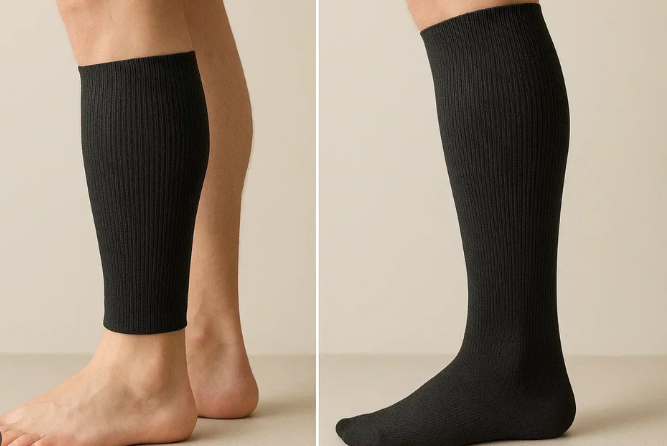
Knee-high compression socks cover the foot, ankle, and calf, with some versions reaching the thigh. They apply graduated compression starting at the ankle and moving upward, which supports venous return and controls swelling in the lower leg and foot.
A calf compression sleeve covers the calf. It focuses on muscle support and localized blood flow, letting wearers stay in their own shoes and socks.
Sleeves are also simpler to manufacture. They use a straightforward tube design, while socks demand dedicated foot sizing, toe construction, heel placement, and shoe clearance.
Choose socks when the brief calls for:
- Foot and ankle swelling control
- Graduated compression starting at the ankle
- Medical, pharmacy, or clinical-channel distribution
- Open-toe or closed-toe variants
- A complete, standalone wearable solution
Choose sleeves when the brief calls for:
- Calf-only compression
- Compatibility with preferred running, cycling, or work socks
- Easy changes during training or recovery
- Fewer foot-related fit complaints
- A unisex accessory SKU with simpler merchandising
Don’t treat a sleeve as a direct substitute for a sock in medical claims. Leaving the foot and ankle uncovered changes the compression profile and narrows what the product can functionally deliver.
Compression Socks vs Sleeves for Running, Teams, and Athletic Recovery
Compression gear will not make runners faster. A systematic review found no statistically significant average improvement in marathon, 15-km, 10-km, 5-km, or sprint performance, along with no measurable changes in oxygen uptake, blood lactate, or cardiac response. A 2025 study on running socks reached the same verdict, reporting very low- to moderate-certainty evidence of no benefit over standard socks during a run.
What the research does show are modest gains in running economy, lactate clearance, perceived effort, post-run muscle power, and muscle-damage markers. The benefits were clearer for post-exercise soreness and delayed fatigue. Market these products around comfort, perceived support, reduced swelling, warmth, and recovery. Avoid promising faster race times.
How socks and sleeves split by use case
| Use case | Compression socks | Calf sleeves |
| Running | Full foot coverage, ankle-to-calf graduated pressure, blister prevention, and swelling control | Calf support that lets athletes keep their preferred socks and footwear |
| Team sports | Great for travel, tournaments, and recovery between matches; full coverage eliminates sock-stacking issues | Slide cleanly under team socks and shin guards, making them easy to swap between games |
| Athletic recovery | Knee-high pressure supports the foot and lower leg, typically sold at 20–30 mmHg | Targets calf fatigue, muscle vibration, and heavy legs while leaving the feet free |
| Heat and footwear | Extra material in the shoe can make footwear feel tighter and warmer | Lighter coverage with better ventilation and shoe-fit flexibility |
| Logistics | Sizing must match shoe size, foot length, calf circumference, and team uniform rules | Sizing depends only on calf circumference and sleeve length |
Compression Socks or Calf Sleeves for Nurses, Travel, and Daily Standing
A 12-hour shift tells you more about a compression garment than any spec sheet. Nurses, flight crews, and frequent travelers need support that holds up all day without becoming a distraction. For this group, choosing between compression socks vs sleeves comes down to pressure level and footwear.
Match the mmHg level to the job
- 15-20 mmHg: Entry-level support for travel, commuting, daily standing, and mild leg fatigue. Listings for knee-high 3-pair packs pitch this range at nurses, flyers, cyclists, and everyday wearers.
- 20-30 mmHg: Firmer graduated support for 12-hour nursing shifts, prolonged standing, swelling, and frequent travel. Most listings concentrate the tightest compression at the ankle and ease pressure upward.
- Calf sleeves: Footless versions come in 15-20 and 20-30 mmHg. They suit wearers who want to keep their own work shoes and socks.
Compression Socks vs Sleeves for Post-Surgical and Venous Health Applications
In clinical practice, published evidence dictates whether to use socks or sleeves. Graduated stockings have clinical trial data behind them; sleeves mostly lack it.
What the evidence supports
– A 12-study review found graduated compression stockings cut postoperative venous thromboembolism risk by 68% in moderate-risk surgery.
– Across 19 studies and 2,693 participants, DVT occurred in 9.8% of patients with stockings versus 21.2% without them.
– Orthopedic evidence is weaker. One eligible study showed an odds ratio of 0.50, but the result was not statistically significant.
Pressure ranges buyers should know
– 15–20 mmHg: mild symptoms
– 20–30 mmHg: mild to moderate venous insufficiency
– 30–40 mmHg: edema, post-thrombotic disease, or more severe venous disease
Pressures above 40 mmHg rarely work for routine long-term wear because patient tolerance drops off quickly.
Where each product fits
Socks and stockings treat postoperative prevention, foot or ankle edema, and established venous disease. A sleeve leaves out the ankle, which is the key distal compression point.
Sleeves make sense when a wound dressing blocks a full stocking, the patient cannot tolerate covering the foot, or edema fluctuates. Intermittent pneumatic compression sleeves belong to an entirely separate device category.
Never position a passive sleeve as a substitute for a prescribed graduated stocking.
Safety points for labeling and sizing guides
- Screen for peripheral arterial disease before recommending moderate or high compression.
- Measure ankle, calf, and limb length accurately. Poor sizing can create a tourniquet effect.
- Check skin and incisions daily.
- Remove and reassess if the patient experiences pain, numbness, discoloration, or coldness.
Conclusion
Deciding between footless compression socks and a calf compression sleeve depends on who you sell to. Runners and teams, nurses and travelers, and post-surgical and venous-health buyers each lean a different way.
Take three things into your next review meeting:
- Start with the customer, then build the SKU mix around them.
- Settle your mmHg compression levels and your medical-versus-athletic claims before you commit. That’s where return risk lives.
- Run any factory through the OEM/ODM compression socks capability check before you place an order.
Use the comparison table and SKU combinations as your internal checklist, then ask aofitmed.com for samples, a specification sheet, or a quotation.