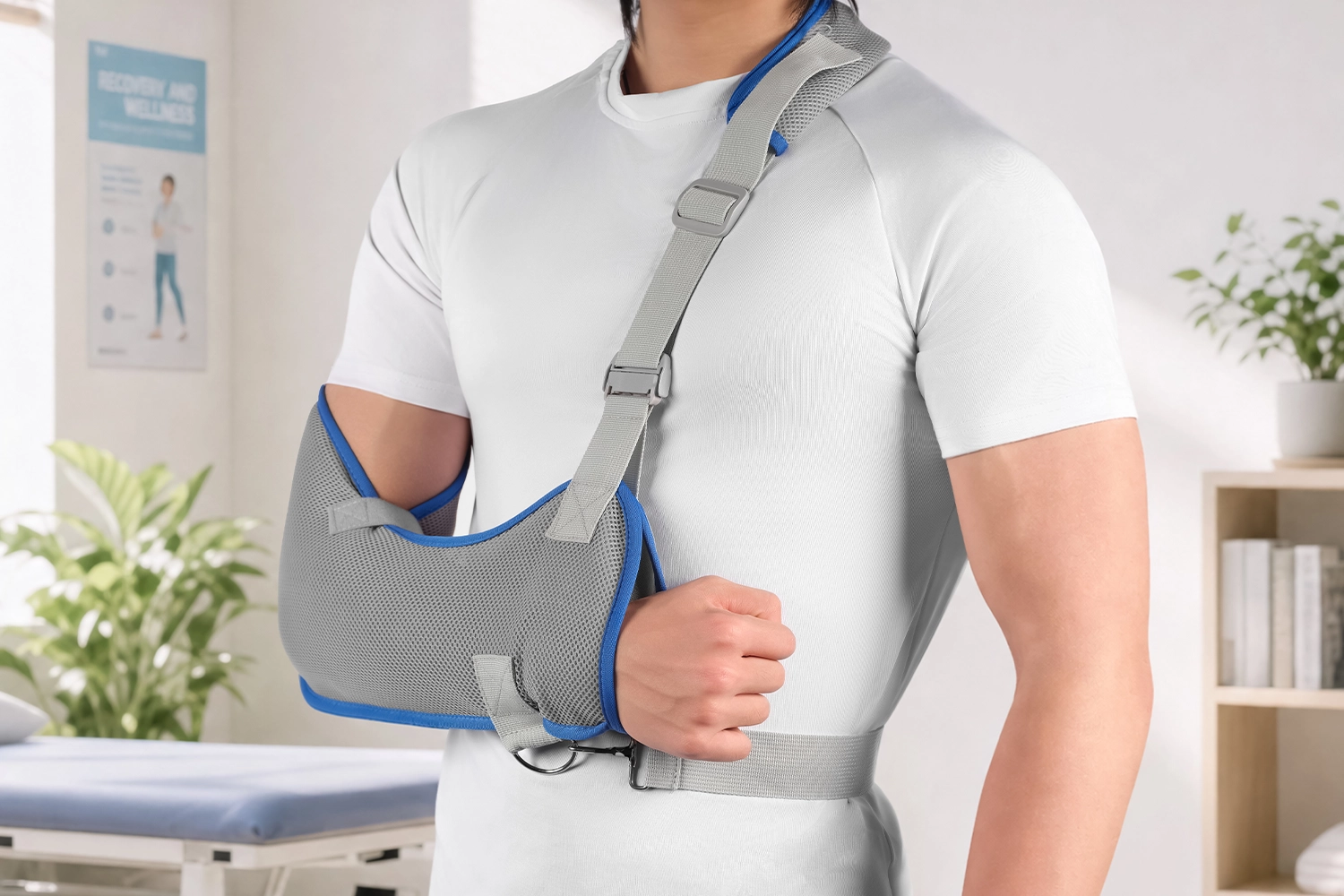
Your arm’s in a sling, your car keys are staring at you from the counter, and you’re stuck between “I feel fine” and “wait, is this actually a terrible idea?” That hesitation is your gut doing its job. Can you drive with a sling on your arm is a genuine safety question with real consequences if you get it wrong.
There’s no single yes-or-no answer, because it depends on what kind of injury put you in that sling in the first place. Driving with a broken collarbone is very different from driving after shoulder surgery. We’ll walk through the medical realities, the murky legal territory around arm sling driving laws, and a practical checklist to help you figure out honestly whether you’re ready.
Can You Drive With A Sling On Your Arm: Direct Answer
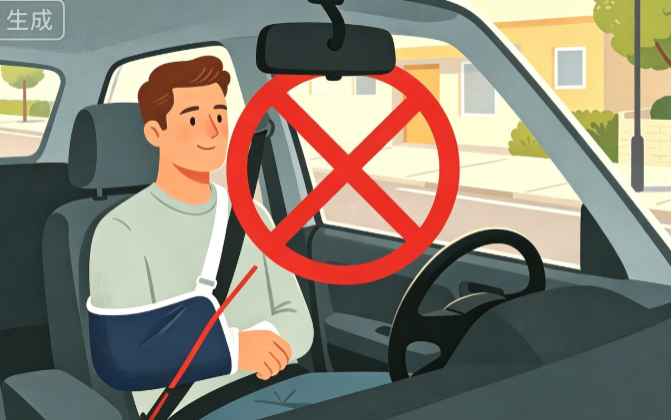
Short version: no. The American Academy of Orthopaedic Surgeons puts it bluntly—“if you need to be in a sling, you cannot drive” because “it isn’t safe.” The UK’s NHS agrees, and Scottish NHS guidance goes further, calling it illegal to drive when wearing a sling, splint, cast, or moonboot.
Here’s the real test, though. The sling itself isn’t the problem. It’s what the sling represents: a dominant arm you can’t move, pain that blocks quick steering, or slowed reflexes from painkillers. Birmingham’s UHB NHS nails the actual concern: can you comfortably control your vehicle and perform emergency manoeuvres? If the answer’s no, the sling is irrelevant—you shouldn’t drive regardless.
Why a Sling Affects Your Driving Ability (How a Sling Affects Driving Safety)
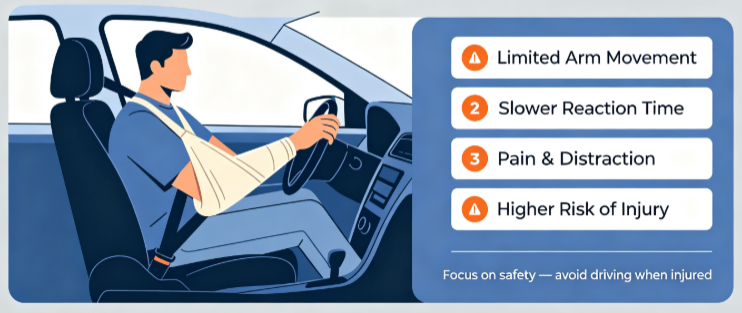
A sling changes how your whole body reacts behind the wheel. Modern steering wheels are designed for two-handed control, especially during quick corrections. Lock a shoulder immobilizer across your chest, and you’ve lost half that system. One handed driving legal questions come up a lot, but the real issue is physics: turning the wheel fast enough to avoid a swerving car requires torque most people can’t generate one-armed, especially with a stiff or aching shoulder.
Then there’s the seatbelt problem nobody mentions. Your shoulder strap sits directly over the injured area. Any sudden stop—even a minor fender-bender—slams that belt into a fracture, a fresh incision, or a dislocated joint. Airbags deploy with enough force to break bones; add an already-injured arm braced against the wheel, and you’re looking at serious re-injury.
Reaction time takes a hit too. Pain signals compete with your brain’s ability to process traffic, judge distances, and respond to hazards. If you’re on prescription painkillers or muscle relaxants—common after fractures or surgery—your reflexes slow down further, sometimes without you noticing.
Manual transmission drivers face an obvious dealbreaker: shifting gears requires the injured arm entirely, ruling out driving with limited arm mobility altogether. Even automatic drivers still need that arm for turn signals, mirror adjustments, and emergency maneuvers like swerving or bracing.
Is It Legal to Drive With a Sling
Most places don’t have a specific law against driving with an arm sling. You won’t find “no driving with slings” written into your state’s vehicle code. The language is broader—something like “operating a vehicle in a safe and competent manner”—and that’s where things get tricky.
In the US, there’s no federal law addressing slings. But nearly every state has a version of “fitness to drive” statutes. If you cause an accident while wearing a sling, and it’s shown your injury impaired your ability to drive safely, you can be charged with reckless driving or negligence, even without a sling-specific law on the books.
In the UK and Scotland, the guidance is more direct. NHS Scotland states outright that driving with a sling, cast, or splint is illegal if it restricts your ability to control the vehicle. That’s a much clearer standard than what most American drivers get.
Insurance Won’t Bail You Out
Car insurance claims involving sling injuries get denied more often than you’d think. If your insurer determines you were medically unfit to drive—sling or no sling—they can refuse to cover damages. Some policies include exclusions for driving against medical advice.
Arm injury car accident liability works against you here too. If the other driver’s lawyer proves your sling impaired your reaction time or steering, you’re looking at a negligence case that’s hard to win.
The Doctor’s Note Actually Matters
A doctor’s note for driving restrictions protects you legally. If your physician clears you to drive with specific limitations (short trips only, automatic transmission required, no highway driving), get it in writing. That documentation covers you if insurance disputes arise or if you’re questioned after an incident.
No note means no proof you were medically cleared. That’s a gap you don’t want during a claims investigation.
Driving With a Broken Arm vs Shoulder Injury vs Post-Surgery
Not every sling tells the same story. A hairline fracture in your forearm behaves nothing like a torn rotator cuff, and a fresh surgical incision comes with its own set of rules. Lumping them together is how people talk themselves into bad decisions.
Driving with a broken collarbone usually means six to eight weeks of restricted movement. Clavicle fractures sit right where your seatbelt crosses, so even low-speed impacts can shift the bone or cause serious pain. Most orthopedists say no driving until the fracture shows solid healing on X-ray, not just when the pain fades.
Shoulder injuries—dislocations, labral tears, rotator cuff damage—hit your range of motion hardest. You might have decent grip strength but zero ability to rotate the joint fast enough for an emergency swerve. That gap between “feels okay sitting still” and “can react in half a second” is where accidents happen.
Post-surgery cases are the strictest. Anesthesia lingers longer than most people expect, sometimes affecting coordination for 24-48 hours. Surgical hardware—pins, plates, anchors—needs weeks to stabilize before handling steering wheel torque. Surgeons often specify exact timelines: two weeks for minor arthroscopic work, six-plus weeks for reconstructive procedures.
What Determines Your Timeline
Three factors matter more than the injury label itself:
- Which arm is injured — dominant-side injuries limit control more
- Transmission type — manual cars demand full arm function; automatics are more forgiving
- Medication schedule — opioids and muscle relaxants extend your “no driving” window regardless of healing progress
Your specific diagnosis dictates your specific timeline. Generic advice doesn’t cut it here.
Practical Decision Checklist: How to Self-Assess Whether You Can Drive
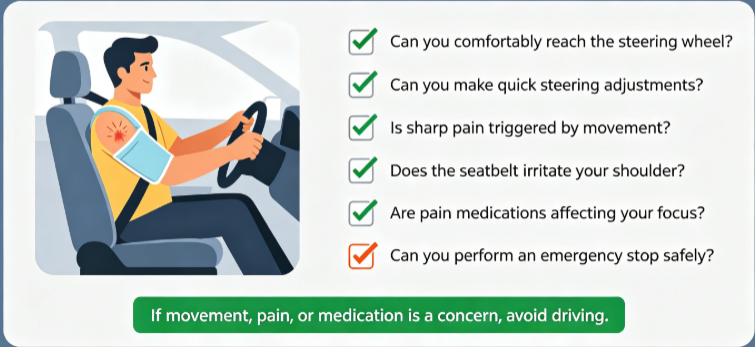
Skip the guesswork. Run through this checklist before you touch the ignition—it’s the same set of questions orthopedic surgeons use to gauge medical fitness to drive when a patient’s arm is out of commission.
Test your range of motion first.
Sit in the driver’s seat, engine off. Can you turn the wheel a full 90 degrees in both directions without wincing? Can you reach the turn signal, gear shift, and parking brake without straining the injured arm? If any of those moves trigger sharp pain or require you to compensate with your torso, that’s a hard no.
Check your medication timeline.
Opioids, muscle relaxants, and even some anti-inflammatories carry drowsiness warnings. If you’ve taken anything stronger than ibuprofen in the last 6-8 hours, don’t drive—period. This overrides everything else on this list.
Rate your pain honestly.
A 2-out-of-10 ache is manageable. But a 6-out-of-10 that spikes with sudden movement means your brain will hesitate at the exact moment you need to react. Pain that distracts you from traffic is pain that makes you dangerous.
Simulate an emergency stop.
Mimic slamming the brakes and bracing. If that motion makes you flinch, gasp, or instinctively protect the injured arm, you’ve just proven you can’t react fast enough in a real scenario.
Confirm you have documentation.
No doctor’s note for driving restrictions? Don’t assume you’re cleared just because the pain’s tolerable. Get it in writing—specific limitations included (automatic-only, short trips, no highway).
If you fail even one of these checks, you’re not ready. Driving with limited arm mobility isn’t a judgment call you get to make solo—your body’s signals and your doctor’s clearance both need to agree before you turn that key.
How to Get Medical Clearance to Drive (How to Get Medical Clearance to Drive)
Getting medical clearance takes more than a five-minute conversation. Bring specifics to your appointment. Vague updates like “I’m feeling better” aren’t enough.
Come prepared with concrete details: your daily pain level on the 1–10 scale, your current medication list with dosage and timing, what movements you’ve tried at home (reaching overhead, gripping objects, rotating your shoulder), and your car’s transmission type (automatic or manual).
Ask your doctor directly, “Can I control a steering wheel safely? Can I brace for a sudden stop?” Push for a specific timeline tied to your injury type: six weeks for a clavicle fracture, two weeks for minor arthroscopic surgery, longer for reconstructive work. Don’t accept “you’ll know when you’re ready” as an answer.
If you’re cleared with restrictions, get them in writing on letterhead: automatic-only, no highway driving, trips under 30 minutes. Ask for the document, not a verbal “should be fine.” This becomes your proof for insurance disputes and a concrete reference to rely on instead of guessing based on how you feel that particular morning.
Schedule a follow-up before you leave. Healing timelines shift, and so should your clearance.
Conclusion
Whether you can drive with a sling on your arm is rarely about the sling itself. It comes down to what your body can actually do. A stiff shoulder, limited range of motion, or pain medication can make a routine drive risky for you and everyone else on the road.
Before you grab your keys, go through the checklist we covered. Talk to your doctor honestly about driving after shoulder surgery. If your recovery involves real restrictions, get that clearance in writing. It protects you legally, medically, and financially if your insurer asks questions.
If you’re not cleared yet, don’t push it. Rideshares, a favor from a friend, or a few days of inconvenience beat a setback that adds weeks to your recovery. Heal first. Driving will still be there when you’re ready.