With a doctor’s note that says “wear a cervical collar,” you’re standing in the medical supply aisle or scrolling through search results at 2 a.m., feeling lost. Should you grab the soft foam one that looks comfortable, or the rigid plastic version that seems intimidating? The choice on Cervical Collar Hard Vs Soft comes down to what’s happening inside your neck. A minor strain and a fractured vertebra need different levels of support. Getting it wrong can slow your healing and even cause harm. So let’s break down what separates these two collar types, when each is medically appropriate, and how to pick the one your recovery needs.
Soft Cervical Collar: Suitable Scenarios and Feature Analysis
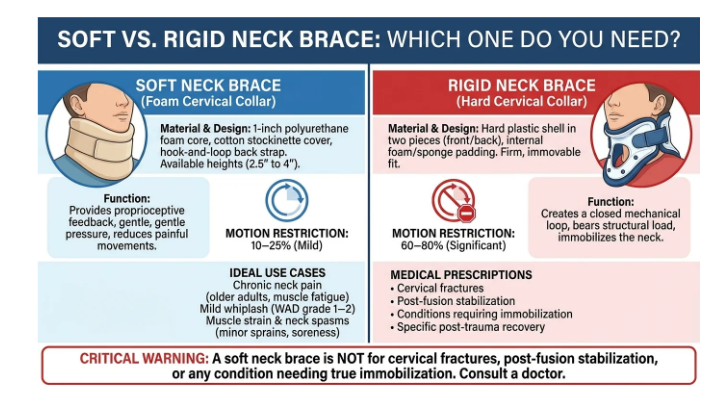
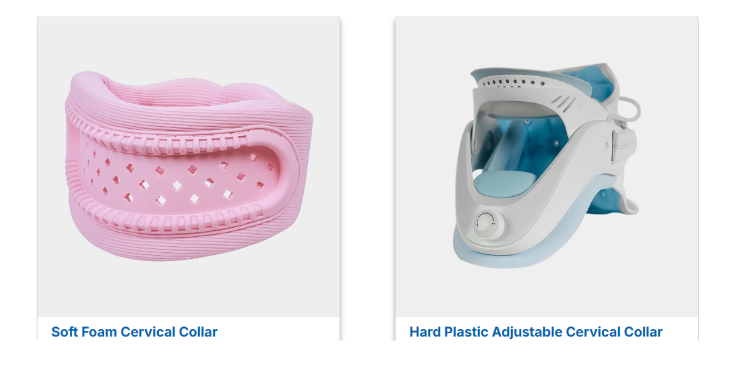
Think of a soft cervical collar as a gentle nudge. Made from soft foam wrapped in a breathable cotton stockinette, this foam neck collar puts comfort first and structure second. It’s a friendly reminder that says, “hey, maybe don’t turn your head that far.”
What “minimal immobilization” actually means
Research on healthy volunteers found that soft collars limit forward-bending (flexion) by only about 39%, and side-to-side rotation by a mere 11%. That’s a big difference from what many people assume. The collar offers a kinesthetic cue, gently cradling your jaw and neck to discourage extreme movements, especially at the far edges of bending and twisting.
Who actually benefits from this type of collar
Soft collars shine in situations where some movement is safe and even helpful:
- Mild neck stiffness or muscle spasms
- Minor strains or sprains
- Cervical collar for whiplash, but only the mild kind, without neurological red flags or signs of bone instability
- Late-stage recovery support after more serious injuries have healed
If there’s any suspicion of fracture, spinal instability, or nerve damage, this isn’t the right tool. That calls for stronger cervical spine immobilization, which we’ll cover in the next section.
How long should you actually wear one?
Soft collars are meant for short-term use, generally around two weeks, with some clinical notes suggesting under 10 days causes no measurable muscle weakness. But wearing one continuously beyond 2–4 weeks can backfire. Your neck muscles start relying on the support instead of doing their own work, leading to disuse weakness. It’s a classic case of too much of a good thing.
Why people love wearing these for sleep
Because they’re light, breathable, and don’t dig into your jaw or collarbone the way rigid collars can, soft collars double as a solid neck support brace for sleeping. Many designs use one-inch foam with a latex-free cotton cover and are specifically marketed for daytime and nighttime wear. They’re ideal if you’re dealing with nighttime pain flare-ups or want to avoid rolling into an awkward position.
Hard Cervical Collar: Use Cases and Key Features Explained
A rigid neck collar locks your cervical spine into a neutral position and refuses to budge. Built from hard polyethylene or rigid plastic, sometimes reinforced with metal support, it stops flexion, rotation, and side bending.
When doctors actually reach for this option
Hard collars show up when something serious is on the line:
- Cervical fracture, especially a major injury or what patients often call a “broken neck”
- Cervical dislocation or subluxation, where the vertebrae have shifted and need firm control
- Suspected spinal instability, common in trauma or ER settings where clinicians immobilize first and diagnose second
- Post-cervical surgery, protecting the surgical site while healing takes hold
- Other scenarios like nondisplaced cervical spine fractures, acute neck pain with spinal degeneration, cervical disc issues, or rheumatoid-related instability
The risks nobody warns you about
Wearing a hard collar for too long causes skin breakdown, pressure sores, and localized pain at contact points. Prevention means choosing the right size, padding high-risk areas, checking your skin daily, and watching for swelling. Some hospital protocols aim to reassess fixation within 24 hours to avoid unnecessary prolonged rigidity.
Wearing it correctly
When wearing a neck brace, the collar should hug your jaw and the back of your skull snugly. Keep your head neutral. Inspect your jawline, back of the neck, and collarbone area daily for redness or numbness. Do not remove it yourself without medical clearance.
Cervical Collar Hard Vs Soft: Core Comparison Dimensions
A soft collar cuts neck movement by about 17.4%. A hard collar cuts it by roughly 62.9%. That gap tells you which one your recovery needs.
| Dimension | Soft Cervical Collar | Hard Cervical Collar |
| Material | Foam padding with a fabric cover, lightweight and flexible | Rigid plastic or polyethylene with foam lining, firm |
| Fixation Strength | Low to moderate; motion reduced ~17.4% | High; motion reduced ~62.9% |
| Best For | Mild neck pain, muscle strain, whiplash, cervical spondylosis, minor sports injuries | Neck fracture, post-surgical recovery, ligament injury, trauma precaution |
| Comfort Level | Higher comfort, less pressure | Lower comfort, but far greater stability |
| Wear Duration | Typically 2–6 weeks | Typically 6–12 weeks |
What happens when you pick the wrong one
Using a soft collar for a serious injury is like putting a Band-Aid over a broken bone. It can’t provide adequate cervical spine immobilization. Studies describe it: soft collars are “insufficient for adequately immobilizing the cervical spine” when there’s real instability. If you’re dealing with a fracture, significant ligament damage, or you’re fresh out of surgery, a soft collar lets your neck keep micro-moving, which can delay healing or worsen the injury.
Hard collars carry their own baggage. The most common side effects include pressure sores, skin breakdown, and general discomfort from prolonged rigid contact. That’s why nurses and doctors emphasize regular skin checks, proper sizing, and consistent monitoring, especially for patients wearing one for weeks at a time.
How to Choose the Right Cervical Collar Based on Your Symptoms
Four questions determine your collar choice, and none of them require a medical degree to answer. Ask them in order, and the right answer usually reveals itself.
Did You Have a Recent Injury?
Car accidents, falls, sports collisions, sudden impacts — any of these change the entire equation. If something traumatic just happened to your neck, skip the guessing game. Reach for a rigid neck collar or semi-rigid support immediately, then get evaluated by a medical professional as soon as possible. Trauma cases are not the moment to experiment with cervical spine immobilization on your own; they need proper imaging and clinical judgment first.
No recent trauma? Move to Step 2.
Are Any Red Flags Present?
Certain symptoms mean “stop and go straight to a hard collar.” Watch for:
- Severe or worsening pain that does not ease up
- Weakness, numbness, or tingling in your arms or hands
- Unsteady walking or noticeably restricted movement
- Bladder or bowel changes, which can signal spinal cord pressure
- Persistent neurological symptoms alongside neck pain
Any single item on this list, and a soft collar is not enough. These signs point toward possible nerve or spinal cord involvement, and that calls for a rigid neck collar plus urgent evaluation, not a wait-and-see approach.
Nothing on this list matches your experience? Head to Step 3.
What Does Your Symptom Pattern Look Like?
This is where most people land, and it is also where the choice gets more nuanced.
For mild neck pain, muscle spasm, or minor strain, a short-term soft collar works here, ideally with guidance from a clinician or physical therapist. Some studies suggest windows as short as 10 days; others extend to two weeks.
For cervical spondylosis with moderate pain, soft collars offer a starting point. But if pain persists or function stays limited, a semi-rigid or Philadelphia collar often performs better for pain, gait, and balance.
For degenerative disc disease or chronic degenerative pain, short-term soft collar use during flare-ups helps reduce muscle load, unless neurological symptoms or suspected instability appear — then the need shifts toward stronger support.
For cervical radiculopathy (pinched nerve), mild radiating pain without weakness may respond to a brief soft collar trial. But if numbness or weakness shows up or worsens, treat it as a red flag and escalate to a rigid collar with medical follow-up.
Prolonged, unsupervised soft collar use for real instability has been linked to delayed recovery and increased dependence, so clinician guidance matters at every stage, not just at the start.
When to Stop Guessing and Call a Doctor
Never self-manage these situations:
- Neck pain or limited movement after a car accident, fall, or sports impact
- New numbness or weakness in arms or legs
- Swallowing trouble, choking, restricted breathing, or worsened breathing during sleep
- Vision changes or possible neurological symptoms
- Deciding whether to wear it overnight, stop wearing it, or switch between soft and hard support
These decisions belong to your medical team, not a search engine.
Conclusion
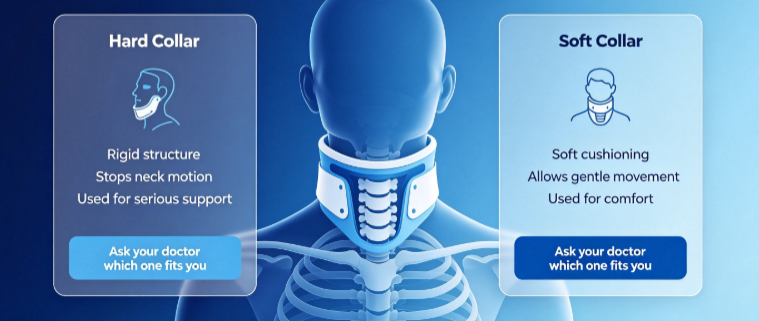
The best collar depends on your body’s needs right now. If you’re nursing a mild strain or need gentle reminders to keep your head still, a soft collar offers comfort without overkill. If you’re recovering from a fracture, whiplash, or post-surgical instability, a rigid neck collar is essential for proper cervical spine immobilization and safe healing.
Knowing the difference between hard and soft cervical collars helps you avoid the two-week trial-and-error most people go through, wasting money and risking further injury.
Looking for a Cervical Collar Factory to rich your product instructions? Reach out AOFIT now, and we are ready with wide OEM/ODM solutions, including rigid cervical collars built for post-surgical stabilization, and soft foam collars won’t cut strict immobilization.