Choosing between the Miami J collar and the Aspen brace affects healing time, skin integrity, and how well a patient sticks with treatment. If you’re a clinician recommending a cervical collar brace, a caregiver shopping for a loved one, or a patient trying to figure out why your neck still hurts after a week in the “wrong” collar, you need real answers.
Both brands dominate the rigid cervical orthosis market. But they’re built differently, fit differently, and work better in different situations. The comparison on Miami J Collar Vs Aspen comes down to immobilization strength, comfort, sizing, and price, so you can match the right collar to the right injury the first time.
Miami J Collar: A Detailed Look at Product Features
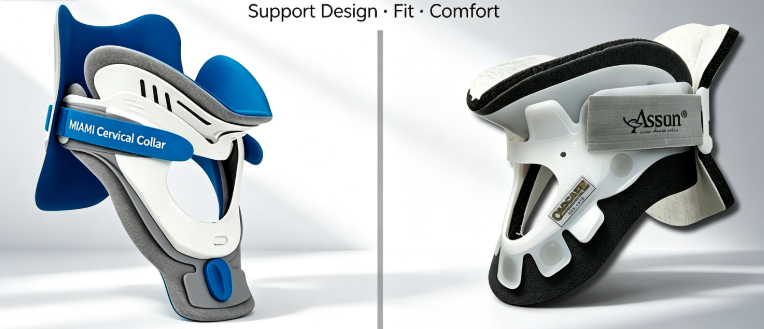
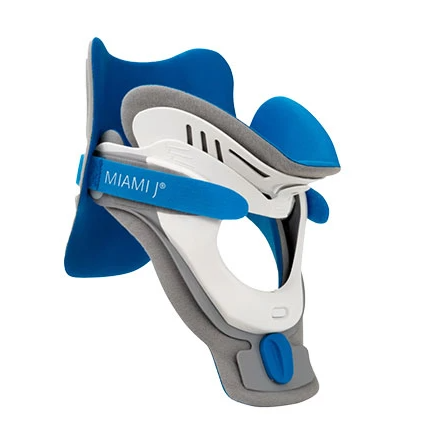
The Miami J is engineered around neck height. Most buyers overlook that variable and choose a collar by weight or BMI instead. It uses a two-piece rigid plastic frame (front and back panels), and the panels are interchangeable. A Small Front paired with a Large Back can solve fit problems that a single fixed-size collar never could.
Sizing options
- Super Short/Kyphotic (chin-on-chest patients)
- Stout (larger neck circumference)
- XS (short, thin necks)
- Short (most adults)
- Regular (typical adult female frame)
- Tall (long-necked patients)
- Bariatric versions also exist
Model numbers MJ-200S, 200L, 250, 300, 400, and 500 correspond to these variations.
The pressure data is where Miami J stands out
In clinical comparisons it produces lower average interface pressure than the Aspen Vista, Stiffneck, and Philadelphia collars, particularly at the occiput and jaw. One study found the Miami J and Miami J/Occian back configurations delivered the lowest jaw and occipital pressure among tested devices, directly reducing pressure ulcer risk.
That said, it’s not flawless. FDA MAUDE reports document jaw, chin, and clavicle pressure injuries with Miami J Select, usually tied to post-surgical swelling or extended wear without refitting.
One measurable trade-off is that jugular venous pressure rises from roughly 9.4 mmHg to 11.7 mmHg after fitting, less than competing brands but still worth monitoring.
Aspen Collar: Product Features Explained
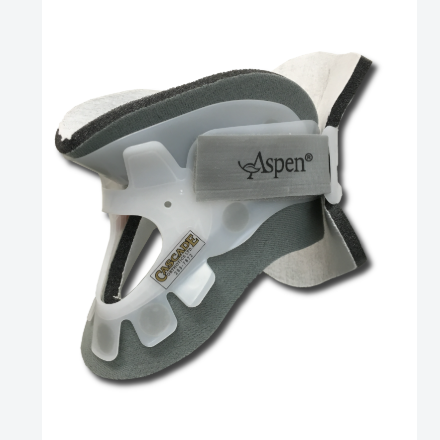
Aspen takes a different engineering approach than Miami J. Instead of interchangeable panels, it uses an adjustable-height design with a split front/back shell and washable padding. That height adjustment is the entire selling point.
Pediatric sizing is supported
Adult sizing runs four categories based on shoulder-to-chin distance:
- Short (<5/8″)
- Regular (5/8″–1-1/4″)
- Tall (1-1/4″–1-7/8″)
- X-Tall (>1-7/8″)
Neck circumference typically falls between 13″–21″. Pediatric sizing gets even more granular, split by age and weight: PD1 covers 1–18 months (11–29 lbs), scaling up to PD5 for ages 3–6 (27–54 lbs).
To measure for a neck brace, shoulder-to-chin distance matters more than neck circumference. Get that wrong, and you’ll either overshoot the jaw or leave the collar unstable, regardless of correct circumference.
Motion restriction data is where Aspen genuinely separates itself
Radiological studies on healthy adults show flexion-extension dropping from 98.8° to 31.1°, roughly 31.5% of normal range. Lateral bending falls to 51.1% of baseline. Rotation drops to just 41%, around 26.8° from a normal 64.6°.
Compared against Aspen Vista, Miami J, and Philadelphia collars, Aspen performs equal to or better across all three planes, particularly rotation control. Philadelphia matches it on flexion-extension, but nothing beats Aspen on rotational limitation among tested rigid cervical orthosis brands.
Miami J Collar Vs Aspen: Side-by-Side Comparison
| Feature | Miami J Collar | Aspen Collar |
| Motion Control | Highly restrictive; excels in preventing flexion/extension | Excellent circumferential stability and lateral bending control |
| Padding Material | Sorbtek moisture-wicking, breathable pads | Cotton-lined, ventilated foam pads |
| Skin Protection | Engineered to reduce friction on key pressure points | Distributed support designed to minimize heat buildup |
| Primary Use Case | Stable spine fractures, post-surgical immobilization | Trauma stabilization, post-operative cervical recovery |
| Estimated Price Range | Generally retails between $60 – $140 online (depending on the phenotype size or universal “Select” model) | Typically ranges from $40 – $135 (standard multi-size versions tend to be cheaper, while the adjustable Vista series is higher) |
| Review Rating | ~4.3 out of 5 stars across online retailers like Ubuy (praised for rigid immobilization and pain relief, though users note it takes time to get the sizing right) | ~4.5 out of 5 stars across medical supply stores like SupremeMed (highly rated for daily comfort and easy tool-free dial adjustments on the Vista model) |
| Insurance Coverage | Excellent Coverage. Both fall under the same Medicare/HCPCS billing code (L0174 or L0172 for rigid cervical collars). Typically 100% covered if prescribed by a physician post-injury or post-surgery. Also FSA/HSA eligible for out-of-pocket reimbursement. | Excellent Coverage. Fully reimbursable via insurance when deemed medically necessary. Because adjustable Aspen models fit multiple sizes, hospitals frequently stock them as a go-to covered option for trauma or immediate discharge. |
Immobilization Effectiveness
Researchers don’t agree on which collar restricts motion better. The data shows that.
A 3D motion analysis study on healthy subjects found Aspen limited flexion-extension to 29.9° ± 12.2 of residual movement, compared to Miami J’s 38.3° ± 11.6. No collar at all left subjects at 127.4° ± 14.0. Aspen also beat Miami J on rotation, with the difference reaching statistical significance (p < 0.05).
A separate ROM study backed this up. Aspen outperformed both Aspen Vista and Miami J across four movement planes (P ≤ 0.003). But when compared against Miami J Advanced, that gap disappeared. Different Miami J models give different results.
Then there’s a third study that muddies things further. It measured Miami J at 12.1° flexion, 15.1° extension, 26.7° right rotation, 30.2° left rotation. Aspen’s numbers landed close: 12.8°, 16.5°, 28.0°, 32.3°. Barely any daylight between them.
An older comparison study flips the script entirely, ranking Miami J as superior “on all motion parameters,” with Aspen finishing near the bottom.
Patient Comfort & Skin Care
Here, Miami J pulls ahead consistently.
The numbers back it up. Miami J’s pressure-tension slope in the upper cervical and shoulder regions measures 1.0 mmHg/N and 2.5 mmHg/N respectively. That’s a gentler curve. Tighten the collar, and pressure rises slowly instead of spiking. Aspen Vista’s upper cervical slope hits 2.7 mmHg/N, meaning pressure peaks show up faster and harder.
Peak tissue interface pressure (TIP) confirms the pattern. Across every test point and every position, standard Miami J scored significantly lower than Aspen (P ≤ 0.001). In supine positioning specifically, Miami J and Miami J/Occian back configurations produced the lowest average tissue pressure among tested collars, while Aspen and Philadelphia ranked highest (P < 0.001). Standing tests showed the same ranking.
Pricing & Insurance Coverage
Money changes decisions. And the price gap between these two cervical collars is too big to brush off.
Miami J Cervical Collar retails for $64.99–$149.00 depending on the vendor—samples I’ve seen land at $64.99, $115.00, $137.01, and $149.00. The Miami J Select version runs about $110.00. Aspen Vista Cervical Collar ranges from $50.11–$132.99, with common prices at $59.99, $89.00, and $132.99.
Aspen Vista’s starting price is lower. Miami J sits at the premium end of the market.
Institutional Purchasing vs. Patient Out-of-Pocket
Hospitals don’t publish their contract prices. But bulk discounts are standard. If you figure 60%–80% of retail as a rough benchmark, Miami J institutional pricing would land between $39–$119, and Aspen Vista closer to $30–$106. That’s useful for budgeting, not a guarantee.
Insurance and Medicare Coverage
Cervical orthosis products bill under HCPCS L-codes, not CPT. L0180 covers multi-post collars with occipital and mandibular supports. Medicare Part B can cover these under DMEPOS rules, but only if you have documented medical necessity and a valid order. L0180 is Coverage Code C, meaning your local MAC decides reimbursement case by case. It’s not automatic.
There’s no CPT code for the collar itself. CPT covers the physician’s fitting or evaluation. The device gets billed separately through the L-code.
For patients, that means the brand name matters less than the paperwork. Whether Miami J or Aspen gets reimbursed depends on the L-code assigned, the clinical notes backing up medical necessity, and your local coverage policy—not the marketing claims.
Scenario Selection Guide: Which One Fits Which Situation
Data helps only if you know how to apply it. The decision framework below breaks it down by clinical scenario.
Cervical Fracture or Post-Surgery Fixation
This is where the two collars pull in different directions. Published comparisons show Miami J posting lower average interface pressure in both supine and standing positions. Aspen, meanwhile, tends to test higher on multi-axis motion restriction. If the fracture is unstable and you need maximum cervical spine immobilization, that restriction advantage matters more than comfort. If the surgical site is healing and swelling is a concern, Miami J’s pressure profile becomes the priority.
High Pressure-Ulcer-Risk Patients
Diabetic, elderly, or bed-bound patients need a different calculation. Diabetes is a major risk factor, and the risk climbs further for patients bed-bound for seven days or longer. Elderly patients wearing a rigid collar past 24 hours show higher complication rates. For this group, pressure management outranks pure stability.
Short-Term Mild Injury vs. Long-Term Severe Cases
Mild, non-traumatic neck pain rarely justifies continuous wear beyond a week. Clinical guidance treats collars as short-term tools here, favoring whatever fits fastest and controls symptoms.
Long-term or post-surgical cases are a different picture. Reported skin breakdown rates run around 7% (33/484) in Aspen groups versus roughly 6% (2/34) in Miami J patients wearing collars long-term after odontoid fractures. Small numbers, but they matter when wear time stretches into weeks.
Quick Decision Logic
If your goal is maximum motion restriction, lean toward the stronger-fixation option — Aspen shows higher restriction in several comparisons. If your goal is lower jaw/occipital pressure, lean toward Miami J, especially with the Occian back panel. For high-risk skin profile, treat pressure protection as equal priority to fixation. For extended wear expected, prioritize comfort and even pressure distribution, then schedule regular skin checks.
Miami J Collar Vs Aspen: Self-Assessment Before You Choose
Run through this: What is the situation — fracture/post-surgery, mild sprain, or long-term bed rest? What is the problem — diabetes, elderly, reduced sensation, prior pressure injury, poor nutrition? What is the bigger concern right now: insufficient immobilization or skin breakdown/pain? What do you need: stronger fixation, or lower pressure and better long-wear comfort?
If fixation wins, go with the more stability-focused rigid collar. If pressure relief wins, go with the lower-interface-pressure, better-fitting option. If both matter equally, favor designs with a rear panel or better pressure distribution — that’s the middle ground most clinicians end up choosing anyway.
If you’re a procurement professional, bring this comparison to your next appointment. Ask about insurance coverage and trial periods for both brands. Still looking forward to more custom cervical collar solutions for your patients? Contact AOFIT now, and we are ready with wholesale medical braces in bulk.