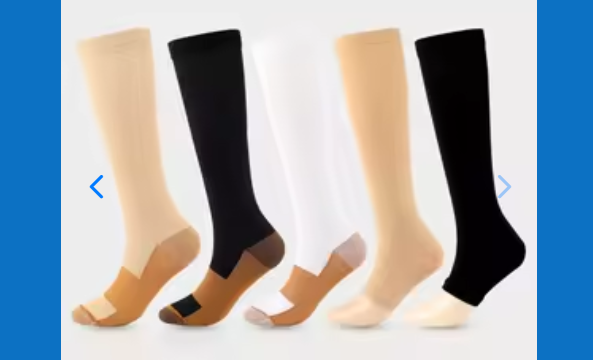
Pick the wrong toe design, and you get a warehouse full of returns, a stack of “too tight on my toes” reviews, and a product line that doesn’t match the people you sell to. Open toe versus closed toe looks like a minor construction detail, but it shapes who the sock fits, how it sells, and what it costs to make.
Open Toe Vs Closed Toe Compression Socks: Which To Choose for Business? Start with the 30-second decision rule, then walk through the procurement comparison table, cost and MOQ, and SKU mix by channel. The guide ends with a purchase brief, so you can go from “which one?” to a quote request without second-guessing.
30-Second Decision Rule: Choose Open Toe for Toe Freedom, Choose Closed Toe for Full-Foot Coverage
Choose an open toe when the toes need room. Choose a closed toe when the whole foot needs coverage. That is the rule.
Specify open toe (compression stockings without toes) when:
– Bunions, hammertoes, claw toes, arthritis, or other foot shapes make covered toes uncomfortable.
– Toes or toenails are sensitive, or fungal infections require regular checks.
– Customers wear sandals or open-toe shoes, or their feet run hot.
Specify closed toe when:
– Full-foot coverage is the priority.
– Customers wear sneakers, safety shoes, or boots.
– Warmth and the look of a regular sock matter.
The open edge of an open-toe garment can rub or shift inside certain shoes.
For prescribed compression, match the toe style to the user’s condition, tolerance, and the clinician’s measurements. Whichever style you choose, the garment should fit flat against the skin with no folds or twisting.
Open Toe vs Closed Toe Compression Socks: Procurement Comparison Table
Wholesale compression socks quotes for both formats run between US1.10andUS7.00 per pair, depending on product grade and order volume. The table below pulls from supplier listings, so treat the figures as realistic benchmarks rather than firm quotes.
| Criterion | Open toe | Closed toe |
| Wholesale price | ~US1.10–1.70/pairat50-pieceMOQ(basic15–20mmHg);US3.17–7.00/pair at ~2,000 pairs (medical-grade) | ~US$6.20/pair at 2,000 pairs (medical stockings) |
| MOQ | Stock starts at 10 pairs/style/color; custom medical runs ~200 pairs, though some factories require 2,000–2,400 | Custom/OEM starts around 200 pairs per color/style; one medical maker lists 500 per design |
| Compression range | 15–20, 15–21, 20–30, 30–40, 34–46 mmHg; common across medical, anti-embolism, and recovery lines | 15–20, 20–30, 30–40 mmHg; standard in everyday, clinical, and athletic lines |
| Foot coverage | Toes stay exposed for airflow. Accommodates dressings, foot deformities, and open-toe shoes. Inspect samples for edge fraying and tight forefoot seams | Full coverage for warmth, protection, and a traditional look. Specify reinforced toes and flat seam placement |
| Best-fit segments | Hospitals, post-op recovery, wound care, edema and lymphedema care, bunion patients, sandal wearers | Retail pharmacy, DME, workwear, travel, sports recovery, general wellness |
| Materials | Nylon/polyamide + elastane; standard blend is 70% nylon / 30% spandex | 83% polyamide / 17% spandex (athletic); 45% nylon / 40% merino / 15% spandex (thermal) |
| Sizing | Ankle, calf, leg length, and shoe size; also requires exposed-toe length and foot width | Same base measurements, with added focus on toe-box pressure and bunching inside shoes |
| QC | Multi-point pressure testing with a tolerance of ~±2–3 mmHg | Same pressure tolerances. Request batch reports, since closed toes can hide defects in the toe seam, heel pocket, or forefoot |
| Durability | Holds up through 50+ washes with at least 85% compression retention | Same 50+ wash standard; also check toe closures, heel reinforcement, pilling, and elastic recovery |
| Documents | FDA registration/listing (U.S.), ISO 13485:2016, OEKO-TEX Standard 100, pressure reports, CE | Same paperwork. Confirm certifications cover the specific SKU, compression class, factory site, and target market |
| Labeling | Mark “open toe”; list mmHg rating, size chart, fiber content, care instructions, lot number, and intended use | Mark “closed toe”; list the same details, plus toe seam construction if your QA standards require it |
| Private label | Good for specialized medical lines. Confirm separate molds, grading rules, or packaging SKUs (custom benchmark: 500 pairs/design) | Well suited for high-volume retail and uniform programs where one toe format keeps SKU counts lean |
| Choose when | Clinical flexibility, ventilation, wound access, or footwear options matter more than clean toe finishing | Warmth, full toe protection, classic styling, and broad retail appeal come first |
Price Benchmarks to Keep in Mind
- US$3–7/pair is a realistic target for bulk medical-grade orders.
- Basic open-toe inventory often prices out below that range.
- Branded retail pairs typically sell for US$34–48/pair.
User and Application Fit: Which Structure Should a B2B Buyer Stock?
Base your toe design on your customer mix rather than what a factory catalog pushes. Match each buyer profile to a structure first, then set order volumes.
| Buyer profile | Stock | Why it fits |
| Pharmacies and DME stores serving general wellness and travel | Closed toe, 15–20 mmHg | Familiar look, broad appeal, and easy sell-through |
| Hospitals, post-op clinics, and wound care | Open toe, 20–30 mmHg | Accommodates swollen feet while allowing quick toe checks and dressing access |
| Edema and lymphedema programs | Open toe, with a closed-toe option | Fits fluctuating foot volume as swelling changes |
| Nurses, retail staff, and other long-shift workers | Closed toe | Works inside sneakers and safety shoes while keeping feet warm |
| Customers with bunions, hammertoes, or sandal habits | Open toe | Leaves toes free and keeps feet cooler |
| Diabetic foot programs | Clinician-directed | Requirements depend on the individual care plan, so confirm the toe style with the prescriber |
How to Split Your Inventory
Start with this baseline split, then adjust it using your own sell-through numbers:
- 60–70% core stock: Standard closed-toe and open-toe pairs in your most common compression socks sizes and pressure levels.
- 20–30% application-specific stock: Certified medical compression socks for recurring needs such as post-op or edema care.
- 5–10% trial or custom stock: Low-MOQ variants for product testing and new accounts.
Stocking Rules That Cut Returns
- Create a separate SKU for each toe style, mmHg level, size, color, and packaging format.
- List MOQ, case quantity, lead time, live inventory, and unit price on every product page. Buyers walk away when stock status is unclear, even if the price looks good.
- Use ODM for unproven demand, and reserve full OEM for validated volume.
- Collect application details before ordering premium SKUs: end user, condition, pressure level, shoe type, target market, annual volume, and delivery window.
Cost, MOQ, and Manufacturing Differences for Open-Toe and Closed-Toe SKUs
Setup fees usually dictate your unit price more than the toe style does. While the comparison table shows actual sock quotes, this breakdown looks at why closed-toe and open-toe builds carry different price tags.
A note on sources: This cost data comes from footwear sourcing, which offers direct side-by-side numbers for open- versus closed-toe production. Compression-sock mills run on different equipment, so use these numbers to understand how toe design shifts production costs rather than as direct sock quotes.
Why Closed-Toe Costs More to Build
In footwear, a closed toe requires extra work at every step:
– Extra panels, lining, and toe reinforcement
– More stitching and inspection points
– More precise forming around the forefoot
– More fitting rounds before bulk approval
– Bulkier packaging and freight
Budget a basic closed-toe shoe 10–30% above an open-toe counterpart. Treat that as a planning baseline rather than a firm quote, because materials, decoration, and total volume sway the final price far more than the toe structure does.
MOQ and Tooling Math
Open-toe styles frequently use off-the-shelf components, keeping MOQs around 100–500 pairs. Closed-toe options require dedicated pattern work and grading, which pushes realistic minimums to 500–1,200 pairs per style.
Tooling expenses hit low-volume runs the hardest. For example, amortizing a $5,000 mold breaks down like this:
– 500 pairs: $10.00 per pair
– 1,000 pairs: $5.00 per pair
– 5,000 pairs: $1.00 per pair
How to Cut MOQ and Development Cost
Ask your sock factory about similar cost-saving options:
– Use existing tooling and stock materials
– Limit the first run to one material and one colorway
– Share tooling across open- and closed-toe variants
– Use the supplier’s standard packaging
– Ask whether color orders can be consolidated to meet MOQ
Request quotes for both toe options using the exact same spec sheet, then compare setup fees line by line.
Product-Line and SKU Mix Recommendations by Channel
Every channel wants a different slice of your range. Treat them all the same, and you’ll end up with dead stock in one and stockouts in another.
These benchmarks draw on general retail assortment research rather than compression-sock data. Use them as a planning guide for your open-toe and closed-toe lines.
The 60/40 Channel Rule
Keep about 60% of your portfolio identical across channels. Reserve 40% for channel-specific configurations, such as retailer-exclusive packs, marketplace bundles, club sizes, or DTC subscriptions.
Label every SKU as core, seasonal/trend, test, or exit. Track sell-through, post-markdown margin, inventory cover, and channel contribution margin before expanding or dropping an item. In one McKinsey assortment study, removing low-productivity variants cut projected SKU count by 36% while keeping the profitable core intact.
Mix by Channel
- Wholesale and pharmacy: Open with a compact, always-in-stock core built around your best closed-toe and open-toe pairs in common 15–20 and 20–30 mmHg sizes. Offer reorderable case packs with dependable lead times. Add ready-made bundles so buyers avoid cherry-picking low-volume SKUs, and keep seasonal or test items in DTC or small retail pilots until sell-through proves them out.
- Physical retail: Focus on the top 20–30% of SKUs, which drive roughly 80% of store sales. Add key value items and a few impulse SKUs. Back listed items with core-level inventory depth, because out-of-stock shelves hurt your visibility and sales.
- Retailer ecommerce: Offer a broader selection than physical shelves allow, including extra sizes, colors, and accessories. Keep top store SKUs prominent, and make sure product data and inventory levels stay reliable.
- Amazon and marketplaces: Lead with proven hero SKUs that feature standard sizes, strong reviews, and clear specs. Add multipacks and Subscribe & Save where demand supports them. Target over 25% channel contribution margin.
- DTC: Carry your widest range here, including limited editions, bundles, and subscriptions. Subscription bundles generate a 10–20% margin uplift. Aim for over 55% contribution margin.
- Grocery and convenience: Single or trial packs run 5–10% lower margin than core formats. Multipacks run about 3–8% higher than single units.
- Club retail: Sell in bulk with 6–24-unit packs (for roughly a 5–12% uplift) or variety packs (yielding about 8–15%).
Build a Channel Grid
List every SKU against each channel. Track role, net sales, margin, fees, freight, sell-through, weeks of cover, and case-pack or lead-time requirements. Set clear priority rules wherever DTC and retail pull from shared stock.
Share a SKU across channels only when buyer needs, specification, pricing, and inventory economics all match. Otherwise, make it channel-specific.
Purchase Brief to Send to a Compression Socks Manufacturer
Paste this brief into your first email so the factory has everything it needs to return an accurate quote.
Product: Custom knee-high graduated compression socks, unisex, with a closed toe. Quote open-toe versions as well.
Compression: Highest pressure at the ankle, tapering toward the calf. Quote four options: 15–20, 18–21, 20–30 (or 23–32), and 30–40 (or 34–46) mmHg. Test to RAL-GZ 387 at the ankle, gaiter, and calf. Provide measured results for every size individually.
Construction: Low-profile toe seam, reinforced heel and toe, non-binding top cuff, and an anatomical left/right option. Socks must wick moisture, breathe well, control odor, and resist pilling.
Materials: Send two quotes.
– Standard: 70–85% nylon with 15–30% elastane.
– Premium: Coolmax, bamboo, cotton, or merino blends.
Branding: Knitted logo, woven size label, hangtag, barcode, and retail packaging. Colors: black, navy, grey, and beige, plus custom Pantones.
Commercial Terms to Quote
- Unit price at 500, 1,000, 2,000, 5,000, and 10,000 pairs
- Fees for samples, size sets, logo setup, plates, and packaging
- Sample and production lead times
- Incoterms (EXW, FOB, DDP), carton specs, and payment terms
- Defect allowance, credit policy, and price validity
Benchmarks: Public quotes run about US$1.30–1.90 per pair at 500 pairs. Silicone-grip and merino options may need 1,000–2,000 pairs. Some suppliers offer 50-pair pilot runs at higher unit prices.
Approval Gates Before Bulk
Require a full size set in all colors, a pressure report matching the samples, and wash tests after 10, 20, and 50 cycles. Include a fit test, proofs for the logo and barcode, and a signed approval sample. Finish with a pre-shipment inspection covering dimensions, pressure, stitching, color, and cartons.
Conclusion
Choosing between open toe and closed toe compression socks comes down to your customer, your channel, and your return rate.
Open toe gives toe freedom, while closed toe provides full-foot coverage. That difference in structure also changes your toe box design, pressure-level coverage, sizing risk, cost, and MOQ, so one SKU rarely serves every buyer. Match each structure to its audience, then build your mix by channel.
Now, contact AOFIT, your reliable sports support manufacturer and fill in your purchase brief with your target pressure levels, materials, toe structure, and size range. Then send it to request samples and a quote for your graduated compression socks.