Your doctor hands you a prescription that just says “shoulder support” after your injury or surgery, and suddenly you’re standing in a medical supply aisle staring at two very different-looking devices, wondering which one is yours. Sound familiar?
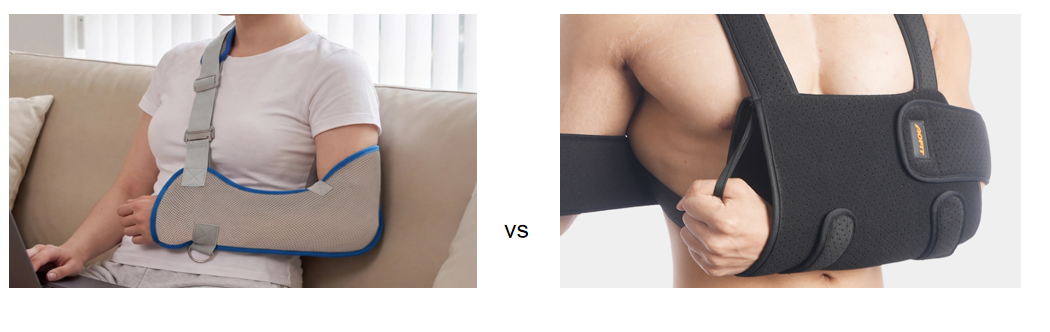
A shoulder immobilizer and a sling might look similar at first glance, but they serve distinctly different purposes in your recovery. Choosing the wrong one isn’t just inconvenient — it could slow down your healing or strain a joint that’s trying to repair itself.
Whether you’re recovering from a rotator cuff repair, nursing a dislocated shoulder, or just trying to make sense of what your surgeon prescribed, this guide breaks down Shoulder Immobilizer Vs Sling on how these two devices differ in structure, function, and best-use scenarios so you can wear the right one with confidence.
What Is a Shoulder Sling? Definition, Structure & Application
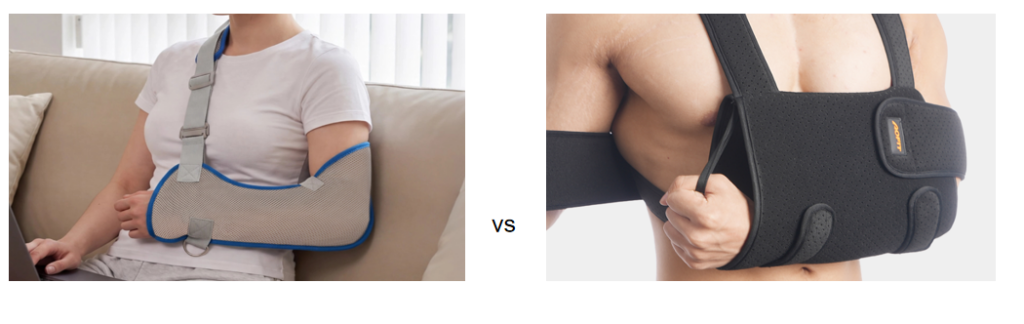
A shoulder sling is a simple orthopedic device. It holds your arm up and keeps your shoulder and elbow from moving too much. No fancy mechanics, just smart support.
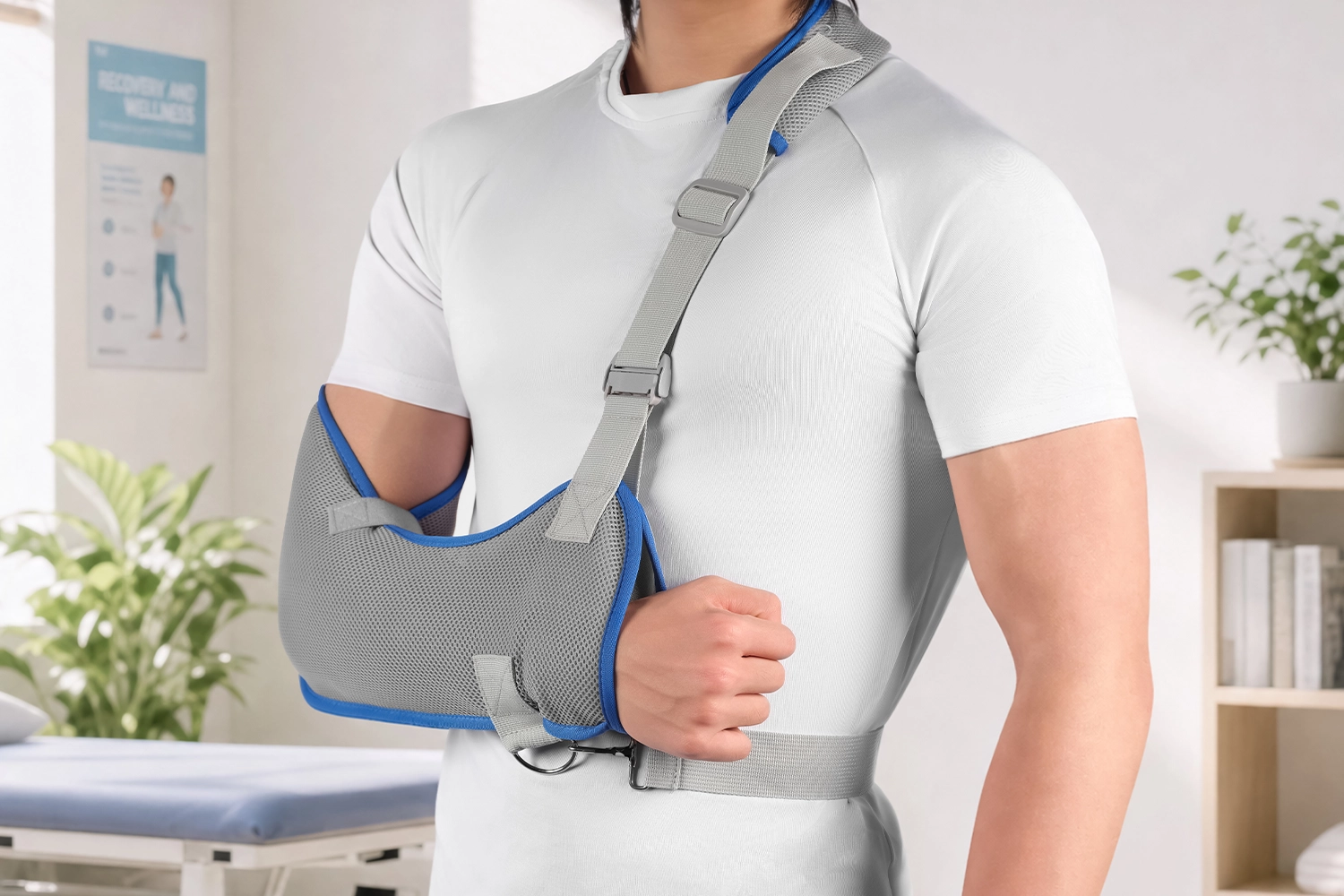
Every basic arm sling for shoulder surgery or injury shares the same essential parts:
- A fabric pouch (or cradle) where your forearm, wrist, and hand rest. Usually made from breathable fabric or mesh.
- A shoulder or neck strap that hangs the pouch, distributing your arm’s weight across your shoulder and torso instead of letting it pull on the injured joint.
- Adjustable buckles or Velcro so you can customize the fit without needing two hands (helpful, since one of yours is in a sling).
- Padding at the neck or shoulder to prevent that raw, chafed feeling after hours of wear.
A basic sling doesn’t lock your shoulder in place. It keeps your elbow bent around 90 degrees and your forearm tucked close to your body, but you can still shift and move a little. That’s intentional — it eases gravity’s pull on your shoulder without eliminating motion entirely.
When to Use a Sling: Common Injury Scenarios
Doctors reach for a sling far more often than an immobilizer. NHS guidance is refreshingly clear: for shoulder, elbow, or upper arm injuries, wear the sling as advised, but keep moving gently. Complete stillness slows healing down.
Here’s when a standard sling makes the most sense:
- Shoulder strains or soft tissue injuries: that specific ache when you lift your arm and it just protests. A sling calms things down for a few days to two weeks while you heal.
- Shoulder dislocations and AC joint separations: these often start with an immobilizer sling to limit swinging, transitioning to lighter support as stability returns.
- Clavicle fractures and stable, uncomplicated arm fractures: the sling holds your upper arm and forearm against your chest, taking gravity out of the equation. Both AO and NHS resources list this as a textbook use case.
- Rotator cuff strains or tears: short-term support during the acute phase or right after surgery, easing pain without locking you down.
- Post-surgical recovery for simpler procedures: shoulder and clavicle surgeries typically call for 2–6 weeks in a sling. ORIF surgery for proximal humerus fractures often means at least 3 weeks, removed briefly for eating, dressing, and bathing. Clavicle ORIF patients frequently wear it full-time for two weeks, then just when heading out in public afterward.
Wear time varies by severity. A minor strain might need days. Stable fractures often need the full 2–6 week window. Some large tuberosity fractures with minimal displacement require a strict 6 weeks. No shortcuts there.
Across every scenario, your arm rests supported with your elbow bent near 90 degrees and your forearm across your chest, while you still move naturally through your day.
What Is a Shoulder Immobilizer? Definition, Structure & Application
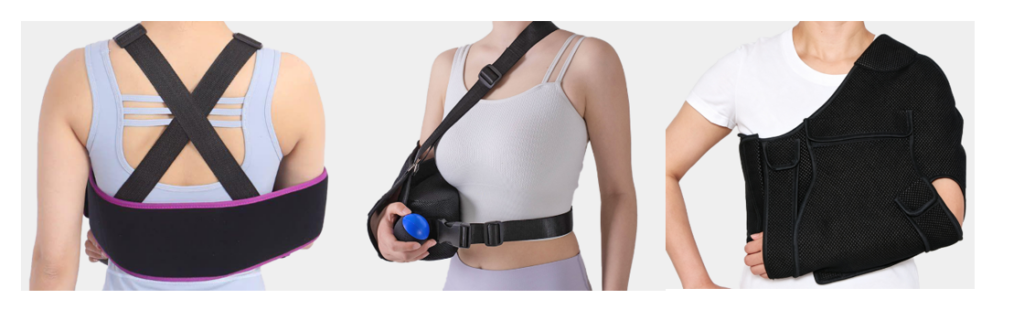
Think of a shoulder immobilizer as a sling’s stricter older sibling. It locks your arm down. This immobilizer brace works through external fixation: your forearm rests in a pouch, just like a sling, but then a waist or torso strap cinches your arm firmly against your body. Your shoulder can’t freely rotate around your trunk anymore.
Some versions include an abduction pillow, which holds your arm slightly away from your body to reduce tension on healing tendons.
Here’s what’s typically packed into the structure:
- Sling or arm pouch: cradles your forearm and hand
- Torso-control strap or secure body attachment: anchors your arm to your torso, blocking rotation
| Feature | Body Swathe | Torso Strap | Waist Belt |
| Primary Role | Pins upper arm firmly to the torso | Controls directional drift of the upper arm | Anchors the base at the waist to stop shifting |
| Coverage | Wraps broadly around the chest and arm | Routes across specific anchor points on the brace | Circles lower around the waist or abdomen |
| Common Use | Post-surgery or major shoulder fractures | General shoulder instability or mild separation | Heavy or specialized abduction-pillow braces |
- Optional abduction pillow: some models add this to hold your arm slightly away from your body, usually at a 10°–15° angle. The abduction pillow prevents internal rotation contracture and keeps your shoulder properly aligned during healing.
When to Use a Shoulder Immobilizer: Common Injury Scenarios
Surgeons don’t reach for a shoulder immobilizer lightly. When they do, it’s because the joint needs serious protection.
- Anterior shoulder dislocation (after reduction): Once your shoulder pops back into place, an immobilizer — often called a shoulder dislocation brace — blocks external rotation so the joint can’t slip out again while soft tissues knit back together.
- Chronic subluxation or shoulder instability: Repeated partial dislocations call for the same rotation-limiting design, worn longer.
- Rotator cuff repair: This is one of the most common reasons for a rotator cuff sling with a body strap. Early tension on a fresh repair can undo the surgeon’s work, so motion gets locked down almost entirely.
- Bankart repair and capsular shift: These stabilization procedures protect the healing capsule and labrum. One rehab protocol calls for 4 to 6 weeks in the sling, allowing only early, graded, protected motion.
- Serious fractures: Humeral head fractures, scapula fractures, shoulder girdle fractures, and greater tuberosity fracture-dislocations often need immobilization in slight abduction to minimize passive tension on the surgical hardware. For greater tuberosity fractures with less than 5mm of displacement, doctors sometimes order weekly X-rays for three weeks because even small shifts can worsen fast.
- AC joint dislocation: Both surgical and nonsurgical cases may call for immobilization.
- Shoulder arthroplasty and biceps tenodesis: These procedures are also common indications for stricter, longer-term bracing.
Across all of these, the goal is to keep the joint completely still so healing tissue isn’t undone by everyday movement.
Shoulder Immobilizer Vs Sling: Key Differences at a Glance
| Dimension | Sling | Shoulder Immobilizer |
| Motion allowed | Some swinging, limited movement | Nearly none; rotation and drift are blocked |
| Main job | Support the arm, ease gravity’s pull | Support plus strong restriction |
| Stability | Moderate | High, ideal after a shoulder dislocation brace is needed |
| Comfort | Lighter, easier for daily wear | Bulkier, but more protective |
| Application | general shoulder fracture immobilization or comfort-focused recovery | post-surgery shoulder support for dislocations, rotator cuff sling situations, or repairs needing zero movement |
| Pros | Lighter and easier to live in. You can shower, get dressed, and move through your day without fighting your own gear. Eases pain during mild-to-moderate injuries by taking gravity’s pull off the joint. Simple to put on and adjust, even one-handed, even on a bad day. Costs less, which matters if you’re only wearing it for a couple of weeks. | Locks the joint down, which is exactly what a fresh rotator cuff repair or a shoulder dislocation brace situation demands. Blocks accidental movement that could undo a surgeon’s work in the first vulnerable weeks. Handles the tough cases: fractures, instability, post-op protocols requiring strict internal rotation control. |
| Cons | Limited hold. A sling won’t stop harmful rotation the way an immobilizer will. Stiffness can creep in if you’re stuck in one for too long without moving at all. Not built for serious cases. Bigger tears, unstable fractures, or post-surgical repairs that need real rotation control will outgrow a basic sling fast. | Bulkier and more restrictive. Everyday tasks like getting dressed or driving become harder. Comfort takes a hit. Long stretches in one can cause skin irritation or that raw, pressed feeling. Less practical day-to-day, since it limits so much more than a sling does. |
Bottom line: a sling means comfort and light support; an immobilizer means protection and strict control. Match the device to how much stillness your shoulder actually needs.
Conclusion
So while a sling limits motion loosely, an immobilizer eliminates it almost entirely, including swinging, rotating, and drifting outward. It restricts all of that. The goal is maximum postoperative control when your shoulder needs to stay completely still.
Choosing between a shoulder immobilizer and an arm sling comes down to matching support to your specific injury. A sling cradles a healing joint and allows a little natural movement; an immobilizer locks the arm against the body when surgeons need zero motion during the critical early recovery weeks.
Even the best brace won’t do its job if it’s the wrong one. Now update your design and product line with AOFIT, your reliable medical brace manufacturer. Our shoulder brace categories are designed around patients’ frustrations. In addition, we offer complete OEM/ODM shoulder braces based on your requirement.