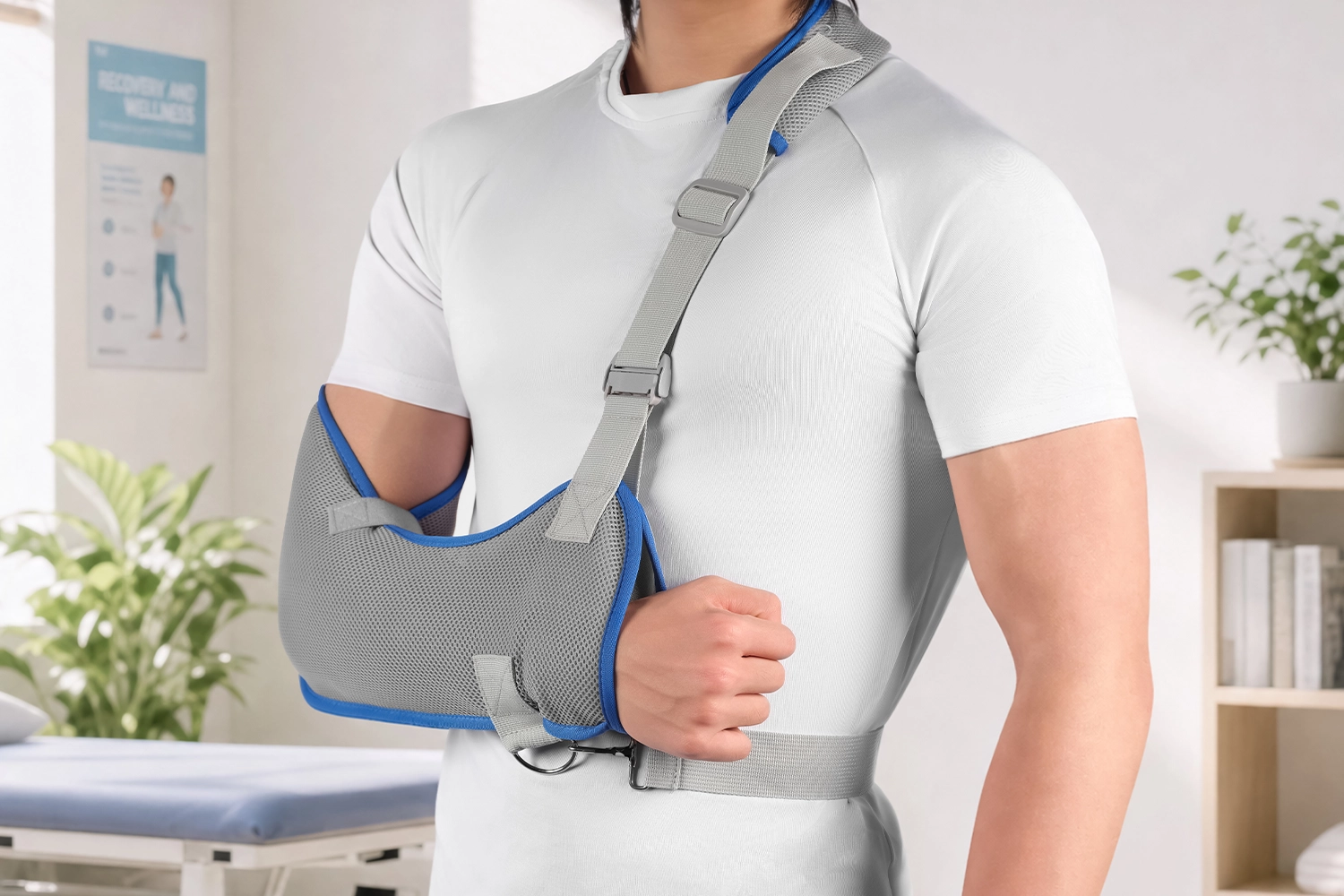
That first night home from shoulder surgery, you’re exhausted, your arm is throbbing, and lying flat feels impossible in that bulky sling. Sound familiar? You’re not alone. Figuring out how to sleep with an arm sling is one of the most common and most frustrating challenges during recovery, and most doctors don’t give you nearly enough guidance before sending you home.
The good news: a few simple adjustments to your setup can make a world of difference. We’ll walk through How To Sleep With an Arm Sling, including the best shoulder sling sleep position, the tools that actually help, and how long you really need to keep that sling on overnight. Better sleep and a smoother recovery start here.
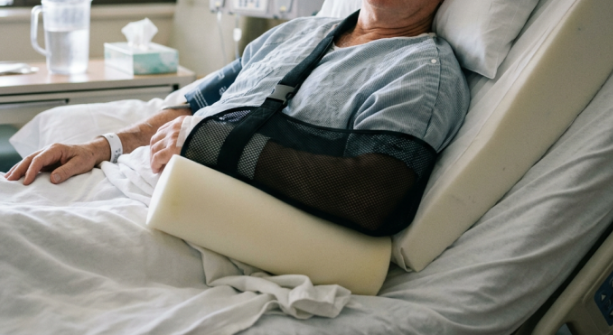
Tip 1: Hold the Best Sleeping Position With Arm Sling: Back Sleeping Setup
Sleeping on your back, propped up at an angle, is the safest position after shoulder surgery or injury. That’s what doctors keep saying. It’s not how you normally sleep, but it works. Here’s how to set it up.
Position Yourself and Arm for Support
The angle you want is 30–45°. You can get there with a wedge pillow, three or four stacked regular pillows, or by sleeping upright in a recliner (more on that later). This half-reclined position takes pressure off your shoulder, keeps you from rolling in your sleep, and makes it much easier for your arm to stay in a neutral, relaxed position.
Propping yourself up at an angle isn’t enough. How you position the pillows under your arm matters just as much.
Support the whole arm. A common mistake is tucking one pillow under the elbow and calling it done. But if your forearm isn’t supported too, it droops and pulls on your shoulder all night long. Instead, stack 1–2 pillows so they support the entire chain, shoulder to elbow to forearm to wrist to hand, letting your shoulder rest slightly forward with your hand fully cradled.
Get the angle right. Aim for your elbow bent around 90°. Anywhere from 30–90° stays in the comfortable neutral zone, but closer to a right angle feels most natural for most people. Keep your arm about 10–15° in front of your chest rather than pressed against it. Think of it as resting your forearm on a little pillow “platform” in front of you, leaving a small gap between your arm and torso.
Step-by-Step: Getting Into Position
- Set your incline first. Prop your headboard, pillows, or recliner to that 30–45° angle before you lie down.
- Ease yourself back. Slide into position so your head, shoulders, and upper back are all resting on the support, not hanging off the edge.
- Tuck a pillow under your elbow and forearm. This keeps your injured arm at chest height, close to your heart, instead of letting it droop or pull on the sling.
- Place a “blocker pillow” beside your injured side. This is your insurance against rolling over during the night and crushing the surgical shoulder.
- Add a pillow under your knees. This one surprises people, but it makes a real difference. Bending your knees slightly takes pressure off your lower back and helps your whole body settle into a relaxed, slightly curled position.
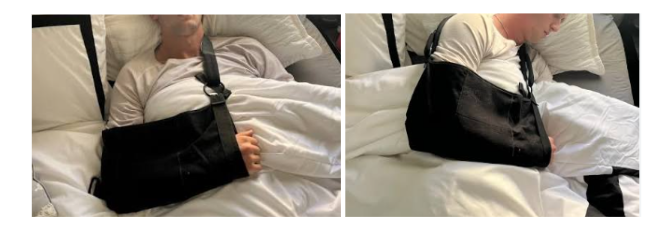
Who This Position Helps Most
This setup works best if you’re recovering from shoulder surgery, dealing with a shoulder dislocation, or managing a fracture in your collarbone or upper arm. If lying flat makes your shoulder ache or your hand swell overnight, the half-reclined position is almost always more comfortable, and often the only way to get real rest.
Can You Sleep on Your Side With a Shoulder Sling?
Side sleeping takes more work than back sleeping after a shoulder injury, but you don’t have to rule it out completely. You can usually sleep on your unaffected side once your doctor clears you, as long as your arm stays fully supported all night.
How to sleep on your unaffected side:
- Lay a long pillow or two stacked pillows under your affected arm, cradling the forearm and elbow so nothing droops.
- Put a pillow in front of your chest so your injured arm rests on top instead of sliding forward.
- Tuck another pillow behind your back to catch you if you roll.
A body pillow works even better. Hug it against your chest and rest your upper arm along the top edge, so your arm never lies unsupported.
Timing matters. Most guidance suggests waiting around 4–6 weeks before trying your unaffected side, and closer to 10–12 weeks, with your surgeon’s confirmation, before sleeping on the affected side. Don’t sleep directly on the surgical shoulder before that point. Direct pressure strains the healing tendon-bone interface and can genuinely slow recovery.
Tip 2: Get Right Tools and Avoid Bad Habits
The right pillow setup and habits matter just as much as the right sleep position. You could have perfect form and still wake up in pain if your tools aren’t doing their job.
Essential Tools for Comfortable Sling Sleep
Wedge pillow for shoulder surgery. Look for one with a 10–20° slope (some clinical setups test closer to 20–22°), and a height around 8–10 inches at the tall end. Skip the ones that only lift your head. You want your shoulders and upper back resting on the incline too, not just your skull.
No wedge? Stack regular pillows instead. Start at your lower back with your biggest, firmest pillow. Layer 1–2 medium pillows on top, overlapping them so there’s no gap for your torso to sink into. Finish with something soft under your neck. The goal is a smooth 15–30° slope, built from the bottom up.
Recliner sleeping after shoulder surgery is genuinely one of the best options for the first couple of weeks. It holds a fixed 30–40° angle all night, so you’re not sliding flat by 3am. It also makes getting up far easier, which matters when you’re avoiding pressure on a fresh incision.
For your elbow and forearm: a firm pillow gives steady support; a rolled towel is great for small gaps. Combining a wedge, neck pillow, and side pillow gives the most stable setup for long-term sleep.
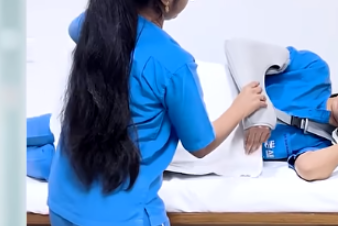
Habits to Avoid When Sleeping in a Sling
A few nighttime habits can quietly undo all your careful pillow work.
Stomach sleeping is off the table. If that’s your natural position, this recovery period will feel strange at first. Lying face-down forces your shoulder and collarbone into an unnatural rotation, pressing your arm inward and forward exactly where healing tissue can’t handle the load.
Sleeping directly on your surgical side is just as risky. Rotator cuff repairs face extra strain on the healing tendon when compressed this way. Clavicle fractures can actually shift under that pressure. Even dislocations are vulnerable, since front-side compression stresses the ligaments trying to knit back together.
Lying flat without support is another mistake, especially in the first weeks. An unsupported arm droops downward, pulling on the shoulder and often worsening swelling overnight.
Never remove a sling your surgeon has prescribed for overnight wear, even if it feels bulky or uncomfortable. Your body doesn’t ask permission before it rolls over in the middle of the night.
Tip 3: Sleep With the Sling On All Night?
Yes, in almost every case. That bulky sling does its most important job while you’re unconscious and can’t control your own movements. A drowsy roll, an unconscious stretch, a shoulder that drifts into rotation — any of these can strain fresh repair tissue. That’s why nighttime wear shows up in post-op instructions as part of the full 24-hour recovery window.
How long depends on what was done:
- Arthroscopic shoulder surgery: roughly 1–2 weeks of overnight wear
- Labral repair: around 4 weeks
- Shoulder replacement: typically 4–6 weeks
- Rotator cuff repair: often 6 weeks, with some surgeons specifying “all day and night” until you’re cleared
- Proximal humerus fracture: NHS guidance points to 6 full weeks, 24/7, with tapering starting around week 4 and full removal near week 8
Check the fit before you drift off. Snug, not tight, is the goal. Your hand should stay warm, visible, and free of numbness. Elbow bent close to 90°, forearm resting flat, a small gap between your arm and your chest. Cold fingers, purple skin, tingling, or a deep strap mark? That’s your sign to loosen it.
When Can You Remove the Sling at Night?
Your body tells you when it’s ready, and your surgeon confirms it. Doctors and physical therapists look for a few signs before they clear you for overnight sling removal — nighttime pain has dropped and stays down for several consecutive nights, you’re relying less on pain meds, and passive range of motion improves without sharp pulling. You also need proof you can sleep through stretches without rolling or unconsciously lifting your arm.
Typical nighttime windows by injury:
- Dislocation: about 1 week, sometimes extending to 3–4 weeks
- Fracture: 3–6 weeks, often a full 6 weeks
- Rotator cuff repair: 5–6 weeks, up to 6–10 for larger repairs
- Labral repair: around 4 weeks
- Shoulder replacement: 4–6 weeks
Removing it early risks re-injury — always confirm with your provider first.
Frequently Asked Questions About How To Sleep With an Arm Sling
Is it normal for sleep to hurt more than daytime rest?
Yes. Nighttime pain often feels sharper because you’re not consciously guarding your arm. The fix is the same 30–45° half-recline setup, with your forearm cradled and a blocker pillow behind you, plus pain meds taken early enough to kick in before lights out.
Does the required sling time differ by injury?
Definitely. Fractures need overnight wear to prevent shifting at the break site. Dislocations usually call for 2–4 weeks of nighttime use to let ligaments stabilize. Rotator cuff repairs are the strictest, often 4–6 weeks straight, since an unconscious arm lift can undo the repair.
Bed or recliner, which one actually helps more?
A recliner holds a fixed angle all night, no sliding flat by 3am, which is why it’s so popular the first 1–2 weeks. A bed with a wedge pillow works just as well long-term and costs less. Choose whichever keeps you from waking up flat on your back with your arm unsupported.
Can I just skip the sling one night if I’m sore?
No. Unless your surgeon has specifically cleared you, keep wearing it.
Conclusion
Sleeping with an arm sling is about giving your shoulder the quiet, uninterrupted time it needs to heal. That means staying propped at a gentle recline (wedge pillow or recliner), keeping your arm cushioned and supported instead of dangling or twisting, and resisting the urge to ditch the sling too early—no matter how tempting by night three.
Those first few weeks of awkward, sling-bound sleep won’t last forever. Every night you protect that shoulder moves you toward a smoother, faster recovery.
Even the best brace won’t do its job if wearing it in the wrong way. Now choose a OEM/ODM shoulder braces manufacturer who can give you detailed branding and complete introduction info. AOFIT, your reliable medical brace manufacturer, designs and makes shoulder braces around patients’ frustrations and gives you the most clear wearing way.