You’ve got a nagging backache, or maybe you want to snatch that waist, and someone told you a waist trainer would work just as well as a back brace. Or maybe it was the other way around. Either way, you’re here because you want the real answer, not a guess.
These two products look similar: both wrap around your midsection and promise support. But they’re built for completely different jobs. Using the wrong one could leave you in more pain than when you started.
We break down Waist Trainer Vs Brace on what each product does, where they overlap (if at all), and how to know which one your body actually needs.
What Is a Waist Trainer? Purpose & Function
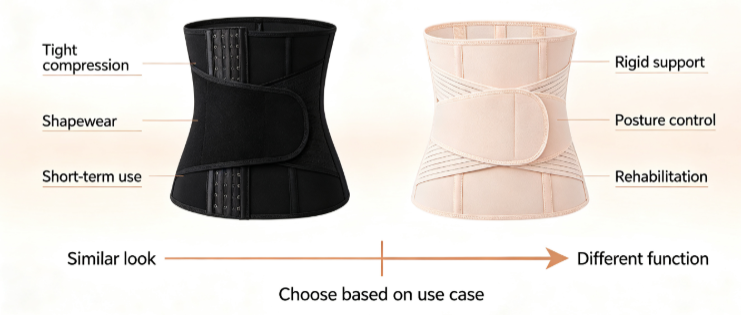
A waist trainer is high-compression shapewear built to squeeze your midsection into a smaller-looking silhouette. Compression is its only job. It doesn’t heal or provide long-term support.
Most waist trainers are made from latex, neoprene, or nylon-spandex, reinforced with steel or plastic boning that stops the fabric from rolling, wrinkling, or shifting out of place. That boning locks in the compression so your waistline stays tucked all day.
Common styles include:
– Latex cinchers — the strongest compression, a favorite for gym sessions
– Steel-boned corset trainers — maximum shaping, sturdiest structure
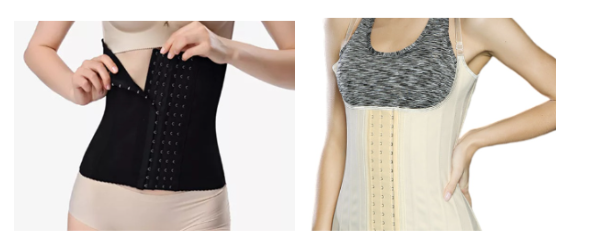
Closures vary too — hook-and-eye, zippers, sometimes Velcro or wraparound straps. Zipper styles are quick on-and-off. Hook-and-eye styles adjust easier, letting you tighten gradually as you go.
What People Actually Use Them For
- Visual waist shaping — the classic hourglass look under clothes
- Workout sweat sessions — latex and neoprene trap heat, popular in fitness circles
- Everyday smoothing — worn under outfits for a flatter line
Waist trainers do not permanently shrink your waist or fix postpartum bodies. They create an instant compressed appearance and nothing more. Latex gives the strongest compression. Hook-and-eye gives the most adjustability. Zippers are the most convenient.
What Is a Lower Back Brace/Waist Brace? Purpose & Function
A back brace is a medical support device. Doctors sometimes call it an “external skeleton” because that’s exactly what it does: holds your spine and torso in place from the outside. (It isn’t shapewear.)
Core structure varies by type, but most back braces share a few key parts. You get adjustable straps for a custom fit, compression material for the main body, and rigid stays or panels (metal or plastic) running along the front and back for added support. Softer versions skip the rigid panels and use elastic compression instead.
The Three Main Jobs of a Back Brace
- Spinal stabilization. Limits excessive bending, twisting, and extension. This protects unstable or injured areas of your spine from movements that could make things worse.
- Post-injury or post-surgery recovery. Doctors often recommend braces after spinal fusion, fractures, or other spine-related surgeries. The brace creates a stable environment so bones, ligaments, and muscles can actually heal, and it lowers your risk of re-injury while that happens.
- Posture correction and load reduction. Keep your spine aligned in a more neutral position. This eases muscle strain and takes pressure off your spine, which helps if you’re dealing with poor posture, long hours sitting or standing, or mild back pain.
Soft, Semi-Rigid, or Rigid: Which One?
- Soft braces work for mild muscle strain, everyday posture reminders, or light back pain.
- Semi-rigid braces add removable stays for extra stability, good for chronic pain, disc issues, or recovery periods.
- Rigid braces use full panels to seriously limit movement. These show up most after fractures, surgery, or when your spine needs real restriction.
Waist Trainer Vs Brace: Key Differences
A waist trainer and a back brace solve different problems. Let’s explore the reason with the Side-by-Side Comparison.
Coverage
Waist trainers focus on a slim zone — the 10–20 cm stretch between your lower ribs and hip crest. Their force is concentrated at your natural waist, the softest and most compressible area of your torso. This produces 360° compression of abdominal soft tissue, with little impact above or below that region.
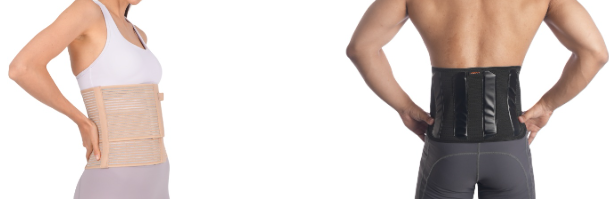
Back braces provide broader coverage, depending on the type:
- Flexible lumbar belts cover the L1–L5 region. They span 20–30 cm and extend slightly into the lower thoracic spine and across the sacroiliac joint.
- Rigid TLSO braces extend from just below the collarbone down to the sacrum. Hard plastic panels cover the entire front and back of the trunk.
Compression Zone
A waist trainer applies high, uniform pressure around the waistline. This helps reshape soft tissue but does little to control spinal movement. A back brace, by contrast, combines a front abdominal panel with a rigid back stay to create a three- or four-point support system. This limits forward bending, backward bending, and twisting — not just waist size.
Material Rigidity
| Device | Core Material | Structural Support |
| Waist trainer (cincher) | Latex, neoprene, spandex | Thin plastic boning, minimal |
| Waist trainer (steel-boned) | Latex + fabric | 12–24 steel bones, garment-grade |
| Flexible back brace | Elastic fabric, canvas | Wide elastic bands, no rigid stays |
| Semi-rigid back brace | Neoprene shell | Plastic or metal back inserts |
| Rigid TLSO | Cotton/canvas shell | Large plastic or metal plates, full orthosis |
The One-Line Rule
- Waist trainer = compression for looks.
- Back brace = support for function.
Wear Time
Most waist trainer brands recommend 6–8 hours a day for active shaping programs. Some medical professionals suggest limiting it to 2 hours, especially during exercise. No standard clinical guideline exists, so you set your own schedule.
Back brace wear time is determined by a doctor. After surgery or a fracture, protocols may require near-continuous use for 6–12 weeks, with the time gradually reduced as healing progresses. A clinician monitors and adjusts that timeline. Wearing a back brace too long without professional oversight can cause genuine muscle weakening — so don’t skip the supervision.
| Dimension | Waist Trainer | Back Brace |
| Core Goal | Shape, compress, visually slim | Stabilize, support, reduce pain, restrict harmful motion |
| Target Area | Abdominal soft tissue, waistline | Spine, lumbar spine, sacral structure |
| Mechanism | External compression alters body contour | Support and movement restriction reduce spinal load |
| Typical Use | Body shaping, photos, short-term wear | Low back pain, fractures, post-surgery recovery, scoliosis |
| Effect Duration | Instant, wear-time only, fades once removed | Can improve pain and function during treatment; long-term results vary |
Can Waist Trainers and Back Braces Be Used Interchangeably?
Short answer: no. Not even close.
A waist trainer compresses. A back brace stabilizes. Swap one for the other, and you create a new problem while trying to solve a different one.
The Two Most Common Mix-Ups
Mistake #1: Wearing a waist trainer during heavy lifting or manual labor.
People grab a cincher thinking it’ll “support” their back at work. It won’t. Waist trainers offer zero medical-grade lumbar stability. Worse, they create a false sense of security. You feel protected, so you bend, twist, and lift like you’re wearing armor. You’re not. That mismatch between perceived support and actual support is exactly how lower back injuries happen.
Mistake #2: Wearing a back brace hoping to shrink your waistline.
Back braces aren’t built for shaping. They’re rigid, functional, and medical. Force one to do a waist trainer’s job, and you’ll get pressure points, discomfort, and still no visible waist compression. It’s the wrong tool doing the wrong job, poorly.
What Goes Wrong When You Mix Them Up
- Insufficient support. A waist trainer can’t protect your spine during lifting, pushing, or bending, the moments your back needs it most.
- Overcompression. Long-term tight cinching (from either product used wrong) raises abdominal pressure, shallows your breathing, and can trigger acid reflux, bloating, or constipation.
- Muscle dependency. Rely on external compression long enough, and your core muscles stop doing their job. Weaker core, worse posture, higher risk of back pain down the line.
- Workout risks. Mixing waist trainers into high-activity settings compresses your stomach and ribcage, restricting breathing exactly when you need oxygen most.
The Judgment Call
Use the wrong one and you get too little support when you need it, or too much compression when you don’t.
Waist Trainer Vs Brace: How to Choose the Right Product for Your Needs
Start with one question: is this a medical problem or a mirror problem?
That single answer sorts everything else.
Medical Need vs. Aesthetic Need: The Fast Decision Tree
If you’re dealing with an actual diagnosis, injury, or functional issue, you’re in medical territory. Check for registered medical device certification, defined risk classification, and clear indications for use. If you’re just chasing a look for a night out or a photo, you’re in aesthetic territory. Comfort, material, and fit matter more than paperwork here.
Ask yourself:
- Do I have a diagnosed condition, injury, or functional limitation? → Medical path.
- Am I after appearance, comfort, or style preference only? → Aesthetic path.
- Will this touch broken skin, mucous membranes, or involve implantation? → Treat it like a medical device question, not a shopping question.
Pre-Purchase Checklist
Before you buy either product, run through this:
- Do you have a doctor’s diagnosis or documented symptoms? If yes, shop the back brace category with medical criteria in mind.
- Any history of allergies, implants, or skin sensitivity? Check material composition and biocompatibility data before committing.
- Is your goal singular? “Support my spine” is a clear goal. “Support my spine AND shrink my waist” isn’t, and that confusion leads people straight to the wrong product.
Three Hard Specs Worth Checking
- Breathable, skin-safe material — especially if you’ll wear it for hours
- Adjustable range — bands, buckles, sizing tiers beat one-size-fits-all
- Verified certification — match certificate numbers, manufacturer name, and device model, not just a badge on a product page
Pick based on need, not hype.
Conclusion
A waist trainer and a back brace might look similar, but they serve different purposes. One is built to shape and compress. The other is engineered to support and heal. Swapping them doesn’t save money—it risks your spine (or ribs).
Waist trainers and back braces are not interchangeable. Your body isn’t a one-size-fits-all situation, and neither is the gear you strap to it.
Looking for a support and brace manufacturer with One-Stop Orthopedic Solutions to satisfy your both waist trainer and back brace manufacturing needs? Contact AOFIT now, and we produce fully finished braces under your brand name, also our in-house R&D team can work with you from concept to prototype.