Every time you glance down at that black neoprene wrap, the same question pops into your head: How Long to Wear a Knee Brace for Torn Meniscus? Especially when you aren’t sure if you’re healing on schedule or just stalling.
Here’s the frustrating truth: there’s no single answer. Your timeline depends on whether you have a minor fray or a full-blown rupture, and whether you had surgery or went the non-surgical route.
That said, there are clear, medically-backed benchmarks you can follow. I’m breaking down those timelines—from acute-phase bracing to a self-assessment checklist that tells you when it’s safe to ditch the brace for good.
Meniscus Tear Severity: How It Determines Your Brace-Wearing Timeline
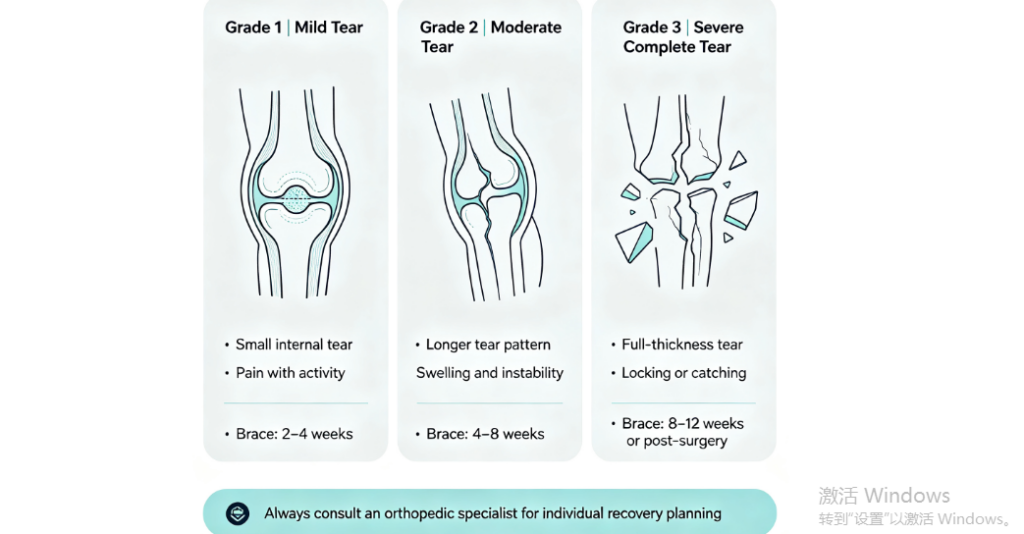
Not all meniscus tears are created equal. Your brace timeline depends entirely on how severe the tear is.
Mild tears (small or degenerative) typically need 4–6 weeks of conservative bracing while you monitor pain and swelling. Symptoms of a mild tear are subtle: localized joint-line pain, mild swelling, maybe a faint clicking sensation during twisting or stairs. Some people barely notice anything.
Moderate tears follow the same 4–6 week initial window, but with a catch: if catching, locking, or that “giving way” feeling persists, your doctor will likely extend brace use and order an MRI to confirm the tear type.
Severe tears (think bucket-handle or root tears exceeding 1cm) rarely heal on their own. If repaired surgically, expect 3–6 months of recovery. A meniscectomy (partial removal) shortens that to roughly 3–6 weeks.
Tear shape matters too. Radial and complex tears are inherently unstable, demanding longer brace protection than simple longitudinal tears. Horizontal tears often stay conservative unless swelling keeps returning.
Quick self-check:
– Mild: Localized pain, minor swelling, no locking, still walking normally
– Moderate: Recurring swelling, twisting pain, occasional catching or buckling
– Severe: Locked knee, can’t fully extend, visible limp, rapidly worsening pain
Always confirm your specific case with an orthopedic specialist—these are general benchmarks, not diagnoses.
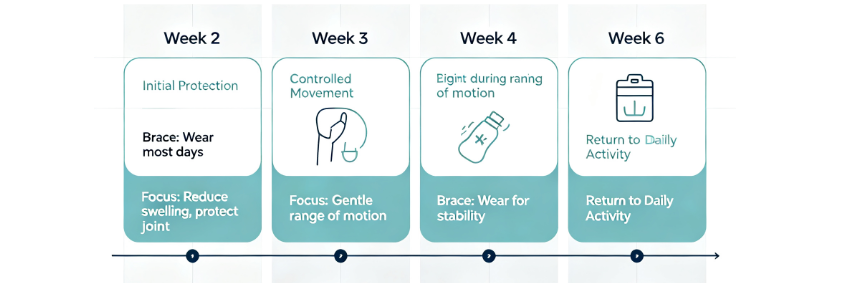
Non-Surgical Treatment: 2-6 Week Knee Brace Timeline Breakdown
Skip surgery, and your brace schedule looks pretty different. Here’s the week-by-week breakdown orthopedic specialists recommend for meniscus tear treatment without surgery.
Weeks 1-2: Round-the-Clock Protection
Expect to wear your brace during the day and while sleeping. This is the inflammation peak—your body needs maximum stabilization. You’ll only remove it briefly for icing, cleaning, or specific exercises your doctor prescribes.
Weeks 2-4: Mild Tears Start Tapering
With a mild tear, this is when you typically transition from all-day wear to activity-only bracing. Watch for swelling to drop noticeably, walking to feel steadier, and daily movements to stop triggering sharp pain.
Moderate tears usually stay in high-frequency wear during this window. Not quite ready to scale back yet.
Weeks 4-6: The Moderate Tear Sweet Spot
This is prime territory for moderate tears. Most people shift from continuous wear to activity-based bracing here, meaning you strap in for walking, work, or exercise, then remove it at rest.
Some sources frame the entire non-surgical recovery window as 4-8 weeks, with the brace working hardest during those first 4-6 weeks.
Beyond Week 6: On-Demand Use
Once you clear six weeks, most protocols shift to situational bracing for twisting movements, extended walking, physical labor, or sports. Rest periods typically go brace-free.
Signs You’re Ready to Reduce Wear:
– No more buckling or instability on flat ground
– Swelling and warmth keep decreasing
– Bending, standing, and stairs feel manageable
– Physical therapy exercises don’t trigger symptom flare-ups
These timelines are general guidance. Confirm your specific pace with your treating physician.
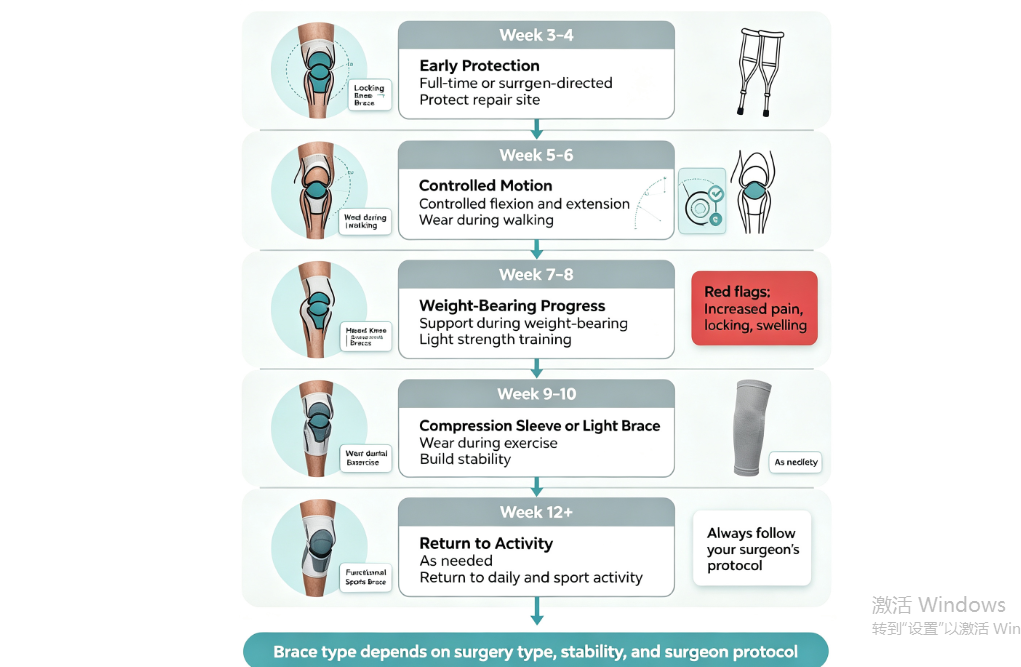
Post-Surgery Recovery: Brace Duration After Meniscus Repair (3-12+ Weeks)
Surgery changes everything about your brace timeline. The knee brace after meniscus surgery protects stitches that need time to hold.
In addition, not every brace does the same job. Choosing the Right Knee Brace Type for Your Recovery Stage. Quick match: mild swelling with a stable knee? A sleeve. Instability, twisting, or stairs feel risky? A hinged brace. Post-op with restricted motion? A ROM immobilizer. One-sided compartment pain? An unloader brace.
Weeks 1-3: Full-Time Immobilizer, No Exceptions
Most postoperative protocols start you in a locked knee immobilizer worn full-time, including sleep. You only remove it for PT-directed exercises and showers. During this window, knee flexion is restricted to under 90 degrees. Bend past that, and you risk stressing the repair before it’s had time to heal.
Week 3-4: The Switch to Hinged Brace
Once you clear three weeks, your physical therapist typically swaps the rigid immobilizer for a hinged brace. It stays locked straight through week 3, then gets unlocked around week 4 to allow controlled range of motion. Some protocols keep this hinged brace through weeks 3-4, others stretch it to a full 6 weeks depending on tear complexity.
Weeks 6-8: Brace Discharge Window
Hospital-based guidance from HSS confirms most meniscus repair patients are out of the brace entirely by weeks 6-8. This lines up with when swelling stabilizes and controlled weight-bearing feels natural again.
Higher-Risk Repairs: 8-12+ Weeks
Root tears or displaced repairs follow a stricter path. Expect the brace locked in extension for the first 2 weeks, minimal to no weight-bearing for up to 6 weeks, and full unassisted walking delayed until weeks 8-12.
Partial Meniscectomy: A Different Story
If you had a partial meniscectomy instead of a repair, your timeline shrinks dramatically. Walking often happens within days, and prolonged bracing usually isn’t necessary at all.
Your surgeon’s specific protocol always overrides general timelines. Confirm your progression at each follow-up appointment.
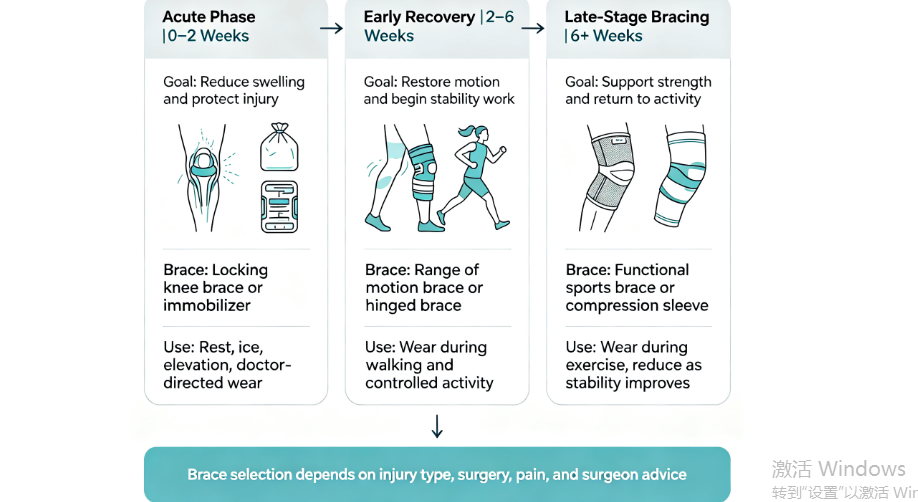
How Long to Wear a Knee Brace for Torn Meniscus? Phase-by-Phase Guide
Calendar days matter less than your knee’s actual signals. Doctors use time windows as rough guardrails, but the real decision to taper bracing comes down to function: pain scores, swelling, gait quality, and quad control. Here’s how the three phases break down when you look past the dates.
Acute Phase (0–2 Weeks): Function Says “Not Yet”
Full-time wear stays the default whenever pain, swelling, or instability are still obvious. Many protocols use a 4/10 pain threshold. Stay under that number, and you’re cleared to progress. Still relying on crutches? Can’t manage a short walk without your knee buckling? That’s your knee telling you it isn’t ready for reduced protection, regardless of what day it is.
Early Recovery (2–6 Weeks): Let Symptoms Drive the Taper
This is where activity-based bracing typically kicks in. Instead of watching a calendar, watch these four markers: pain trending down, swelling subsiding, gait steadying, and quadriceps control returning. Once those improve, you shift from all-day wear to activity-only. Brace on for walking, stairs, or training; brace off for sitting or sleeping.
Late-Stage (6+ Weeks): Stability Over Schedule
Past six weeks, most people move to situational bracing or stop altogether, provided there’s no lingering pain, gait looks near-normal, and single-leg balance holds steady. Structural repairs sometimes stretch this window to 8–12 weeks. Function, not the calendar, makes that call.
Common Mistakes: Removing Too Early vs Wearing Too Long
Ditching the brace too soon or clinging to it long after your knee’s ready to work on its own. Those two mistakes wreck more meniscus recoveries than any other decision you’ll make.
The Too-Early Trap
Most repair protocols mark weeks 4-6 as the window for gradually unlocking and phasing out the brace. Jump the gun while pain, swelling, or buckling are still there, and you’re rolling the dice on re-injury. An unstable knee without a brace forces your other muscles to pick up the slack, working in ways they aren’t ready for. If limping, instability, or swelling are still present, staying locked in extension a little longer beats risking a setback.
The Too-Long Trap
Push past weeks 5-8 with continuous wear, and different problems creep in. You get quad and hamstring deconditioning, joint stiffness, and a knee that feels weaker the moment the brace comes off. That’s your dependency signal—muscles stopped doing the stabilizing work the brace took over.
Research on knee osteoarthritis bracing found longer wear didn’t weaken strength within six months. It correlated with better hamstring strength and activity levels. What causes the trouble is skipping rehab exercises while braced, not the duration of wear alone.
Test It Safely
Walk short distances at home without the brace. Wait 24 hours. No rebound pain, swelling, or buckling? Extend the distance. Any regression sends you back a step.
5 Signs You’re Ready to Reduce Brace Use
Physical therapists use five concrete markers, not calendar dates, to decide when to scale back brace use for meniscus tear recovery. Run through this checklist before making any changes.
1. Normal Gait, No Limp
Walk across a room. If a therapist wouldn’t spot a limp, that’s a green light. Some protocols require this specific milestone before touching the brace settings.
2. Full Extension, No Quad Lag
Straighten your leg completely. Then try 10 straight-leg raises. No quadriceps lag means your muscle control has caught up to your healing.
3. Range of Motion Beyond 100°
Bend your knee. Protocols want flexion past 100 degrees, and past your brace’s lock.
4. Pain-Free Functional Loading
Stairs, standing from a chair, bending, uneven ground. If these movements don’t spike pain or trigger catching and locking, your knee is handling real-world stress well.
5. Controlled Single-Leg Squat
Attempt a single-leg squat to 30 degrees. Good control here, without wobbling or collapsing, often clears people for brace discontinuation around the six-week mark.
Sharp pain while braced, increasing swelling, numbness, or your knee giving way are red flags that override everything above. If you have any of those, call your surgeon or PT before removing the brace.
Pairing Your Brace with Physical Therapy
A brace alone won’t rebuild your knee. Physical therapy does the repair work, and pairing it with your brace schedule speeds up meniscus tear rehabilitation exercises.
Weeks 1-2 (Acute Phase): Most protocols cap flexion at 0-90°, locking the brace at 0° extension. Priority moves: quad sets (5-10 second holds, 10 reps, 3-5 sets daily), heel slides (3 sets of 10, twice daily), and ankle pumps. Patellar mobilization runs 2-3 minutes, twice a day. Weight-bearing stays “as tolerated” with crutches, brace locked straight.
Weeks 2-6 (Recovery Phase): Once you hit 10 consecutive straight-leg raises with zero quad lag, that’s your signal to start loosening brace restrictions. Add mini-squats (0-45°), step-ups, glute bridges, and stationary cycling with the seat raised high.
What to Skip: Pivoting, deep squats, twisting, and anything that spikes pain or swelling stresses the repair site. Swap those for balance training and low-resistance cycling.
Sync your exercises to these thresholds, not the calendar, and your brace timeline shortens.
Conclusion
Recovery timelines depend on severity and treatment path: 2 to 6 weeks for conservative care, 3 to 12+ weeks after surgery. Each phase—acute, early recovery, late-stage—needs a different level of brace support. The real challenge is knowing when to start dialing that support back.
Use the self-assessment checklist to track your readiness. If you have a stable gait, minimal swelling, and controlled range of motion, it’s time to start weaning off—always with your physical therapist’s guidance.
Don’t know how to launch a business on the knee brace market? Talk to AOFIT now. We are ready to service you with our full ODM/OEM knee brace line.