You’re in a medical supply aisle—or scrolling through a dozen browser tabs—staring at two products that look almost identical but promise very different things. You’re not alone. The knee stabilizer vs knee brace question trips up even the most diligent researchers, especially when you’re dealing with post-surgical recovery, a sports injury, or the slow burn of arthritis and just need something that actually works.
These two supports aren’t interchangeable. Pick the wrong one and you might under-support a healing ligament or over-restrict a joint that needs to rebuild strength. We’ll break down how each device is built, what conditions they’re designed for, and how to match your situation—whether that’s an ACL tear, a meniscus injury, or everyday joint pain—to the right level of support.
What Is a Knee Stabilizer: Definition, Structure & Best Use Cases
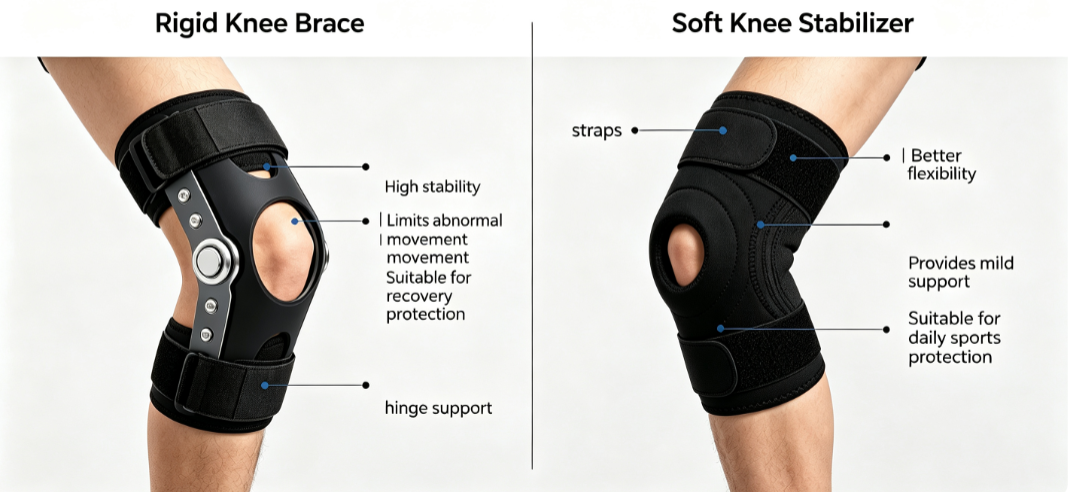
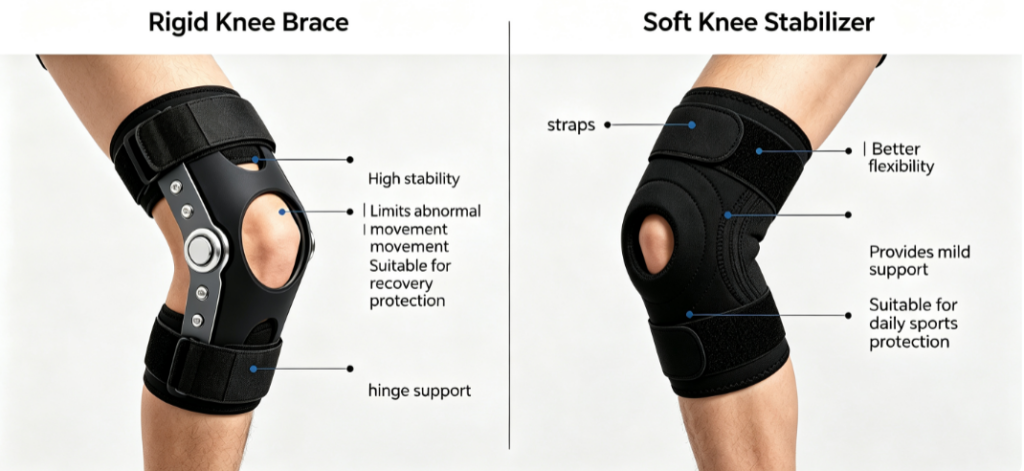
“Knee stabilizer” is an umbrella term, not one specific product. Knee brace manufacturers and medical sites use it interchangeably with “knee brace” or “knee support,” which is why shoppers get stuck comparing labels. A stabilizer delivers light to moderate reinforcement, keeping the joint aligned during movement without locking it down.
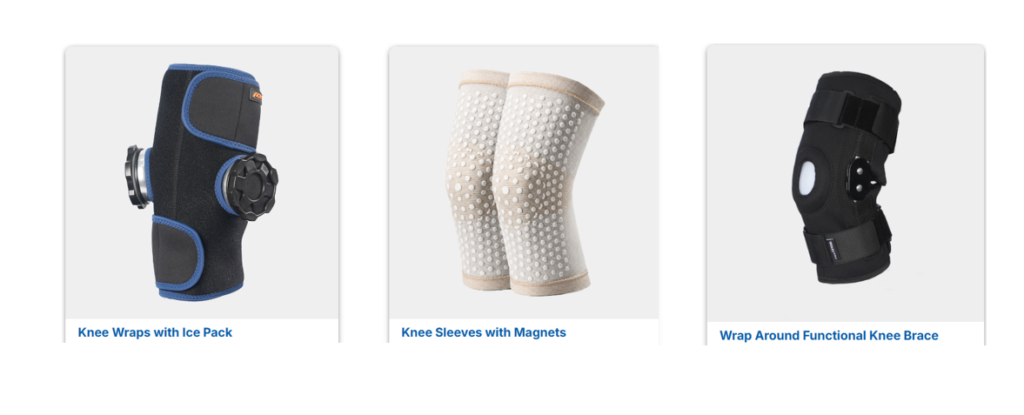
Most stabilizers use soft, stretchy materials like neoprene or blended fabrics. Basic versions rely on compression and a snug fit. More structured versions add flexible stays, adjustable straps, or hinges when extra control is needed. A practical rule: a “support” or “sleeve” has minimal mechanical features, while a “stabilizer” or “brace” brings more reinforcement. Products within this category sort into prophylactic, functional, and rehabilitative types.
Stabilizers work by supporting the knee’s own stabilization system. That includes primary stabilizers (ACL, PCL, MCL, LCL), secondary stabilizers (menisci, patella, cartilage), and dynamic stabilizers (quadriceps, hamstrings, popliteus). A patella stabilizer limits excessive lateral kneecap movement so it tracks smoothly instead of shifting during activity.
Who Needs a Stabilizer
- Mild osteoarthritis or general knee discomfort
- Sensitive or recovering knees during walking or running
- Post-injury or post-surgical patients needing protected, controlled motion (not full immobilization)
- Meniscus tears or sprains requiring comfort over rigid restriction
Sleeve, Support, or Structured Stabilizer?
| Need | Best Fit |
| Warmth, mild compression, daily wear | Compression knee sleeve |
| Kneecap tracking issues | Patella stabilizer |
| Instability or rehab motion control | Hinged, structured stabilizer |
Pricing scales with structure. Basic compression sleeves run $10–25, wraparound supports $15–40, patella stabilizers and strap braces $20–60, and hinged functional braces $40–150+. The price jump reflects added stays, straps, or hinge complexity, not marketing markup.
What Is a Knee Brace: Types, Rigidity Levels & Clinical Applications
A true knee brace earns its name through mechanical structure. Clinicians sort them into different types of knee braces: prophylactic, functional, unloader/offloader, patellofemoral, rehabilitative, and knee sleeve. The older AAOS four-category system (prophylactic, functional, rehabilitative, patellofemoral) still shows up in a lot of clinical literature, but the six-category breakdown reflects how the market works today.
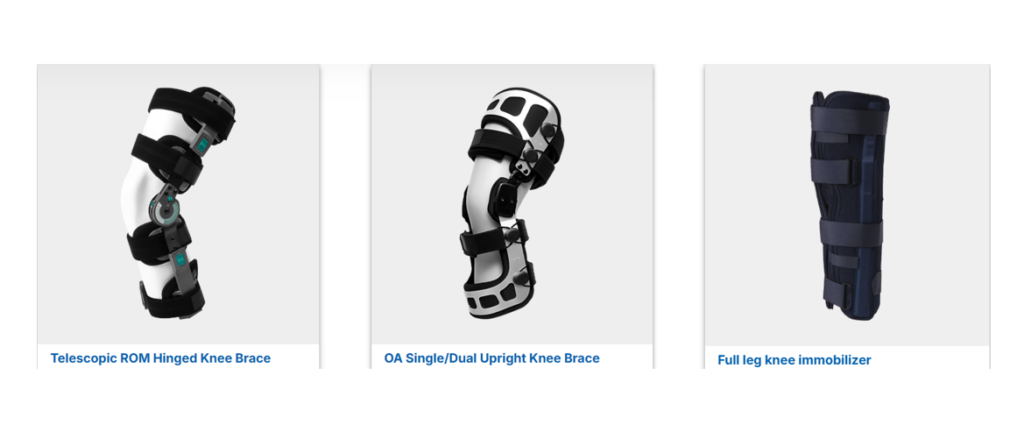
Rigidity is where things get practical. Semi-rigid braces add stays, straps, or soft hinges to a flexible base. They provide moderate support for moderate instability. Hinged knee braces step up with metal or high-strength mechanical hinges that control varus/valgus movement and manage flexion-extension, making them the go-to for ligament support brace needs after ACL, MCL, or LCL injuries. Rigid braces and immobilizers go further still, locking the knee in extension or capping range of motion entirely. They are built for post-op protection or acute injury, not for daily wear.
Matching Brace Type to Condition
- Ligament injuries (ACL/MCL/LCL): functional hinged brace during return-to-activity; rehabilitative/ROM brace early post-injury or post-op
- Knee brace for ACL recovery: rehabilitative or controlled-motion brace protects the graft immediately after surgery, transitioning to a hinged brace later
- Knee brace for meniscus tear: hinged or ROM brace when instability or surgery is involved; a sleeve only covers mild swelling
- Knee support for arthritis: unloader/offloader brace, which shifts pressure away from the damaged compartment
- Patellar dislocation/tracking issues: patella stabilizer or patellofemoral brace
- Fractures or early post-surgical protocols: knee immobilizer or controlled-motion brace
Knee Immobilizer vs. Knee Brace
An immobilizer is longer and stiffer than a brace, designed to stop all knee movement. You use it for fresh surgical repairs or fracture protection, where not moving is the medical instruction. A functional or hinged brace, by contrast, allows controlled motion once a doctor clears you to bend and flex again.
Sleeves run $15–45, patella stabilizers $15–60, hinged braces $40–150, immobilizers $30–80, post-op braces $60–300, and unloader braces $150–1,000+ depending on customization.
Knee Stabilizer Vs Knee Brace: Side-by-Side Comparison Table
| Dimension | Knee Stabilizer | Knee Brace |
| Support Level | Light to moderate | Moderate to maximum |
| Structure | Flexible, elastic, stretchy | Semi-rigid to rigid; often includes metal hinges |
| Motion Control | Allows natural movement | Restricts instability, controls flexion/extension |
| Best For | Mild discomfort, patella tracking, daily wear | Ligament injury, instability, post-op, high-stress sports |
| Bulk | Lightweight, low-profile | Heavier, more restrictive feel |
| Fitting | Usually self-selected | Often clinician-recommended |
| Cost | Lower | Higher, especially unloader models |
A 2015 American Family Physician review says functional braces counter rotational and anteroposterior forces—exactly what unstable knees need. But the same review notes that prophylactic braces, per the AAOS and American Academy of Pediatrics, lack solid evidence for preventing ligament injuries. Bracing helps stability but doesn’t guarantee prevention.
Knee Stabilizer Vs Knee Brace: Which Should You Choose
Match the product to your symptom severity, not to whichever option looks the most heavy-duty on the shelf. Overdoing it can backfire just as easily as underdoing it.
The Three-Question Decision Tree
Run through this before you buy:
- Are you in early post-surgical recovery? If yes, go with the more protective, restrictive option first. Protection outranks mobility right now.
- Are you dealing with instability—repeated buckling, giving-way, or re-injury? If yes, size up to a higher-stability brace and get imaging or a professional evaluation to rule out structural damage.
- Is it mild, everyday discomfort? If yes, a light-to-moderate stabilizer covers it. If none of these fit cleanly, factor in your activity intensity and pain threshold, then loop in a clinician.
Best Knee Support for Specific Conditions: Arthritis, ACL, Meniscus & Patella Issues
| Condition | Best Brace Type |
| Arthritis/OA | Stabilizer, hinged, or unloader brace |
| ACL recovery | Hinged functional brace with ROM control |
| Meniscus tear | Lateral stabilizer brace (unloader if OA-related) |
| Patella issues | Patellar stabilizer with lateral support |
Matching Your Scenario Further
- Athletes with active pain but full mobility: functional support, moderate protection, focus on staying in motion.
- Athletes with locking, instability, or repeated sprains: upgrade immediately and get evaluated for structural injury.
- Arthritis patients without instability: light-to-moderate support to reduce daily pain without weakening surrounding muscle.
- Arthritis patients with visible wobbling or deformity progression: more stable options, but avoid over-restricting—muscle atrophy from disuse is a real risk.
- Post-op patients: high protection early, gradual step-down as tissue heals, shifting toward active rehab later.
The Three Inputs That Matter
Before purchasing, weigh symptom severity (mild pain, instability, or surgical stage), functional goal (walking, training, weight-bearing, protecting healing tissue), and risk threshold (how much re-injury or delayed recovery would cost you). Over-bracing creates dependency without added benefit. Under-bracing leaves you exposed to setbacks. The goal is the right support for where you are right now.
Frequently Asked Questions About Knee Stabilizers and Braces
Real questions from real shoppers, answered without the fluff.
How long should I wear a knee brace each day? There’s no universal rule. For post-surgical or ligament cases, you wear support during high-risk activities, not 24/7. Follow your clinician’s protocol over any generic guideline.
Can I wear a knee stabilizer while running or during sports? Yes, if it’s a functional stabilizer built for movement. Prophylactic braces for contact sports lack strong evidence for injury prevention, so don’t overpay expecting guarantees.
Can I layer a compression sleeve under a brace? Absolutely. It’s common practice post-op or during swelling.
Will bracing weaken my knee long-term? Overreliance can reduce muscle engagement, but supervised use during rehab is standard and safe.
Can You Sleep With A Knee Brace On? You can sleep with a knee brace on, but only if your doctor or PT specifically told you to. If they did, keep it on. If not, take it off before bed.
Conclusion
The choice between a knee stabilizer and a knee brace comes down to what your body needs right now. A stabilizer gives you light, breathable support for everyday aches and mild instability. A hinged knee brace provides structured protection after ligament injuries, surgery, or moderate arthritis flare-ups. Picking the wrong one wastes money, and it can slow healing or leave your joint vulnerable to reinjury.
Before you buy a brace, revisit your diagnosis, activity level, and recovery timeline. Cross-check them against the comparison table and decision guide above. If you’re still unsure whether you need extra rigidity or simple compression, don’t guess—consult an orthopedic specialist or physical therapist who can assess your knee’s specific mechanics.
Don’t know how to launch a business on the knee brace market? Talk to AOFIT now. We are ready to service you with our full ODM/OEM knee brace line.