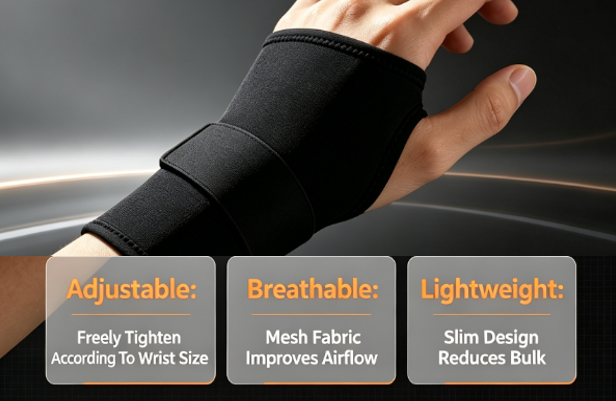
You know that moment when you finally give in and buy a wrist brace, only to rip it off an hour later because it’s strangling your hand or sliding around like a loose sock? Yeah, that one. Most people shopping for a wrist support brace have been there—stuck between something that holds their joint in place and something they can stand to wear past lunchtime. The difference almost always comes down to wrist brace design. The best carpal tunnel wrist brace options get three things right: adjustability, breathability, and a low-profile fit that doesn’t announce itself under a sleeve. This guide breaks down how those three elements work together (or don’t), compares the materials manufacturers actually use, and helps you figure out which combination fits your wrist, your routine, and your patience for fussing with velcro straps.
Understanding Wrist Brace Design: Why These Three Features Matter
A wrist brace is really three arguments happening at once. Immobilization wants to lock your joint down. Support wants to keep things stable enough to function. Comfort wants you to actually keep the thing on past hour two. Every wrist splint design is a negotiated peace treaty between those three, and the good ones settle it in your favor.
Breathable Construction: Preventing Heat and Sweat Buildup
Sweat is the real brace-killer, and most product descriptions never mention it. You can nail the adjustability, get the compression exactly right, and still end up peeling off a swampy brace by 3pm because nobody thought about what happens to your skin over eight straight hours.
Neoprene
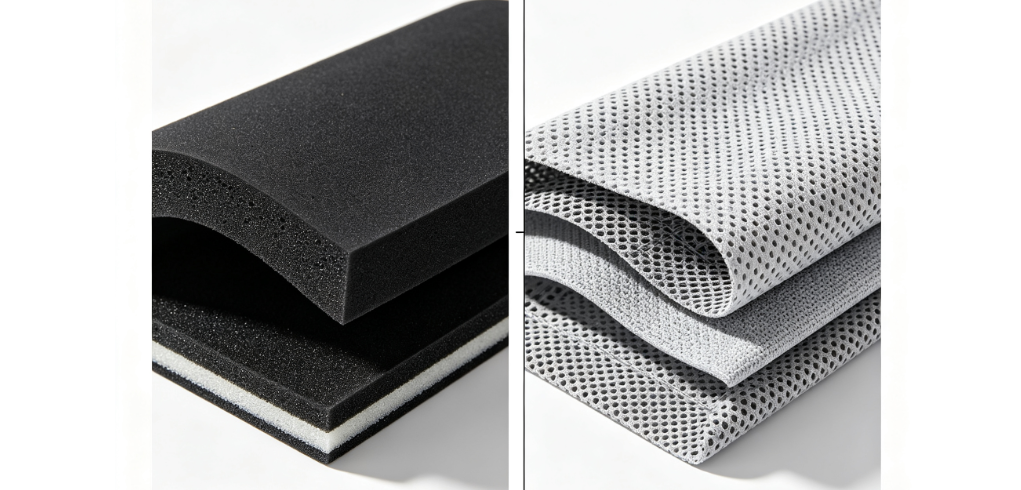
Neoprene is the classic wrist brace material because it compresses well, holds heat, and feels sturdy right out of the box. It’s also the reason so many people quit wearing their brace by lunch. Thick neoprene traps heat and moisture against skin, and it’s been linked to contact dermatitis in some wearers, with one clinical dataset showing a 2.4% patch test positive rate tied to thiourea compounds used in the rubber.
Fabric blends
Perforated neoprene wrist braces(Airprene) keep the compression but punches airflow channels through it. Mesh panels swap heat retention for near-instant breathability, drying in 30–60 minutes compared to hours for solid foam. Some braces blend 60% neoprene with nylon and polyester for a support-forward compromise; others go further, pairing 80% Airprene SBR neoprene with 10% Coolmax polyester and 10% nylon, a warm outer shell with a sweat-wicking inner layer.
Air-layer knit
For sensitive skin or all-day office wear, latex-free, neoprene-free, hypoallergenic designs using 3D spacer fabric replace foam with an air-layer knit. Moisture-wicking liners pull sweat off your skin and spread it toward the outer fabric to evaporate. That’s the actual mechanism behind every “all-day comfort” claim on the label.
Adjustable Fit: Moving from high support to lighter support
Some wrist braces labeled adjustable are just a single strap you yank as tight as your patience allows. Others are engineered to change with your wrist throughout the day.
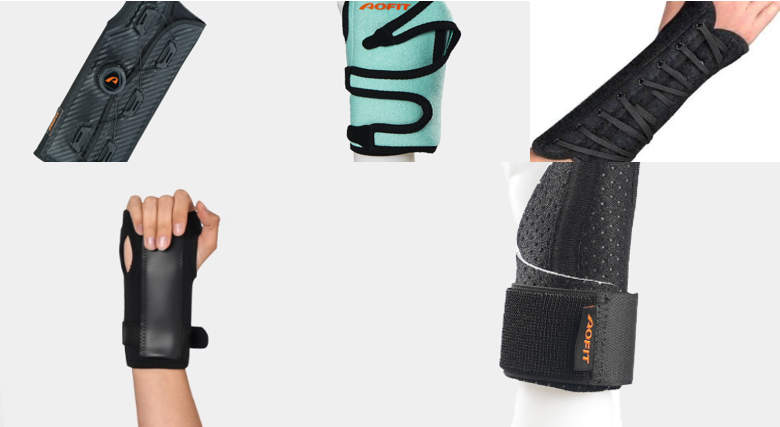
Micro-adjustable dial systems (BOA-style reel-adjust) work like a boot dial. Push, pull, done. One hand, no velcro, fine-tuned tension in seconds. They’re pricier and more mechanically involved than a basic strap, and wrist brace manufacturers tend to market them for fit precision rather than heavy-duty immobilization.
Hook-and-loop straps are the workhorse. They’re cheap, fast, and forgiving of different wrist sizes. They’re almost always paired with rigid stays. The strap handles compression, the stays handle motion restriction. Simple division of labor.
Lace-up systems distribute tension differently. Some braces route equal tension across all four laces for uniform compression instead of one tight spot digging into your wrist bone. Single-pull versions simplify this into one motion, keeping adjustability without the multi-strap fumbling.
Wraparound/speed-wrap closures exist for people who need to get the thing on fast, repeatedly. Slide in, tighten the speed lace, secure the wrap.
Removable stays are palmar or dorsal inserts (usually malleable aluminum) that let a single brace flex between moderate support and near-immobilization. Pull them for later-stage rehab; keep them in for acute flare-ups. Several products build their entire step-down recovery model around this feature.
Who needs this adjustability:
- People recovering post-cast, whose wrist size shifts as swelling resolves
- Carpal tunnel patients whose symptoms (and swelling) fluctuate day to day
- Rehab patients moving from high support to lighter support over weeks
- Anyone needing one-handed application, since a dial or single-pull lace beats fumbling straps with your non-dominant hand
Low-Profile Design: Balancing Support with Everyday Functionality
A badly designed brace fixes your wrist and breaks your fingers. Not literally, but functionally—so much material creeps past your palm that you can’t close your hand around a coffee mug, let alone type an email. A low-profile wrist brace solves this with geometry.
Manufacturers spec this precisely. You’ll see lengths like 6.5″, 7″, 7.5″, and 9″, each calibrated so the shell ends before your hand’s natural fold line. A 7.5-inch body that respects the palmar crease is the difference between “full dexterity” and “why can’t I pick up my pen.”
Removable or bendable stays let one brace flex between “locked down for a flare” and “loose enough to grip a mug.” That’s the whole point of a low-profile orthopedic wrist support: constant structure, minimal footprint.
Add perforated fabric and the design finishes what it started—discreet enough to disappear under a sleeve, breathable enough to survive a full day sitting at a computer.
Material and Structural Comparison: Neoprene vs Mesh vs Nylon vs Rigid Stays
Four materials keep turning up in wrist brace construction, each one with a personality you’ll either love or fight with by day three. No single material does everything well. The brace you end up with is always a compromise, and once you know what’s being traded for what, shopping gets a lot less confusing.
Neoprene/foam is the old standby. Usually laminated with Lycra, sometimes blended with nylon and paired with rigid splints, it gives you serious compression and a snug, locked-in feel. This is the material behind most heavy-duty immobilization devices—it holds its shape and doesn’t budge.
Mesh/knit/perforated fabric goes the other way. Breathable compression knit, perforated panels, microfiber layered with dense nylon mesh—this is what runs behind every “wear it all day and forget it’s there” claim. Thinner, cooler, and more comfortable over long stretches, but it needs help from stays to support anything.
Nylon/elastic straps, usually built from nylon, polyester, and spandex, form the outer shell or closure system on most braces. Lightweight, easy to adjust, resistant to wear—but on its own, without a stay running through it, it’s not doing much structural work.
Rigid stays—palmar, dorsal, medial/lateral—are what stop flexion and extension. No amount of neoprene compression matches what a properly placed aluminum stay does for stability.
Where Each Material Ranks
- Support: rigid stays > neoprene/foam (with inserts) > nylon strap > mesh/knit alone
- Comfort over time: mesh/knit ≈ perforated fabric > nylon strap > neoprene/foam
- Breathability: mesh/knit ≈ perforated fabric > nylon strap > neoprene/foam
- Low-profile fit: knit + removable stay, perforated fabric + stays, and BOA/thin-strap systems pack the slimmest profiles
Common Configurations Worth Knowing
Product design tends to cluster around a few proven combinations:
- BOA + knit compression + removable palmar stay (DonJoy Bionic line) — high adjustability, moderate-to-strong support, slim build
- Perforated fabric + dorsal/palmar stays (Comprexor-style) — breathable, dual-stay stability, thin profile
- Nylon mesh + moldable stays (M-Brace) — microfiber lining, dense nylon mesh shell, 2 removable/moldable aluminum stays
- Foam + Lycra + preformed aluminum stay (DJO Composite) — mid-to-strong stability with some comfort retained
- Elastic strap + adjustable stays (ProCare Quick Fit) — felt lining, brushed nylon, adjustable dorsal stay, contoured palmar stay
A few products push the stay count further. The Air A Med uses 3 adjustable straps with removable dorsal/palmar stays and D-rings for dialed-in compression. The Tripod brace ships with 3 aluminum stays and lets you pull 2 for a lighter setup. DonJoy’s Bionic Elastic version skips heavy stays almost entirely, relying on 4-way stretch knit for functional compression instead. The pattern holds: more stays, more support; less material, more comfort.
Quick Selection Checklist: Adjustable vs Breathable vs Low-Profile vs Rigid Support
Matching Design Features to Your Specific Use Case
- Swelling that changes by the hour → go adjustable. BOA dials or micro-strap systems let you loosen up after lunch without taking the whole thing off.
- Wearing it 6–8+ hours a day → prioritize breathable, low-profile. Anything thick and airless becomes unbearable by hour four, guaranteed.
- Still need to type, grip, or do light work → pick a brace, not a splint. Splints are built to lock you down; braces are built to let you function.
- Nighttime use, acute injury, post-fracture, or post-surgical → rigid splint, full stop. This is not the category to compromise on comfort.
That last distinction matters more than most people realize. A wrist splint immobilizes—rigid or semi-rigid stays, minimal flex, for acute injuries or post-op recovery. A wrist brace supports while preserving some motion—softer materials, for chronic use, repetitive strain, or carpal tunnel management during the day. For carpal tunnel, a neutral-position splint worn full-time for at least four weeks is a common conservative benchmark, and many people manage symptoms in a 2–4 week window if they can tolerate it. Fresh sprains call for something shorter—7 to 10 days of short-term immobilization before easing into a lighter support as swelling resolves.
Medical Grade vs Consumer Grade: What Actually Changes
“Medical grade” means standardized construction, tighter sizing tolerances, and a design built around a specific clinical use—removable metal or plastic stays, stabilizing palmar strips, adjustable compression systems, and anatomical contouring that holds a joint in a particular way. Consumer-grade versions lean elastic, soft, and general-purpose: fine for mild strain or a long day at a desk, not built for post-fracture stability or documented CTS management. The higher-end products—the ones combining breathable knit with low-profile shells—borrow medical-grade structure while keeping the all-day wearability consumer buyers want.
Conclusion
The right wrist brace is the one you’ll still be wearing at 2 p.m., under a desk or under a barbell. Get the adjustable straps right and you can tweak the compression as swelling shifts during the day. Get the breathable fabric right and that soggy feeling is gone by lunch. Get the low-profile fit right and the brace disappears—no announcing itself at every keystroke or handshake.
A good wrist support should let your patients heal and live life at the same time. Before sourcing a wrist brace supplier, validate demand with a limited product run.