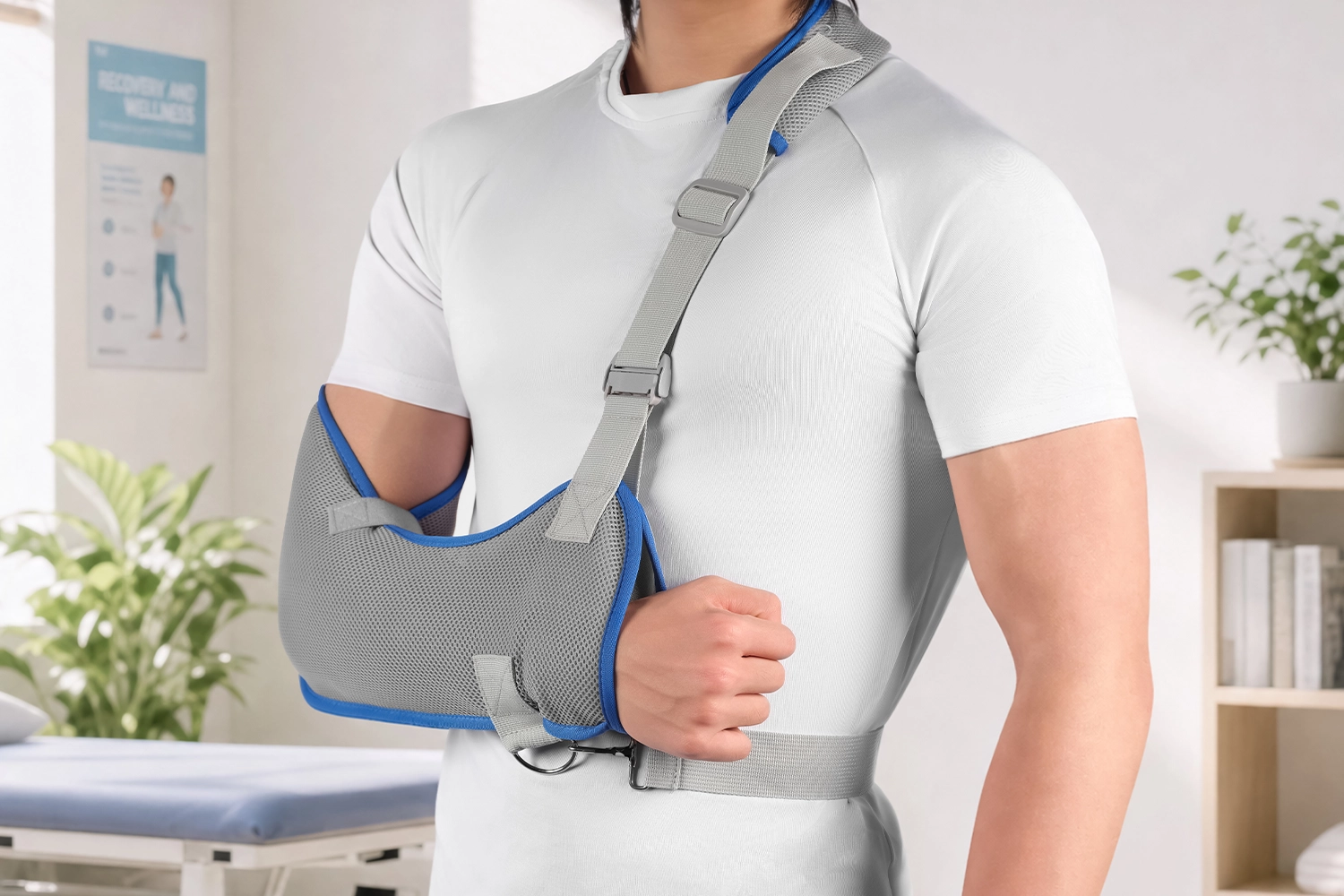
The global wrist brace market is quietly becoming one of the more resilient niches in the medical device and sports equipment space, with demand spiking from office workers battling carpal tunnel to athletes protecting weekend warrior wrists.
If you’re weighing whether to launch a product line, invest in a wrist brace manufacturer, or expand your existing medical supply business, you’re probably drowning in scattered data and vague market reports that don’t tell you whether this niche is worth your time and capital.
I’ve dug through the numbers (market size, growth rates, regional demand shifts, competitor positioning) to give you a clear, no-fluff picture of where the real opportunities and risks are hiding in this space.
Wrist Support and Brace Market Size and Growth Trend 2026-2035
Numbers in this space are messy, and that’s the first thing you need to know before you sink money into it.
The Growth Curve, Year by Year
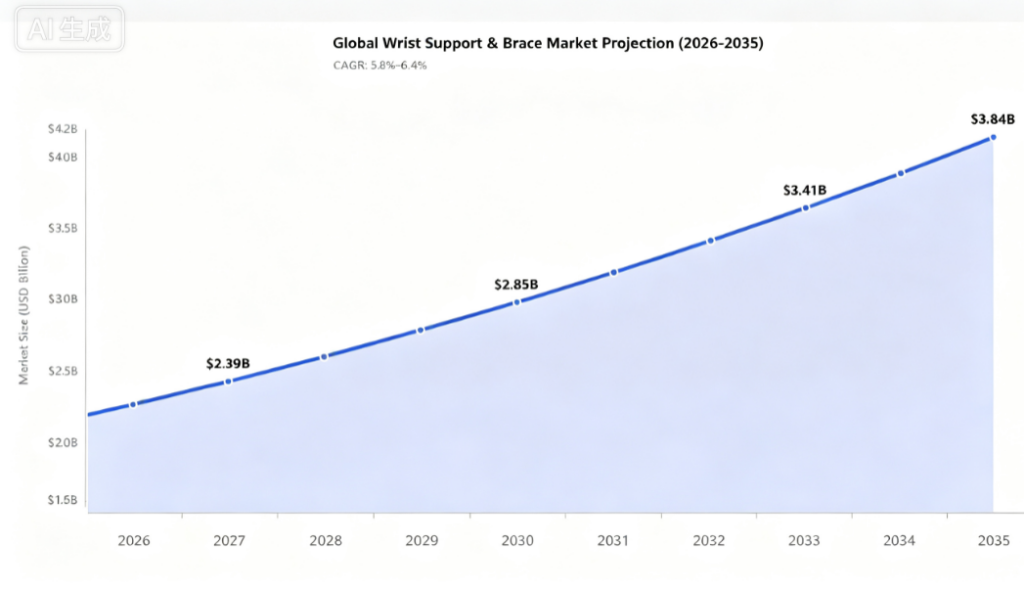
The global wrist support and brace market is projected to expand steadily, growing from approximately $2.39 billion to surpass $3.84 billion by the mid-2030s, sustaining a compound annual growth rate (CAGR) of roughly 5.8% to 6.4%.
| Study Period | 2020-2035 |
| Base Year | 2026 |
| Estimated Year | 2027 |
| Forecast Period | 2027-2035 |
| Historical Period | 2020-2025 |
Regional Market Opportunities: Where to Focus
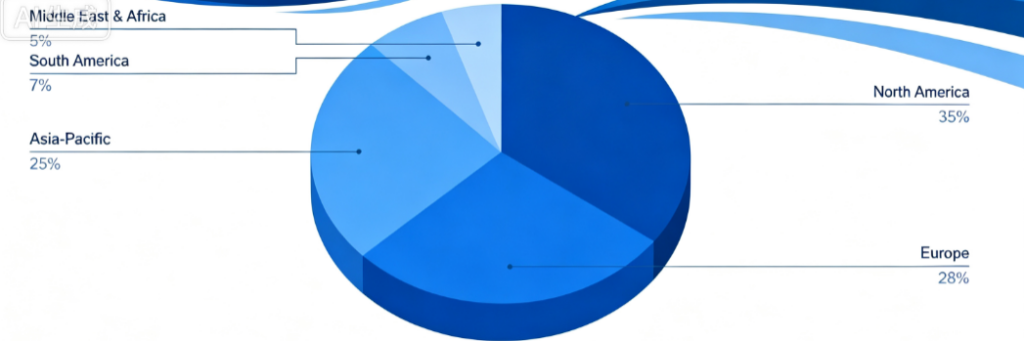
North America leads the global wrist supports and braces market, valued over $2 billion, driven by advanced healthcare infrastructure, sports injuries, and aging populations. High-growth opportunities are shifting toward Asia-Pacific due to rapid urbanization, rising disposable incomes, and expanding digital health integration.
North America
- Market Status: Dominates global revenue share (approx. 33% to 39%).
- Key Drivers: High rates of sports participation, aging demographics, and robust post-operative rehabilitation use.
- Opportunities: Lightweight, customized materials and smart IoT-connected braces.
Europe
- Market Status: Stable, mature market led by Germany, the U.K., and France.
- Key Drivers: Strict compliance via EU Medical Device Regulations and high preventative health awareness.
- Opportunities: Premium eco-friendly materials and advanced smart manufacturing.
Asia-Pacific
- Market Status: Fastest-growing regional market, with South Korea and China/India showing massive gains.
- Key Drivers: Expanding middle class, urbanization, and government healthcare reforms.
- Opportunities: Affordable over-the-counter (OTC) options, tele-rehabilitation, and ergonomic industrial supports.
Rest of the World (Latin America, Middle East & Africa)
- Market Status: Emerging regions with rising adoption in Brazil, Mexico, Saudi Arabia, and the UAE.
- Key Drivers: Investments in modern medical hubs and growing lifestyle-related joint stress.
- Opportunities: Partnerships between international medical suppliers and regional clinics.
Wrist Brace Market Segments: Where’s the Real Business Potential
Not all wrist braces are created equal, and that’s exactly where the money is.
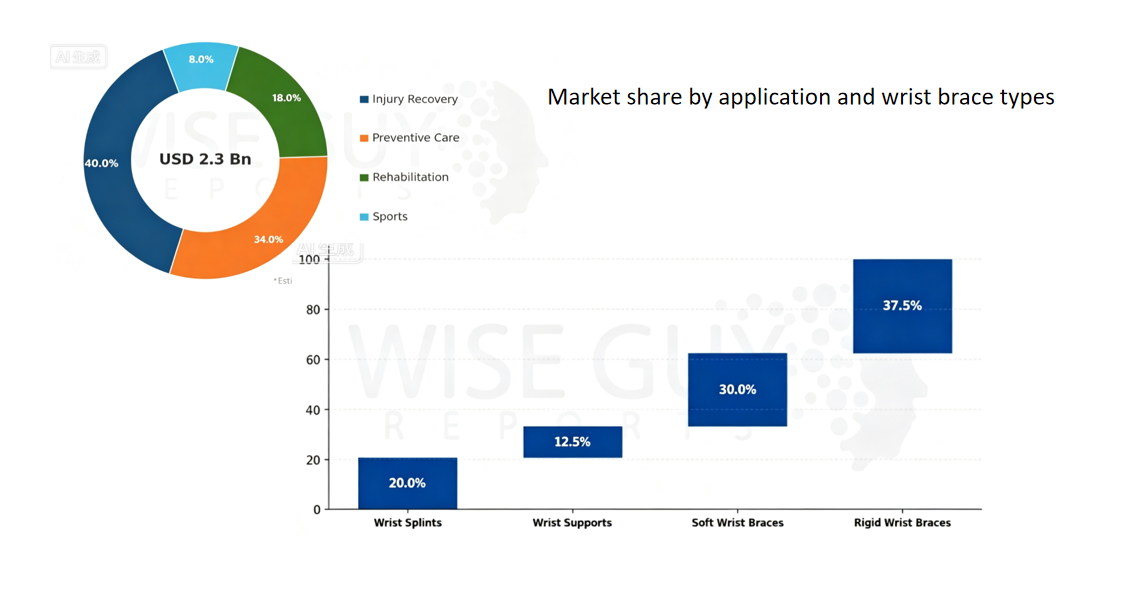
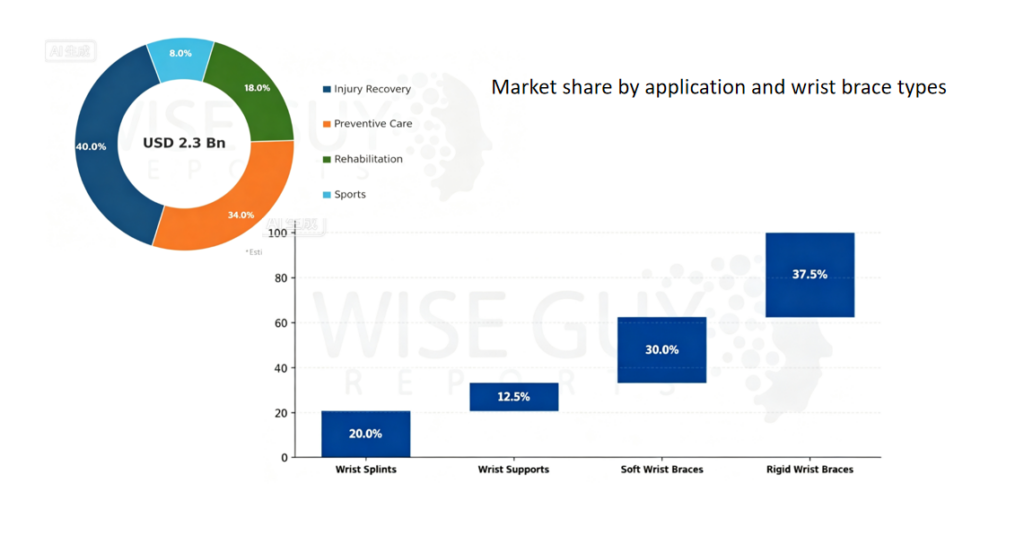
Post-injury and post-surgical recovery braces carry the most stable demand, tied to fractures, tendon sheath injuries, and TFCC tears. Rigid wrist braces in this category were valued around $900M in 2024, climbing toward $1.6B by 2035. Hospitals, clinics, and rehab centers are your buyers here, and ticket prices run well above standard sleeves.
Office-worker RSI products sit in the largest combined demand pool, with arthritis management and post-injury recovery together representing 55%–65% of total market value. This segment grows fastest at 7%–9% annually. Pricing spans $10–20 for basic compression, around $25 for mainstream rigid braces, and $70+ for premium therapeutic versions. It’s a strong DTC and e-commerce play, but only if you differentiate. Without that, you’re just another cheap sleeve.
Sports-specific braces are where high margins live. Mueller’s Hg80 Premium retails at $33.99, Aircast’s A2 with Thumb Spica hits $51.95, and Bauerfeind’s wrist and hand supports command $84.90 to $229.90. “Athlete-endorsed” and “competition-grade” positioning sells premiums that plain compression sleeves never will.
Pediatric and elderly variants won’t be your biggest revenue line, but they build sticky, low-return customer relationships through hospital and orthopedic clinic partnerships. Elderly demand overlaps with arthritis and chronic pain; pediatric demand needs stricter sizing and safety compliance.
The Pricing Split That Matters Most
Basic neoprene sleeves average $10–20 ASP, own 40%–45% of unit sales, but only capture 15%–20% of market value. Rigid, semi-rigid, and hybrid wrist brace designs drive 50%–60% of regional revenue at $25–70+ retail, with top-tier products crossing $100+.
Prioritize entry by starting with premium therapeutic and sports braces, then post-injury recovery, then office RSI, and finally basic compression as a traffic driver.
A quick benchmark: under $20 with no clinical backing means you’re in the price war. $35–70 with rigid support and adjustable straps is your profitable professional line. $80+ requires medical branding or athlete partnerships to justify.
Who Wins in This Market and Why
Nobody in this market wins with one killer product. The brands sitting on top built multi-tier pricing ladders and made you keep coming back for replacement parts.
Ossur runs this playbook the hardest. Its CTi joint support line retails around 449.99–599, the Rebound line sits near $74.99, and the Cold Rush therapy unit runs about $325. Replacement straps, pads, and gear guards cost 19.99–69.99, creating recurring revenue that outlasts the original sale.
DonJoy/Aircast plays a wider price band. The AirSelect Standard runs about $79.58, other Aircast models hit $121.07, and DonJoy’s IceMan Classic3 therapy system sits near $325. This is a brand built to be clinically recognized but still accessible at retail.
Medi stays premium. Its Stabimed support retails around $513.80, and the brand leans on medical credibility and prescription-channel value.
Ottobock spans standard-to-orthotic tiers, with products ranging from $86.22 to $541.13.
The common thread is brand equity plus accessory repurchase, not one hero SKU.
Where OEM and Private Label Win
Factory-cost data tells a different story. Knit sleeves cost $1–2 to produce, strap-reinforced designs $3–6, and rigid or hinged models $8–15. Retail markup typically runs 3–5x, supporting three clean price tiers: $15–25 for daily support, $25–40 for sports protection, and $35–60 for medical recovery.
Private label margins average 50%–65%, versus 20%–35% for pure resale — a 25%–40% margin lift.
The Real Gap for New Entrants
Four openings exist for smaller players entering the wrist brace industry:
- Regional private label — local packaging, local certification, and exclusive distributor deals that avoid head-on brand competition.
- Mid-tier functional products — locked at $25–60, targeting post-surgical recovery, sports protection, and daily wear.
- Accessories and replacement parts — straps, pads, liners. Lower ticket items with higher repeat purchase and steadier margins than full units.
- Niche fit customization — sizing for specific demographics or use cases where fit beats brand name.
Big brands win on clinical credibility and accessory ecosystems. OEM wins on cost and speed. New entrants win in the middle, with functional products, regional channels, and replacement-part economics.
Is It Worth Launching a Wrist Support Business? Feasibility Verdict
This is a moderate-to-strong investment case, but you still need to enter with your eyes open.
I cross-checked sources. The wrist brace and support category sits at roughly USD 282M in 2024 and rises to USD 428.8M by 2030. Broader wrist support device forecasts land between USD 1.5B in 2025 and USD 4.5B by 2033, with another estimate near USD 2.04B by 2034. Growth consistently runs in the 5.8%–7.5% CAGR range across those numbers. In the U.S. alone, annual retail sales will be between $1.2B and $1.8B by 2026, moving 25M to 35M units across price tiers. That’s repeatable revenue, not hype.
Entry costs are low. One retail listing I found shows a wrist brace at INR 340 ex-GST, MRP INR 670, with an MOQ of 50 units. You can test this market without heavy capital.
Where to Enter, Where to Skip
Enter if you’re building a premium niche around medical rehab, sports fitness, RSI, or ergonomic desk-worker use, with real differentiation in materials, adjustable fit, or clinician-backed claims. Sell through DTC, marketplaces, physiotherapy clinics, sports retailers, and corporate wellness channels.
Skip it if your plan is an undifferentiated, price-led commodity sleeve. The low MOQ cuts both ways. Competitors can copy you overnight, crushing margins and forcing you into paid-traffic dependency with higher return rates from poor fit.
Score yourself on tailwind access, differentiation, channels, margin control, and regulatory readiness. Fifteen-plus points, go build. Under ten, wait.

Entry Barriers You Need to Know Before Starting
Money gets you in the door. Compliance decides how long you stay.
Regulatory paths split into three tiers. In the U.S., low-risk wrist support falls under FDA Class I, but stronger medical claims or combination designs push requirements up fast. FDA-registered supply chain quotes run $9–15 per unit. In the EU, CE MDR Class I covers most medical-claim wrist braces, pricing around $5–8 per unit, with certification taking 12–18 months. Total compliance cost for Class I self-declaration sits at €8,000–€26,000; jump to Class IIa and you’re looking at €32,000–€110,000, driven by third-party assessment (€15,000–€50,000), testing (€5,000–€30,000), and clinical evaluation (€10,000–€40,000). Skip medical claims entirely and stick to sports-only positioning, and unit cost drops to $2–4, but you’re locked out of EU and U.S. medical channels.
Trust is the bigger wall for new brands. Retail prices swing from £5.99 budget sleeves to £7.06–£10.99 in UK medical retail, up to 32.99–84.90+ for brand-name sports medicine lines. Bauerfeind justifies premium pricing by listing exact material composition, including 47% polyamide, 17% polyester, 3-D MotionTech fabric, down to the fiber. Buyers expect breathable, adjustable, latex-free, slip-on fit as baseline, not bonus features. Without certification, verified materials, and clear sizing, new entrants get stuck competing in the $2–10 price war.
Supply chain risk hides in single-source dependency. Core components such as neoprene blends, aluminum or metal support strips, and adjustable straps swing entry-level products from $2–4 to premium builds at $60–230, depending on fabric grade and rigid insert quality. Relying on one fabric or one metal supplier exposes you to procurement price swings and lead-time shocks the moment volume scales.
How to Start a Wrist Support Business
Forget launching ten SKUs on day one. Every wrist brace industry report I’ve dug through points to the same pattern: winners start narrow, then expand once one product actually sells.
Step 1: Pick Your Hero SKUs
Don’t build a catalog. Build 1–3 hero products around two high-frequency use cases.
Office-worker line: Night-time braces for carpal tunnel and tendonitis, with removable splints, three adjustable straps, breathable mesh, right/left hand versions, sized XS–XL.
Sports line: Elastic wrist wraps for weightlifting, tennis, and gym use, with sweat-wicking cotton and light compression. Factory pricing on these runs $0.30–0.95 per unit at MOQs of 500–1,000+.
A tested starter lineup: one night-fixation brace targeting carpal tunnel, one lightweight breathable support for daily office wear, and one sports wrap for gym or tennis. Lock down support level (soft, semi-rigid, rigid), materials, wrist circumference sizing, and whether you’re pursuing CE, MDR, FDA, or ISO 13485 certification before you order samples.
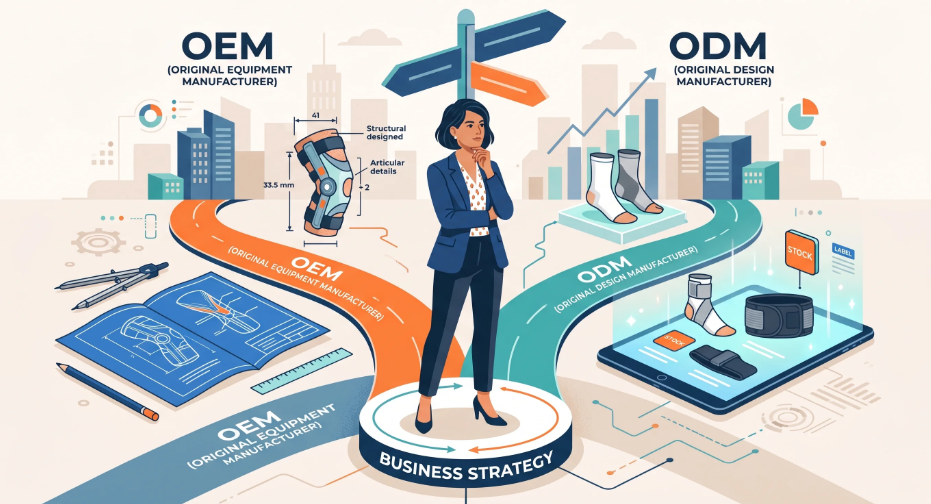
Step 2: Choose OEM/ODM Over Building Your Own Line
Skip the factory investment. Custom tooling alone runs $5,000–50,000, and most OEM/ODM suppliers set MOQs at 500, 800, or 1,000 pieces. Samples cost $100–300 per design, often credited back once you hit MOQ.
Run two suppliers in parallel — one ODM for rebranded finished goods, one OEM for deeper customization. Test each SKU at 500–1,000 units, launch in black or standard colors first, then expand once repeat orders confirm demand. Put your budget into tooling, packaging, and product photography — not a production floor you don’t need yet.
Step 3: Sequence Your Channels
Validate on Amazon and DTC first, where fit, breathability, and support strength drive conversion. Move into pharmacy channels once you have certification. Save orthopedic distributors and clinical partnerships for last — they demand proof, not promises.

Wrist Brace Manufacturers and Suppliers: How to Source Your Product
Sourcing decides whether your margins survive year two. Chinese OEM/ODM wrist brace factories dominate this space, with MOQs running 500 / 800 / 1,000 / 5,000 pcs per style. 500 is the common starting point, and some factories negotiate lower for trial orders.
Lock These Four Certifications Before You Pay Anything
Demand certificate originals, scope, issuing body, and expiry dates upfront:
- ISO 13485 — quality management for medical devices
- CE/MDR — technical file and Declaration of Conformity
- FDA registration/device listing
- BSCI or SGS factory audit records
A manufacturer like Gangsheng (est. 2017, ~12,000㎡, ~150 staff) holds all four plus annual SGS reviews. That’s the profile worth shortlisting.
Materials That Create Real Differentiation
Push suppliers beyond neoprene basics. Ask about bamboo fiber, cool-yarn fabrics, far-infrared yarn, magnetic elements, splint stays, and breathable hole wrist braces. For sensitive-skin applications, require latex-free materials, OEKO-TEX Standard 100 Class I, and ISO 10993 biocompatibility testing. Those certifications give you proof points that actually matter.
The Negotiation Sequence
Request quotes at 500, 1,000, and 5,000 pcs. Get samples first. Most factories support sample runs before bulk orders. Then get written confirmation on sizing, elasticity grade, material weight/blend, color, logo, packaging, and barcode before committing.
Start with a standard neoprene build and an upgraded bamboo-fiber or cool-yarn version with breathable panels. Test market response before scaling.
Conclusion
The numbers don’t lie: aging populations, rising repetitive strain injuries, and a fitness culture that isn’t slowing down are driving real growth in the wrist support and brace market. The entrepreneurs who profit are the ones who pick the right segment and move fast on sourcing and certification.
If you’ve made it this far, you already know this isn’t a set-it-and-forget-it business. It takes real diligence around suppliers, compliance, and positioning before you spend a single dollar on inventory.
Start small. Pick one niche — sports or medical. Validate demand with a limited product run and build supports and brace supplier relationships before you scale. The wrist brace market rewards people who move deliberately, not those who rush in blind. Your research phase ends here. Your execution phase starts now.