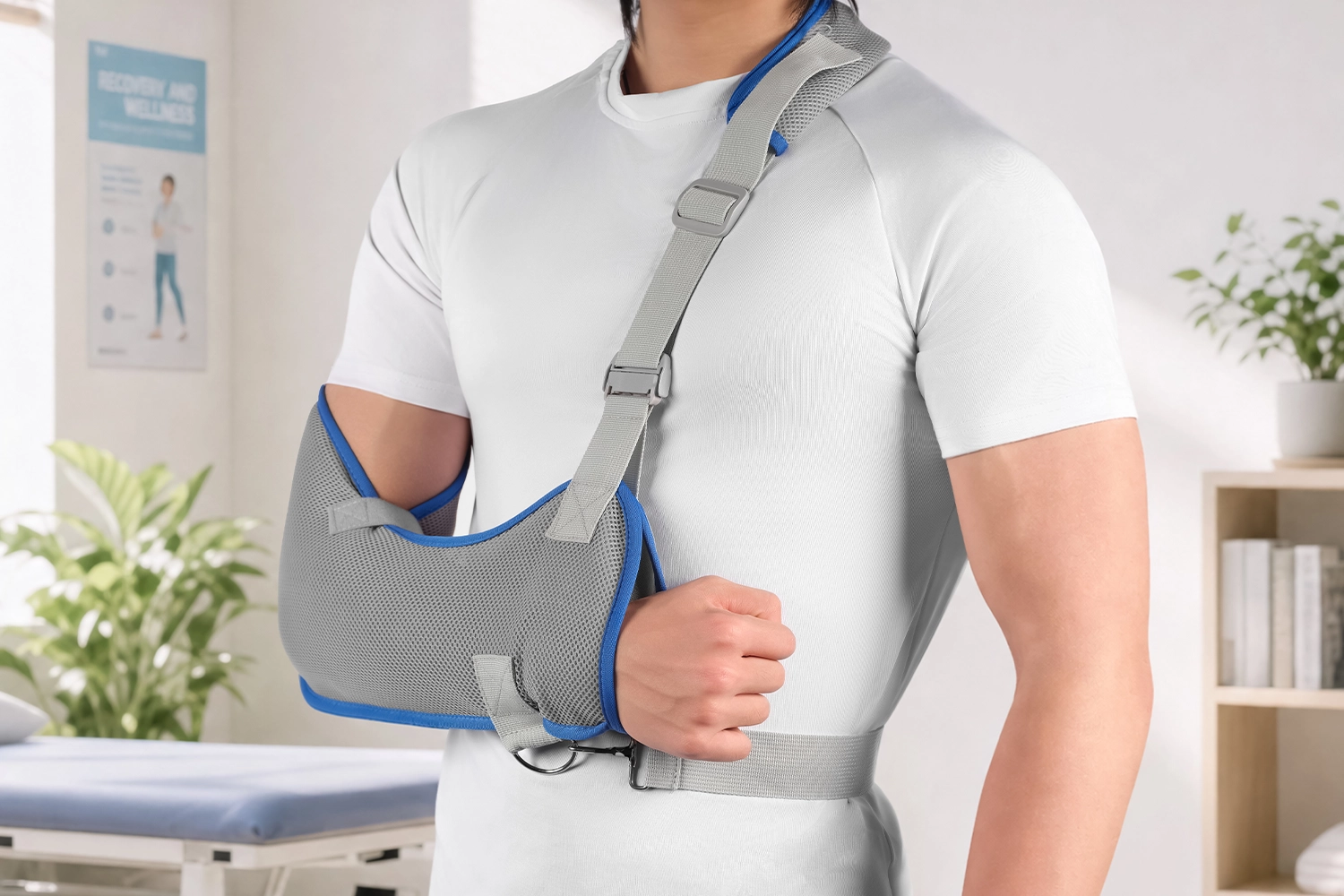
You broke your arm, dislocated your shoulder, or just walked out of surgery—and now someone’s handed you a sling with zero instructions. Should your arm sit tucked against your chest, or does it need to be propped up higher to keep the swelling down? That one question trips up more people than you’d think, and getting it wrong can genuinely slow your healing or leave you in more pain than necessary.
So, Elevation Sling Vs Arm Sling Vs Collar and Cuff Sling: which should be your choice. They aren’t interchangeable, even though they might look similar hanging on a pharmacy shelf.The right choice depends on your injury and how you wear an arm sling, so you’re not left guessing during a recovery that’s already hard enough.
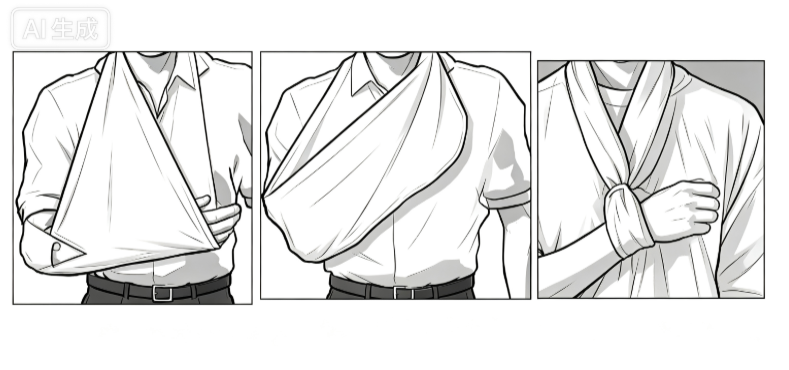
What Is an Arm Sling (Standard/Broad Sling)
Your arm rests across your chest, elbow bent at a comfortable 90 degrees, forearm cradled horizontally. That’s the standard arm sling doing its job—the one you’ll see most often after surgery or a bad shoulder injury.
How it’s built:
– A broad fabric cradle or triangular bandage supports your entire forearm, not just the wrist
– A neck strap takes on most of the weight, so your shoulder muscles get a real break
– The design pulls your arm snug against your torso for stability
This shoulder support brace works for upper arm, wrist, forearm, hand, and elbow injuries, plus clavicle fractures and shoulder dislocations where keeping the arm still matters more than height. It’s also the go-to as a post surgery arm sling for rotator cuff repairs, Bankart procedures, and capsular shift surgeries, especially in that first rough stretch of recovery when swelling control and limiting movement take priority.
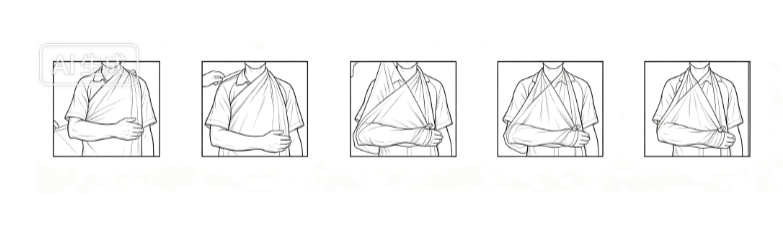
How to use an arm sling:
- Place the small pointed end of the triangular bandage towards the casualty’s elbow and gently slide the bandage under their arm.
- Bring the end of the sling around the casualty’s neck, to the injured side.
- Grab the bottom end of the sling and fold it over the casualty’s arm.
- Tie both ends of the sling in a knot, on the side of the neck. Too high and the knot will dig into the casualty’s spine, causing pain or discomfort.
- Secure the elbow into the sling by fastening with a pin or twisting the bandage and tucking into the sling. Tuck any loose ends away.
The fit is specific: your hand should sit just slightly higher than your elbow, with the sling’s edge reaching roughly to the base of your little finger. Fingers stay free so you (or your nurse) can check circulation without unwrapping everything.
What Is an Elevation Sling (High Arm Sling)
Your hand sits up near your opposite shoulder, fingertips almost brushing it, with your forearm raised well above elbow level instead of lying flat against your chest. That’s an elevation sling—sometimes called a high arm sling.
Why the height matters:
– Swelling control – keeping the hand raised limits fluid pooling in the wrist and fingers
– Bleeding management – elevation helps slow blood flow to wounds on the forearm or hand
– Comfort during acute injury – less stiffness, less throbbing pain
How it’s built:
It is usually a triangular bandage or a purpose-made sling that runs diagonally across your chest. Your elbow nestles in a small cradle, and the whole thing ties around your neck and back to hold that raised angle steady. Simple, but surprisingly precise.
This sling works best for hand, wrist, and finger injuries, crush injuries, sprains, and fresh fractures where swelling is the main concern. You can also wear it over a below-elbow cast or splint and still keep the elevation.
You can buy an arm sling easily or make one yourself.
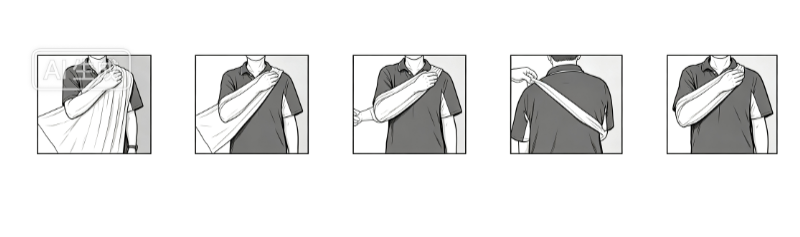
How to use an elevation sling:
- Place the small pointed end of the triangular bandage towards the casualty’s elbow and gently slide the bandage under their arm.
- Bring the lower part of the sling over the top of the casualty’s arm.
- Twist all parts of the bandage at the casualty’s elbow so that it is secure.
- Bring the bandage behind the casualty’s back, making sure it is securely under their shoulder blade.
- Tie the triangular bandage close to the casualty’s fingers with the other loose end. Tuck any loose ends away.
Check thumb circulation every 10 minutes right after fitting. Most leaflets say to wear it for only 1–2 days, and prop the hand on pillows overnight.
What Is a COLLAR AND CUFF SLING?
Collar and Cuff Slings are used for broken upper arms or to elevate bleeding of the arm.
How it’s built:
Keep folding a triangular bandage, in half, until it is approximately 1–2 inches wide.
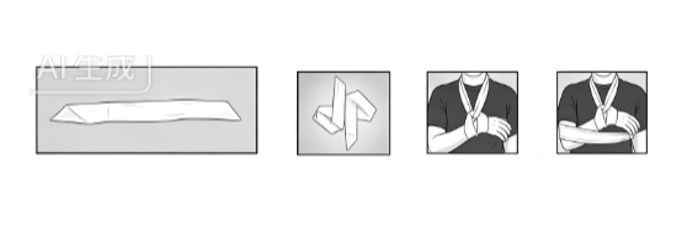
How to use a COLLAR AND CUFF SLING:
- Fold one end of the sling over the top of the bandage so the end comes towards you, and the other end goes away from you.
- Place a hand under each circle and fold them up together.
- The casualty’s arm goes through the circles and the loose ends tie on the side of the casualty’s neck (either side). Tuck any loose ends away.
- Another broad triangular bandage can be tied around the casualty’s elbow, in the case of a broken upper arm.
Elevation Sling vs Arm Sling Vs Collar and Cuff Sling: Core Comparison Dimensions
These two slings aren’t chasing the same goal at all. Elevation sling is for “raise it to drain it.” Arm sling is for “hold it comfortably.” Neither replaces a proper shoulder immobilizer on its own.
| Dimension | Elevation Sling | Arm Sling | Collar and Cuff Sling |
| Core goal | Reduce swelling, control bleeding | Support, comfort, reduce strain | to elevate bleeding of the arm |
| Typical position | Hand above elbow, closer to shoulder | Elbow ~90°, hand slightly above elbow | Suspends the arm from the wrist, allowing gravity to provide slight downward traction. |
| Best recovery phase | Acute swelling/bleeding (early);first 0–72 hours | Ongoing recovery, daily support | Easier for long-term wear and compliance. Lightweight, minimal bulk, and cooler to wear. |
| Shoulder immobilization | Weak—not a full solution | Weak to moderate—still not full immobilization | Less restrictive |
| Common pairing | Used for hand/wrist/forearm swelling | Add swathe/immobilizer for true shoulder fixation | Upper arm (humeral) and certain shoulder or collarbone injuries. |
How to Choose the Right Sling Based on Your Injury
Three questions decide almost everything here: where’s the swelling, how much movement can you tolerate, and did a doctor mention your shoulder specifically. Answer those honestly and the right sling practically picks itself.
Rule 1: Swelling Is Loud → Elevation Sling Wins
If your hand, wrist, or fingers are throbbing, puffy, or you’ve just come out of surgery on the distal forearm, elevation takes priority. Raising the hand above the elbow—ideally above heart level—reduces the pull of gravity on venous and tissue fluid, and that’s what slows swelling down. This matters most in the raw window right after injury, roughly the first 1–2 days, when swelling peaks.
Rule 2: Just Need Daily Support → Standard Arm Sling
Once swelling settles, or if your injury never involved dramatic swelling to begin with, a standard arm sling does the job. It supports the arm’s weight and stops that annoying downward pull during daily movement, but it won’t lock your shoulder in place. Fine for shoulder, elbow, upper arm, or wrist injuries where you just need something to rest the arm in during the day.
Rule 3: Shoulder Needs to Stay Put → Upgrade to a Shoulder Immobilizer or Sling and Swathe
A lot of people get caught out here. A basic arm sling doesn’t stop internal or external rotation at the shoulder. If your injury is a shoulder dislocation, AC joint separation, rotator cuff tear, or clavicle fracture, you need more. Add a swathe strap or switch to a commercial shoulder immobilizer instead.
- Shoulder dislocation: immobilization for 7–10 days, then gentle range-of-motion work starting around 2 weeks
- Clavicle fractures: figure-of-eight bands were once standard, but they’re fussy to adjust and often lose position
- Non-displaced radial head fractures: short-term simple sling only, with active movement starting around 48 hours to avoid stiffness
Rule 4:Pick the right size
Most arm sling manufacturers grade sizes from XXS through 2X, based on two measurements: depth (how deep the pouch sits, roughly 6–11 inches) and length (how far it stretches, roughly 8.5 — 23 inches). Stuck between two sizes? Go with whichever one fully cradles your forearm and still has an adjustable strap—undersizing is the more common mistake.
When to Seek Immediate Medical Care (Safety Warning)
No sling, however well-fitted, can tell you whether a bone is broken or a joint has slipped out of place. That’s a job for a doctor, not a piece of fabric.
Stop and seek emergency care if you notice:
– Bone piercing the skin, an open wound, or a puncture-like hole near the injury
– Numbness, tingling, or reduced sensation—signs of nerve involvement
– Fingers turning white, blue, gray, or feeling unusually cold—circulation may be compromised
– Obvious deformity, a joint sitting at a strange angle, or suspected dislocation
– Inability to move the limb or bear any weight, especially with severe pain
– Pain that keeps intensifying instead of settling with rest
Fracture red flags: skin puncture, visible deformity, sharp tenderness, limited motion, plus numbness or color change.
Dislocation red flags: visible joint distortion, complete loss of movement, often paired with pale or bluish, cold fingers.
Color change plus numbness together is more alarming than pain alone—it usually points to nerve or blood vessel compression.
If pain won’t ease with rest or worsens hour by hour, don’t just monitor it in a sling—get imaging and a proper exam. A sling and swathe or shoulder immobilizer only holds position; it can’t diagnose a fracture, dislocation, or vascular injury, and it can’t replace reduction or surgical assessment.
If things get colder, whiter, bluer, more numb, or more painful after you’ve put the sling on, loosen it immediately and get seen. Let your doctor or physical therapist match the sling type to your actual diagnosis—not just how much it hurts.
Conclusion
There is no universal winner in the elevation sling vs arm sling Vs Collar and Cuff Sling debate—only what’s right for your recovery right now. If your shoulder needs to stay elevated to reduce swelling after surgery or a serious rotator cuff repair, the elevation sling is your best friend. If you’re managing a straightforward fracture or need everyday arm support, a standard arm sling might be all you need.
Even the best shoulder brace won’t do its job if it’s the wrong one. Now update your design and product line with AOFIT, your reliable medical brace manufacturer. Our support and braces are designed around patients’ frustrations. In addition, we offer complete OEM/ODM shoulder braces based on your requirement.