That nagging ache in your lower back has you eyeing a lumbar support brace online, but before you click “buy,” you want a straight answer: does this thing work, or is it just an expensive placebo? Whether a back brace helps with lower back pain depends on what’s causing your pain in the first place. A brace that’s a lifesaver for a muscle strain might do little for a herniated disc, and wearing one incorrectly could even weaken your core over time. We dug into the clinical evidence, talked through when a back support belt helps versus when it’s just a crutch, and broke down how to choose between soft and rigid designs.
Will A Back Brace Help With Lower Back Pain (Core Direct Answer)
Yes, but with an asterisk. A back brace can genuinely help, but only for the right kind of pain and for a limited window of time. What determines whether it’s worth your money is the type of pain you have.
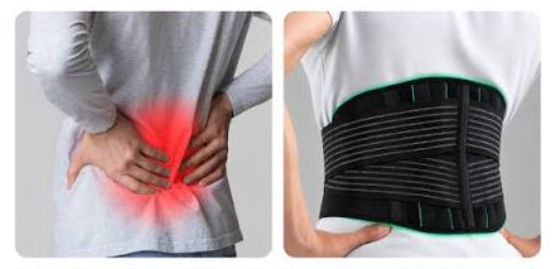
Acute low back pain
The kind that hits suddenly is where a lumbar support brace performs best. Research on select populations calls bracing “an effective treatment” for acute flare-ups, though the evidence pool is narrower than for general symptom relief.
Subacute pain
Pain lasting under six months shows measurable gains. Higher-level studies report improvements in pain scores, medication use, and functional disability somewhere in the 30 to 90 day range.
Chronic pain
It is where the story falls apart. A Cochrane review rated the evidence “very low-quality.” A lumbar support belt used alone showed little to no effect on pain or disability after three months. Pairing it with pain medication did produce a small reduction in pain, but only after 3–4 weeks, and “small” is the operative word.
A back brace is temporary stabilization. It buys time and comfort, but it doesn’t fix what’s causing the pain.
When a Back Brace May Actually Help Your Lower Back Pain (Applicable Scenarios List)
Context matters more than the brace itself. Five specific situations actually make a lumbar support brace worth wearing.
Fresh strains and sprains
In the first days after a strain, wearing a back brace for muscle strain up to 8 hours a day limits painful movement and reduces load on the injured area.
Subacute recovery
Once you’re past the initial flare-up but not fully healed, a brace works as short-term support, not a permanent fixture.
Activity-triggered pain
If bending, gardening, lifting, or long stints of standing set off your back, a compression back brace during those specific tasks reduces the range of motion that triggers pain.
Post-surgical or post-procedure recovery
Discectomies, spinal fusions, epidural injections—these all come with brace protocols your doctor actually prescribes.
Occupational lifting
Jobs requiring repeated bending and lifting benefit from task-specific bracing, not all-day wear.
Note: A back brace for herniated disc stabilizes the area but doesn’t fix the disc. It reduces micro-movements when bending or twisting worsens symptoms. Same logic applies to a back brace for sciatica: if nerve compression from a disc issue causes the pain, limiting aggravating movement helps. Progressive numbness or weakness means the brace isn’t your answer.
Quick self-check: Does pain spike with bending, lifting, or standing? Did it start days or weeks ago and ease with rest? Are you following post-surgical orders? Yes to any of these, and a lumbar support belt for pain relief is a reasonable tool—for now, not forever.
Soft Lumbar Support vs Rigid Back Brace: How To Choose for Your Lower Back Pain
Not all braces are built the same, and the material difference changes what the product can do for you.
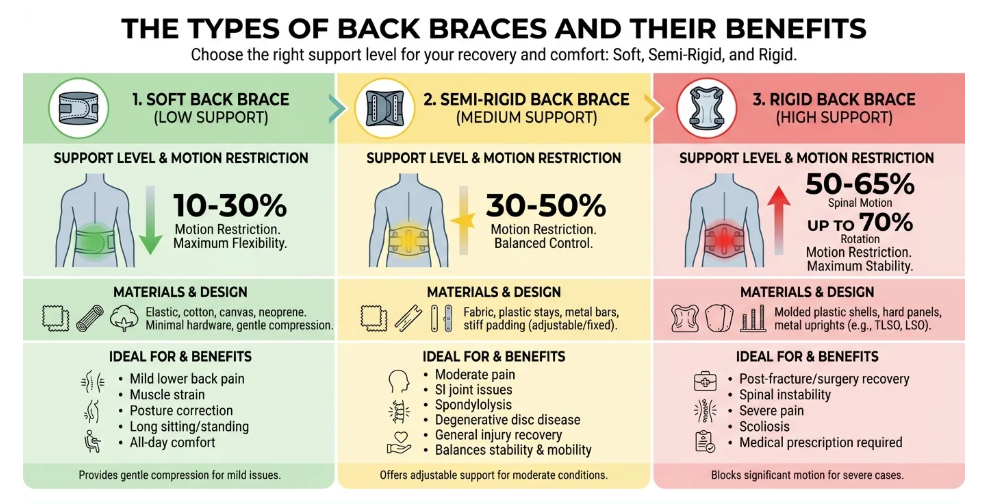
Soft Lumbar Support vs Rigid Back Brace: Understanding
Soft lumbar support braces are made from elastic fabric, nylon, neoprene, or cotton-spandex blends. They use Velcro closures, compression panels, and sometimes thin flexible stays. The goal isn’t rigid stabilization. It’s comfort, warmth, gentle compression, and a physical reminder to sit or stand straighter—which is why these show up so often marketed as a posture corrector for back pain.
Rigid or semi-rigid braces use hard plastic shells, thermoplastic panels, metal bars, or a three-point pressure system. These are built to limit motion and lock the spine in place, not to feel comfortable all day.
The motion restriction gap matters more than you’d think
A soft compression back brace typically limits spinal movement by only 10–25%. Most of what it’s doing is compressing your midsection and feeding back proprioceptive signals—basically reminding your body where “neutral” is.
A rigid TLSO-style brace restricts flexion and extension by 45–70%, and lateral bending by 35–50%. Some models push motion restriction as high as 50% overall.
More restriction sounds better on paper, but it’s not automatically the right choice. A rigid brace that locks your torso makes bending, twisting, and even sitting down harder. For daily wear, that stiffness often tanks compliance—people just stop wearing it.
Match the brace to the situation, not the strength
- Mild pain, desk job, long commutes, standing all day → soft, breathable lumbar support belt for pain relief. Look for “gentle compression” and “daily wear” on the label.
- Lifting, bending, repetitive physical work → semi-rigid. Balances support with enough mobility to do your job.
- Post-surgery, fracture, confirmed spinal instability → rigid brace, prescribed and fitted by a doctor.
- Chronic pain or disc issues needing long-term wear → soft to semi-rigid almost always wins. Rigid support is a short-term, specific-indication tool, not a daily habit.
Soft gear solves for support plus comfort. Rigid gear solves for restriction plus stability. Chasing maximum support when you only need the first one usually backfires.
Potential Risks And Side Effects Of Wearing A Back Brace
Nobody hands you a warning label with a lumbar support brace, but they probably should.
Muscle deconditioning
The most talked-about back brace side effect is core muscle deconditioning—the theory being that your muscles slack off because the brace is doing the stabilizing work. The evidence is murkier than that claim suggests. Systematic reviews haven’t found solid proof that bracing definitely weakens your trunk muscles. Still, most clinicians play it safe, recommending limited-hours wear paired with rehab exercises rather than treating a compression back brace like a permanent crutch.
Skin irritation
The physical stuff is more predictable. Skin irritation tops the list: redness, rashes, pressure marks, chafing. Usually it’s a fit problem. Wrong size, brace sitting in the wrong spot, straps cinched too tight, or skin that’s damp from sweat. Rigid designs trap heat and moisture, which turns into itchy, eczema-like patches, especially in warm weather or during activity.
How To Use A Back Brace?
Most people get those problems above because they wear a back brace wrong. They strap it on in the morning and forget about it until bedtime, treating it like a piece of clothing instead of a medical tool. That’s backwards. How long you wear a back brace matters just as much as whether you wear one at all.
The default rule is 2–6 hours a day, not 24/7. Unless a doctor prescribes continuous wear for surgery or scoliosis, all-day bracing does more harm than good. It irritates skin, and it teaches your trunk muscles to slack off.
Cap each stretch at 3 hours. Take the brace off, let your skin breathe, give your core a chance to fire again. Some clinicians push this further, recommending a 10–15 minute break every 2 hours.
Match wear time to the situation:
- Muscle strain or sprain: 2–4 days of short-term support, then stop.
- Desk work, standing, commuting: wear during the 2–4 hour window when the activity actually stresses your back. Don’t wear it the entire shift.
- Lifting or repetitive tasks: only during the actual lift, push, or carry.
- Post-surgery or fracture: 6–12 weeks, per your surgeon’s protocol, typically worn when upright and removed in bed.
- Scoliosis bracing: an outlier at 18–23 hours daily, sometimes for years.
Back Brace Alternatives And Complementary Treatments
A brace is one tool, not the whole toolbox. Staying active beats staying still, even when your back hurts. Self-management guidelines keep pointing to gentle, gradual movement over bed rest and call core strengthening the safest way to rebuild support. Start small: 3–4 short walks a day, 5–10 minutes each, then build from there. Gentle stretching belongs in that rotation too.
Ice or heat depends on timing
In the first 48–72 hours (some sources say the first week), cold therapy calms acute pain and swelling. Past that window, or with chronic, lingering pain, heat works better for relaxing tight muscles—10 to 20 minutes at a time, several times a day. Never put either straight on your skin. A towel barrier matters. If your skin turns red, discolored, or blisters, stop and check with a professional.
Call a doctor instead of shopping for gear
Pain lasting the past 6 weeks has crossed into chronic territory, and that calls for medical evaluation, not another product. Numbness, tingling, leg pain, or symptoms that worsen with activity are red flags. Stop and get checked. In the acute phase, skip heavy lifting and twisting for the first 6 weeks and watch how you respond.
Conclusion
A back brace can help with lower back pain when used correctly. Used correctly, it short-circuits pain during flare-ups, protects your spine after a muscle strain, and buys you time to heal. Used incorrectly or worn 24/7, it can weaken the core muscles you need for long-term relief.
Match the brace to your problem. Choose soft support for daily wear, rigid options for acute injuries. Wear it for the recommended windows, and use it to support movement rather than replace it. If your pain persists past a few weeks or radiates down your leg, see a doctor or physical therapist rather than upping your brace time.
Need custom back braces (soft or rigid) for your patients’ lower back pain? Contact AOFIT now, and we are ready with both wide product catalogs and complete private label solutions. Every detail and specification undergoes review by our senior fabrication specialists, then products are tailored to your exact requirements.